The U.S. Army Went Camel Shopping: Texas's Great Camel Experiment
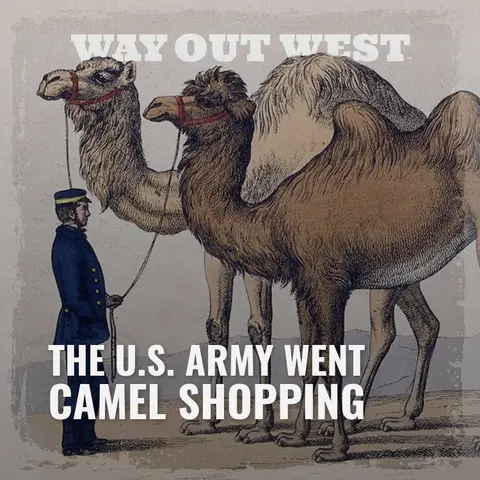
In the 1850s, the U.S. Army brought camels to Texas to see if they could haul supplies through the Southwest. From the docks at Indianola to a wagon-road expedition headed west, the camels proved their worth. Then came the Civil War.
The U.S. Army Went Camel Shopping
Texas’s great camel experiment

In May 1856, camels came ashore at Indianola, Texas. The U.S. Army had bought them overseas to answer a practical question. Could they carry supplies through country where water was scarce, and wagons had a hard time getting through?
Congress had put up $30,000 for the experiment the year before, at the urging of Secretary of War Jefferson Davis. Major Henry Wayne and Navy Lieutenant David Dixon Porter went overseas to buy the animals. From the Texas coast, the camels made their way inland to Camp Verde, northwest of San Antonio, where the Army put them to work.
The camels carried heavy loads, went long stretches between drinks, and ate plants other pack animals passed up. In 1857, Edward Beale took about two dozen of them on a wagon-road expedition across the Southwest. The animals worked well enough to make Beale an advocate for keeping them in service.
The Army still had to make room for an unfamiliar animal in a system built around horses and mules. Then the Civil War broke out, Confederate forces took Camp Verde, and the Texas trials ended. The Army eventually sold its herds. Some camels wandered loose, giving travelers across the Southwest a story worth telling, even if the details grew in the telling.
What You’ll Hear
- Why Jefferson Davis thought camels made sense for the American Southwest.
- How the Army bought camels overseas and brought them ashore in Texas.
- What the animals could do at Camp Verde and on Beale’s wagon-road expedition.
- How Hadji Ali, a camel handler from overseas, came to be known as Hi Jolly.
- What became of the Army’s camels and how they found their way into Western folklore.
Cowboy Glossary
Pack train: A string of animals carrying supplies on their backs, often through country where wagons couldn’t travel easily. Horses and mules usually did the work. For a few years in the Southwest, the Army gave camels a turn.
Sources and Further Reading
- Texas Historical Commission — The Great Camel Experiment
- Handbook of Texas — The Camel Experiment in 19th Century U.S. Military History
- U.S. Army Center of Military History — Army History, Winter 2013
Ride Way Out West
Follow Way Out West in your podcast app, and visit the Way Out West Journal for more stories about the people, places, and working traditions of the American West.
Howdy. Chip Schweiger, here.
Welcome to another edition of Way Out West.
Where the stories of the American West are told...
Cowboy wisdom is earned...
And the legacy of the American cowboy still rides on.
The American West is full of stories that sound like somebody made them up. And every once in a while, the United States government gets involved in one of them.
This week, we've got an Army experiment that was surprisingly successful, a few characters you couldn't invent, and an ending that nobody in Washington quite planned.
It's one of those stories that reminds us the real West could be stranger than anything Hollywood dreamed up.
Now before we get to it.
Remember, you'll find additional resources for today's episode in the show notes at WayOutWestPod.com/army-camels/
[BUMPER MUSIC]
Welcome back.
Chapter 1 – The Army Goes Camel Shopping
You know, every once in a while, you come across a piece of Western history that makes you wonder what on earth somebody was thinking.
And then you look into it a little further and realize they might actually have been onto something.
Take the United States Army.
Back in the 1850s, the Army had a problem. A whole lot of territory in the American Southwest, not nearly enough roads, and thousands of miles of country that could be downright miserable to travel through.
Horses needed water. Mules needed feed. Wagons got stuck.
And somebody in Washington came up with an idea.
Camels.
That's right. Camels.
Not in Egypt. Not in Arabia.
In Texas.
And believe it or not, this wasn't nearly as crazy as it sounds.
Now, the man who really pushed this idea was Jefferson Davis.
Yes, that Jefferson Davis.
Before he became president of the Confederacy, Davis was the United States Secretary of War. And he was convinced that camels might be just what the Army needed to move men and supplies across the deserts of the Southwest.
Think about it.
Camels could carry heavy loads. They could go longer between drinks of water than horses or mules. And they could eat vegetation that most American livestock wouldn't touch.
In a place like West Texas, that sounded pretty useful.
Congress wasn't quite so enthusiastic.
In fact, Davis had been trying to get support for the idea for years.
But in 1855, Congress finally appropriated thirty thousand dollars to give it a try.
And the Army went camel shopping.
Now, I don't know what the government procurement paperwork looked like for that particular assignment, but I would dearly love to have seen it.
The Army sent Major Henry Wayne overseas, along with Navy Lieutenant David Dixon Porter, to purchase camels and bring them back to the United States.
Chapter 2 – Camels Come to Texas
And in May of 1856, the first shipment arrived at Indianola, on the Texas Gulf Coast.
Thirty-four camels had made the voyage, including one born during the crossing.
Imagine being a Texan standing on the docks at Indianola that morning.
You're accustomed to horses, cattle, and mules.
And here comes the United States Army unloading a collection of enormous, long-necked animals with humps on their backs.
Welcome to Texas.
The camels were eventually taken to Camp Verde, northwest of San Antonio, where the Army began testing them.
And here's where the story gets interesting.
Because the camels were actually pretty good at their jobs.
They could carry more weight than mules. They needed less water. They could handle difficult terrain.
There was just one problem.
Well, actually, several problems.
For starters, horses and mules weren't particularly fond of camels.
The smell alone apparently caused some excitement.
And if you've ever spent much time around horses, you know that introducing something strange into their world can turn an otherwise peaceful afternoon into a fairly memorable experience.
Now imagine introducing a camel.
The Army also had to figure out how to handle these animals.
Americans knew horses and mules. Camels were another matter entirely.
Fortunately, the expedition had brought experienced camel handlers from overseas.
One of them was a man named Hadji Ali.
The Americans had some trouble with his name, so they started calling him Hi Jolly.
And that name stuck.
Hi Jolly would become one of the more colorful characters associated with the entire experiment.
Chapter 3 – The Camels Actually Worked
But the real test came in 1857.
An Army officer named Edward Beale was assigned to survey a wagon route across the Southwest toward California.
And he took about two dozen camels along.
Now, this wasn't some leisurely sightseeing expedition.
They were traveling through difficult country, carrying supplies, crossing mountains and deserts, and looking for a practical route west.
And the camels performed remarkably well.
Beale became one of their biggest supporters.
The animals carried heavy loads, traveled through country where conventional pack animals struggled, and proved they could do exactly what Jefferson Davis had hoped they could do.
Chapter 4 – Whatever Happened to the Camels?
Which brings us to the obvious question.
If the camels worked so well, why aren't we still seeing camel caravans crossing West Texas?
Well, that's where history gets complicated.
For one thing, the Army never really developed a permanent system for using them.
There was resistance to the idea. Familiar animals had familiar equipment, familiar handlers, and established supply arrangements.
And then, in 1861, the Civil War broke out.
Suddenly, the United States Army had rather more pressing concerns than experimenting with camels.
Camp Verde fell into Confederate hands, along with its camels.
Other animals remained in California.
And as the war dragged on, the experiment more or less lost its momentum.
After the war, the Army decided it had no further use for its camel herd.
So the animals were sold.
Some ended up in private hands. Others escaped or were turned loose.
And for years afterward, people across the Southwest reported seeing camels wandering around the desert.
Now, some of those stories became pretty fantastic.
There were tales of mysterious beasts roaming the wilderness, frightening travelers and appearing out of nowhere.
Not every one of those stories deserves to be believed.
But the underlying fact is remarkable enough.
There really were camels wandering around the American West.
Animals brought here by the United States government as part of a military transportation experiment.
And here's the part I find particularly interesting.
The camel experiment wasn't really a failure because the camels couldn't do the job.
They could.
In fact, in several tests, they did it better than the animals the Army was already using.
But the country changed. The Army's priorities changed. And the whole idea was eventually abandoned.
Which is a useful reminder that history isn't always a story of the best idea winning.
Sometimes a perfectly good idea just arrives at the wrong moment.
And sometimes that idea involves a camel standing in the middle of Texas.
Chapter 5 – Buster the Bull and Cowboy Glossary
OK, before we ride out today, we’ve got one more thing.
[BULL SOUND]
Yep, that distinctive call from Buster the Bull means it’s time again for our Cowboy Glossary Term of the Week.
And this week's term is Pack Train.
Now, despite the name, a pack train didn't need a locomotive. Or even a railroad.
It was a string of animals, usually mules or horses, carrying supplies across country where wagons couldn't easily travel.
And in today's story, the United States Army decided to try something a little different.
They figured camels might make a better pack train.
And wouldn't you know it?
They weren't entirely wrong.
Chapter 6 – Thanks for Listening
Well, that’s all for this episode of Way Out West. Thanks for riding with me here.
If you enjoyed the episode, please follow, rate, and share the show with someone who loves the history, culture, and traditions of the American West.
If you’re new to the show, you can visit RideWayOutWest.com.
And while you’re there, take a few minutes to explore the Way Out West Journal, where we dive even deeper into the people, places, and history that continue to shape the West today.
That’s RideWayOutWest.com.
Until next time, this is Chip Schweiger, reminding you: Sometimes the craziest ideas turn out to be pretty good ones. Just ask a camel.
We’ll see ya down the road.