Who Decided What Belongs in Chili?
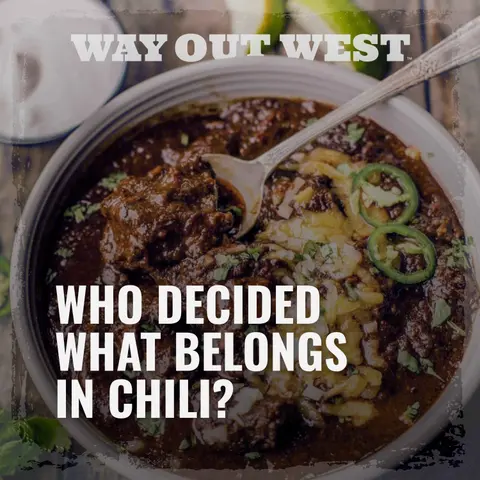
Long before Texans argued about beans, chili was already part of a much bigger Western story. From San Antonio’s Chili Queens to cowboy camps and commercial chili powder, discover how a borderlands dish became one of Texas’s most fiercely defended traditions.
Who Decided What Belongs in Chili?
How the Chili Queens, cowboys, and generations of Texas cooks turned a simple borderlands dish into one of the West’s most fiercely defended traditions.

Few food arguments are taken quite as seriously in Texas as the question of whether beans belong in chili.
Today, traditional Texas red is generally understood as meat cooked with chiles and spices. No beans required, and certainly no apology for leaving them out. But start looking backward, and the history becomes considerably less tidy.
Chili con carne emerged from a cultural crossroads where Indigenous ingredients, Spanish and Mexican cooking traditions, cattle culture, and the practical demands of life in the Southwest came together. By the nineteenth century, the dish was closely associated with Texas, especially San Antonio.
There, Mexican and Tejana women known as the Chili Queens served chili and other foods beneath the lights of the city's public plazas. Their stands attracted locals, soldiers, travelers, and tourists, helping introduce generations of visitors to a dish that would eventually become synonymous with Texas.
In this episode of Way Out West, we follow chili from the borderlands and San Antonio plazas to cowboy camps, commercial kitchens, and eventually the great American argument over what does, and does not, belong in the pot.
What You’ll Hear
- How chili con carne grew from several overlapping culinary traditions rather than a single invention
- The story of San Antonio’s Chili Queens and their role in popularizing chili
- Why chili became associated with cowboys, ranches, mining camps, and life across the West
- How commercial chili powder helped carry Texas flavors beyond the Southwest
- Why modern Texas chili generally excludes beans—and why the historical argument is more complicated
- What the story of chili reveals about the way the American West creates traditions
From the San Antonio Plazas to the American West
The story of chili is about more than a recipe.
For decades, San Antonio's plazas supported a lively nighttime food culture where vendors sold inexpensive meals in the open air. Among the best remembered were the Chili Queens, Mexican and Tejana women whose chili con carne became both local food and visitor attraction.
Their importance goes beyond the bowls they served.
The people who ate at those tables carried the experience elsewhere. Travelers wrote about San Antonio chili. Visitors attempted to reproduce it. Entrepreneurs found ways to commercialize its flavors. By the late nineteenth century, William Gebhardt's development of commercial chili powder helped make something resembling Texas chili possible even where chile peppers were difficult to obtain.
As chili traveled, it changed.
Different regions developed their own versions, while Texans increasingly defined and defended theirs. Eventually, a particular idea of Texas chili emerged: meat in a chile-based sauce, without beans. Texas made chili its official state dish in 1977, further cementing the connection between the food and the state's identity.
But culinary traditions are rarely as orderly in their origins as they become in retrospect.
Cowboys, ranch hands, miners, soldiers, and other Westerners ate beans because beans were inexpensive, portable, filling, and easy to store. Camp cooks worked with whatever provisions were available rather than following modern competition rules.
That doesn't make beans part of traditional Texas red.
It does make it difficult to imagine a nineteenth-century West in which meat, chiles, stews, and beans existed in completely separate culinary worlds.
And that distinction may be the key to the whole argument.
More Than a Bowl of Chili
The Chili Queens also remind us that the history of the West wasn't made only by cattlemen, soldiers, politicians, and outlaws.
It was made in kitchens and saloons, at market stalls and chuck wagons, and on public plazas after dark.
The history contained in a bowl of chili reflects many of the same forces that shaped the American cowboy himself: Spanish and Mexican traditions, Indigenous influence, cattle culture, migration, commerce, and generations of adaptation.
Over time, those influences became something people simply called Texan.
And once a food becomes part of an identity, preferences have a way of becoming traditions—and traditions eventually begin to sound like rules.
Which brings us back to beans.
If you're making traditional Texas chili, leaving them out is a pretty safe decision.
But if somebody claims no cowboy ever ate beans alongside beef and chiles because the rules prohibited it, there's still one question worth asking:
Where exactly did the cowboy get the rulebook?
Read the Companion Story
The Chili Queens of San Antonio
For generations, San Antonio’s Chili Queens served cowboys, soldiers, tourists, working people, and society ladies beneath the lanterns of the city’s plazas. But their story is about much more than chili.
This week’s Way Out West Journal looks more closely at the women themselves—the entrepreneurs who helped shape San Antonio’s nighttime culture and, in the process, helped turn a regional borderlands dish into an American culinary tradition.
Read The Chili Queens of San Antonio →
Ride Way Out West
Way Out West tells the stories, history, traditions, and culture of the American West—looking beyond the familiar mythology to the people and experiences that created it.
Follow the podcast wherever you listen, and explore more stories from the West at Way Out West.
02:51 - Chapter 1 — Nobody Invented Chili
04:55 - Chapter 2 — The Chili Queens of San Antonio
06:56 - Chapter 3 — Was Chili Really Cowboy Food?
09:13 - Chapter 4 — When Chili Left Texas
10:42 - Chapter 5 — The Case Against Beans
13:29 - Chapter 6 — What A Bowl of Chili Tells Us About the West
16:16 - Chapter 7 — So, Beans or No Beans?
17:45 - Chapter 8 – Thanks for Listening
There are certain arguments in the American West that sensible people know better than to get involved in.
Which pickup is better.
Which college football team is the real state religion.
And, of course, whether beans belong in chili.
Now, I recently made the mistake of wandering into that last one.
And I knew exactly what I was doing.
Because if you want to see otherwise reasonable Westerners suddenly begin behaving like constitutional scholars arguing before the Supreme Court,
just put a bowl of chili in front of them and ask whether you can add beans.
There will be testimony.
There will be precedent.
Somebody will eventually inform you that
their great grandfather made chili on a ranch,
in a mining camp,
or on a cattle drive in 1907—and therefore the matter is settled.
But here’s the problem.
The history of chili is a whole lot messier than the rules we’ve created around it.
And that’s what makes the story interesting.
Because before chili became a state dish…
before chili cook-offs…
before packaged chili powder…
and long before Texans started policing one another’s bean usage…
there was simply chili con carne.
And one of the places where that dish became famous was on the plazas of San Antonio.
Where some of the people serving it became famous themselves.
The Chili Queens.
[Music Up]
Howdy. Chip Schweiger, here.
Welcome to another edition of Way Out West.
Where the stories of the American West are told...
Cowboy wisdom is earned...
And the legacy of the American cowboy still rides on.
And today, we’re talking about chili.
Where it came from.
How San Antonio helped make it famous.
Why cowboys, miners, ranch hands, and travelers became associated with it.
How a simple bowl of meat and chiles
became one of the great culinary symbols of the American West.
And finally, the question that could get me run out of several Western states at once:
Do beans actually belong in chili?
Now, before we saddle up, remember you'll find additional resources for today's episode in the show notes at WayOutWestPod.com/chili
Chapter 1 — NOBODY INVENTED CHILI
Welcome back.
Now Let’s begin with something that probably disappoints everybody looking for a clean origin story.
Nobody invented chili.
At least not in the way we might say somebody invented Coca-Cola or the corn dog.
Food usually doesn’t work that way.
People combine the ingredients available to them. Recipes migrate. Cultures meet. Cooking techniques are borrowed and adapted.
Eventually somebody writes a recipe down, gives it a name, or figures out how to sell it commercially.
And then we start pretending there was a single moment when the thing was created.
Chili is particularly difficult because nearly every part of its story stretches far beyond Texas.
Chile peppers were cultivated in the Americas thousands of years before Europeans arrived.
Indigenous peoples cooked with them.
Spanish colonists brought their own culinary traditions.
Mexican cooks combined meat, chiles, spices, and other ingredients in countless variations.
And in northern Mexico and what would become Texas, those traditions met cattle culture.
That last part matters.
Because chili con carne is, at its heart, an extraordinarily practical dish.
Meat.
Chiles.
Seasoning.
Cook it together long enough and inexpensive or tough cuts of meat become something worth eating.
You don’t need a culinary degree to understand why that works in cattle country.
Or in a mining camp.
Or at a remote ranch.
Or anywhere else people had to turn basic ingredients into a hot, filling meal.
By the nineteenth century, something recognizably resembling chili con carne was becoming closely associated with Texas.
And particularly with one Texas city.
San Antonio.
Which brings us to the plazas.
CHAPTER 2 — THE CHILI QUEENS OF SAN ANTONIO
Beginning in the nineteenth century and continuing into the early twentieth, San Antonio developed a remarkable street-food culture.
At night, vendors set up tables and stands around the city’s plazas.
Lanterns illuminated the tables.
Musicians played.
Locals gathered alongside soldiers and travelers.
And Mexican and Tejana women served bowls of chili con carne and other foods to anyone with a few coins and an appetite.
Those women became known as the Chili Queens.
And they became famous.
Not celebrity-chef famous in the modern sense.
But famous enough that travelers wrote about them.
Tourists sought them out.
Writers described them.
And eating chili on a San Antonio plaza became part meal and part attraction.
Think about what was happening here.
Long before food trucks.
Long before celebrity chefs.
Long before somebody decided every restaurant needed exposed brick and Edison bulbs…
San Antonio had a thriving nighttime food scene built around women serving inexpensive, highly seasoned food on public plazas.
And chili was one of the stars.
The Chili Queens matter because they helped take a regional food and introduce it to people from far beyond the region.
Travelers came to San Antonio.
They ate chili.
They went home and talked about it.
Some tried to reproduce it.
Others eventually figured out how to commercialize it.
And chili began traveling well beyond Texas.
But somewhere along the way, something else happened.
Chili stopped being merely something people ate.
It became something people identified with.
And once food becomes part of your identity…
people start making rules.
That’s where things get dangerous.
CHAPTER 3 — WAS CHILI REALLY COWBOY FOOD?
Now let’s bring the cowboy into this.
Because you’ll sometimes hear chili described as cowboy food.
And there’s truth in that.
But there’s also a little mythology mixed in.
Cowboys certainly ate beef.
They ate beans.
They ate stews and other one-pot meals.
And they ate whatever a cook could produce with limited equipment and ingredients that could survive life on the trail.
Food needed to be filling.
It needed to keep reasonably well.
And it needed to be something you could make in quantity for men doing hard physical labor.
The same basic logic applied in mining camps, logging camps, military posts, railroad camps, and isolated ranches across the West.
So a hot pot of meat, peppers, and seasoning makes perfect sense.
But the image of a cowboy sitting beside a campfire eating a bowl of what we’d recognize today as competition-style Texas chili?
That’s where we need to be careful.
Trail-drive cooking was practical rather than doctrinaire.
A cook used what he had.
Beef.
Beans.
Coffee.
Flour.
Bacon.
Dried fruit.
Potatoes.
Whatever could be carried, preserved, and turned into enough calories to keep a crew working.
Nobody rode up to the chuck wagon and said:
“Cookie, I regret to inform you that this dish fails to comply with the Terlingua rules.”
And if somebody did, I suspect Cookie had several large iron utensils available to resolve the disagreement.
The point is that we have a habit of taking a modern definition of Texas chili and projecting it backward.
We imagine that somewhere on a cattle drive in 1878, a sacred recipe already existed.
Beef.
Chiles.
Spices.
No beans.
No tomatoes.
Violators prosecuted to the fullest extent of Western law.
But history is rarely that tidy.
People cooked differently from place to place.
From camp to camp.
And from household to household.
And chili kept changing right along with them.
CHAPTER 4 — WHEN CHILI LEFT TEXAS
One of the people who helped chili make that journey was another San Antonio-area entrepreneur.
William Gebhardt.
Gebhardt operated a café in New Braunfels before moving his business to San Antonio.
In the late nineteenth century, he began producing a commercial chili powder.
That was a bigger development than it might sound.
Fresh and dried chile peppers weren’t readily available everywhere in the United States.
But turn those flavors into a shelf-stable powder?
Suddenly somebody hundreds of miles from Texas could attempt something called chili.
And they did.
Boy, did they.
As chili moved across the country, Americans began doing what Americans have always done with food.
They changed it.
Eventually we produced an entire family tree.
Texas chili.
Cincinnati chili.
Chili over spaghetti.
Chili dogs.
Chili mac.
Vegetarian chili.
White chicken chili.
And at some point somebody probably added quinoa, although Western authorities are still investigating.
But something interesting happened as chili spread.
The farther it traveled from Texas, the more protective Texans became of theirversion.
And eventually the borders hardened.
Which brings us to…
the beans.
CHAPTER 5 — THE CASE AGAINST BEANS
Let’s establish the prosecution’s case first.
If you walk into a traditional Texas chili cook-off and dump a can of kidney beans into the pot…
you’re probably not winning.
Modern competition-style Texas chili is generally understood as meat cooked in a chile-based sauce without beans.
And there’s nothing wrong with that definition.
In fact, it’s a wonderful dish.
Texas even made chili the official state dish in 1977.
The legislature praised the idea that only Texans could appreciate the “distinctive flavor” of the concoction.
Which is an impressively Texan thing for a legislature to say.
We didn’t simply declare chili the state dish.
We essentially suggested everybody else lacked the sophistication to understand it.
I respect the commitment.
And if the question is:
Do beans belong in traditional Texas red?
Then the answer is pretty straightforward.
No.
But that isn’t quite the same question as asking whether beans historically belonged anywhere near chili.
And that’s where the prosecution starts running into trouble.
Because beans were enormously important in nineteenth-century Southwestern cooking.
They were inexpensive.
They stored well.
They traveled well.
And they provided calories and protein.
Cowboys ate beans.
Miners ate beans.
Ranch hands ate beans.
Soldiers ate beans.
Lots of them.
So here’s the distinction I think matters.
Are beans part of the modern culinary definition of traditional Texas red chili?
Generally, no.
Were people across Texas and the West eating beans alongside beef, peppers, and stewed dishes—and combining those ingredients according to whatever they had available?
Of course they were.
That’s what cooks do.
And that’s why I find the argument so entertaining.
We’re taking a food that evolved organically across cultures, kitchens, ranches, plazas, camps, and generations…
and trying to identify the precise moment when God handed Moses a second set of tablets reading:
THOU SHALT NOT ADD PINTO BEANS.
It didn’t happen.
What happened instead is much more interesting.
Different places developed different ideas about what chili should be.
Texas created one especially powerful culinary identity.
Other places created their own.
And over time, those preferences became traditions.
CHAPTER 6 — WHAT A BOWL OF CHILI TELLS US ABOUT THE WEST
And this is where I think the Chili Queens tell us something bigger than what belongs in a bowl of chili.
Look at everything contained in their story.
Spanish influence.
Mexican influence.
Tejano culture.
Cattle.
Tourism.
Commerce.
Immigration.
Street food.
Entrepreneurship.
And eventually American popular culture.
That’s Texas.
But it’s also the broader story of the American West.
The West has always been remarkably good at turning cultural collisions into traditions…
and then conveniently forgetting the collision ever happened.
The cowboy himself is a perfect example.
We sometimes picture the cowboy as something that appeared fully formed on the Texas plains.
But look at his equipment, language, and horsemanship and you find a much more complicated story.
The saddle.
The lariat.
Chaps.
The sombrero that helped influence the cowboy hat.
Even the word buckaroo, derived from vaquero.
The American cowboy was shaped by Spanish and Mexican traditions, Indigenous knowledge, Black cowboys, Anglo cattlemen, immigrants, and generations of adaptation.
Chili followed a similar road.
It wasn’t created in a cultural vacuum.
It grew out of the borderlands.
It traveled along cattle trails, rail lines, and commercial routes.
It moved through restaurants, camps, military posts, and family kitchens.
And eventually Texas claimed it.
Which, to be fair, is also a fairly Texan thing to do.
But here’s what I really love about the Chili Queens.
They remind us that Western history didn’t happen only on ranches and battlefields.
It happened around dinner tables.
In kitchens.
In saloons.
At market stalls.
In mining camps.
At chuck wagons.
And on public plazas late at night, where somebody handed a traveler a bowl of something he’d never tasted before.
We tend to tell history through famous men.
Generals.
Politicians.
Outlaws.
Cattle barons.
But culture is often built by people whose names never appear in textbooks.
People cooking food.
Making clothes.
Playing music.
Raising families.
Running small businesses.
The Chili Queens weren’t commanding armies or signing treaties.
They were feeding people.
And in doing so, they helped create one of the tastes the world would eventually associate with the American West.
There’s something wonderfully Western about that.
Chapter 7 — SO, BEANS OR NO BEANS?
So…
Beans or no beans?
I’ve managed to spend an entire episode avoiding giving you the answer.
Which is the privilege of being both the host and editor.
But all right.
Here it is.
If you tell me you’re making traditional Texas chili, and you put beans in the pot?
I’m probably going to raise an eyebrow.
If you hand me a good bowl of chili with beans in it?
I’m probably going to eat it.
And if you tell me that no real cowboy in the nineteenth century would ever have eaten beans with beef and chiles because that violates the rules of Texas chili…
I’m going to ask you to show me where the cowboy found the rulebook.
Because the history of the West is almost always more complicated than the mythology.
And frankly, that’s why I love it.
The mythology gives us the story.
History gives us the people.
And in this story, some of those people were the San Antonio Chili Queens.
Women working beneath lantern light on the plazas of an old Texas city, serving inexpensive bowls of food whose influences stretched across cultures and centuries.
They couldn’t have known that generations later, Texans and Westerners would still be arguing about what belonged in those bowls.
Although I like to imagine that if they could hear us…
they’d probably tell everybody to quit arguing and eat before it gets cold.
[MUSIC UP AND FADE]
Chapter 8 – Thanks for Listening
Well, that’s all for this episode of Way Out West. Thanks for riding with me here
If you enjoyed it, share it with somebody who has strong opinions about chili.
Which, if you live anywhere near Texas, shouldn’t be difficult.
If you’re new to the show,
you can visit RideWayOutWest.com.
And while you're there, take a few minutes to explore the Way Out West Journal, where we dive even deeper into the people, places, and history that continue to shape the West today.
That’s RideWayOutWest.com
Until next time, this is Chip Schweiger,
reminding you that some traditions are handed down…
and some are apparently argued into existence.
We'll see ya down the road.