What Cowboys Wore and What Happened When They Didn’t
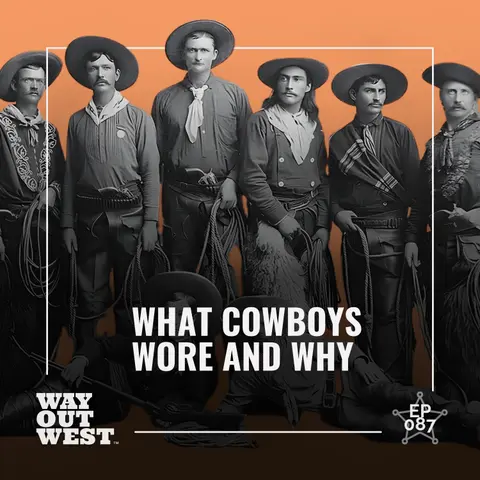
What a cowboy wore wasn’t about style; it was about survival. In this episode, we break down the purpose behind cowboy gear and what happened when it was missing, showing how every piece—from hat to boots—played a role in getting through the day.
"Out on the range, what you wore wasn’t a choice… it was part of the job."
What Cowboys Wore and What Happened When They Didn’t
Every piece of gear had a purpose—and going without it came at a cost
There’s a version of the cowboy that’s easy to picture. The hat. The boots. The silhouette against the horizon.
But out on the range, none of it was about appearance. It was about function.
Every piece of gear a cowboy wore was there for a reason—earned through experience, shaped by the land, and tested by long days of hard work. Take something away… and the consequences showed up fast.
In this episode of Way Out West, we break down what cowboys actually wore—and why it mattered. Not as style, but as survival. Because on the frontier, the wrong gear didn’t just make the job harder. It could make it impossible.
From the Saddle
This episode came from thinking about how often we see cowboy gear today as something aesthetic. Something to wear.
But for the men who did the work, it wasn’t optional, and it wasn’t about identity. It was about necessity. Once you start looking at it that way, every piece tells a different kind of story.
What You’ll Hear
- Why cowboy gear was built for function, not fashion
- The real purpose behind hats, wild rags, boots, and chaps
- How the environment shaped what cowboys wore every day
- What happened when a cowboy went without essential gear
- How preparation and self-reliance showed up in what they wore
Cowboy Glossary Term of the Week
Wild Rag: A square silk scarf worn around the neck to protect against dust, sun, wind, and cold. One of the most versatile and essential pieces of gear a working cowboy carried.
Ride Way Out West
If this episode changed the way you see the cowboy, there’s more ahead.
- Subscribe so you never miss an episode
- Your Turn! Share your thoughts → howdy@ridewayoutwest.com
- Support the Show: Buy me a coffee → https://buymeacoffee.com/thecowboycpa
- Follow Along: Instagram → https://www.instagram.com/RideWayOutWest
And if you know someone who’s drawn to the real story behind the image, share this episode with them.
Because what a cowboy wore… was never just for looks.
03:08 - Chapter 1 – A Cowboy Dressed for the Job
05:08 - Chapter 2 – The Hat Was Shelter You Could Wear
06:53 - Chapter 3 – The Wild Rag and the War Against Weather
08:49 - Chapter 4 – Boots Were Built for the Saddle
10:38 - Chapter 5 – Spurs Were a Tool, Not an Ornament
12:27 - Chapter 6 – Chaps, Leather, and Rough Country
14:00 - Chapter 7 – More Than Denim and Leather
15:05 - Chapter 8 – When Utility Became Identity
16:34 - Cowboy Glossary – Term of the Week
17:30 - Closing Thoughts
18:33 - Thanks for Listening
A cowboy didn’t dress for how he looked.
He dressed for what the day could do to him.
Everything he wore had a purpose…
The hat.
The wild rag.
The boots.
The spurs.
The chaps.
Today, most folks see cowboy gear and think style.
A look.
A silhouette.
A brand.
But out on the range, that’s not where it started.
A hat kept the sun off your face.
A wild rag cut the wind and dust.
Boots kept you in the saddle.
Chaps saved your legs.
And spurs weren’t decoration.
They were communication.
A working cowboy didn’t get dressed to make a statement.
He got dressed to do a job.
And if a piece of gear didn’t help him do it, it didn’t stay with him long.
Because out on the frontier, the wrong gear could wear you down…
slow you up…
get you hurt…
or leave you wishing, by noon, you’d thought harder before daylight.
[MUSIC BUMPER]
Howdy. Chip Schweiger, here.
Welcome to another edition of Way Out West.
Where the stories of the American West are told…
Cowboy wisdom is earned…
And the legacy of the American cowboy still rides on.
Picture the first light of day out on the range.
The air still cool.
Leather still stiff from yesterday’s work.
A saddle waiting in the half-dark.
A horse shifting his weight in the quiet.
And a cowboy getting ready.
Not for a photograph.
Not for a crowd.
Not for some polished idea of the West.
He’s getting ready for weather.
For miles.
For brush.
For rope.
For cattle.
For the chance that the day might turn hard in a hurry.
That’s something I think gets missed now.
We live in a time when cowboy gear is everywhere.
In ads.
In fashion.
In country concerts.
In social media feeds.
And I get it.
There’s something timeless about it.
Something sharp.
Something recognizable.
And the Yellowstone effect is in full force.
But the reason it became recognizable in the first place…
is because it worked.
That’s what made it last.
After the episode, check out the show notes at WayOutWestPod.com/cowboy-gear
[SHORT MUSIC STING]
Welcome back.
Today, we are talking about cowboy gear.
Not as a costume.
Not as an image.
But as working equipment.
Because long before cowboy gear became symbolic, it had to survive a test that mattered a whole lot more.
Could it hold up in hard country?
Chapter 1 – A Cowboy Dressed for the Job
When most people picture a cowboy, they picture the outline first.
The hat.
The boots.
Maybe the spurs jangling a little.
Maybe a wild rag at the neck.
Maybe a pair of chaps over denim.
And that outline is powerful.
You can recognize it from a distance.
You can recognize it in an old photograph.
You can recognize it in a shadow.
But on the frontier, that outline wasn’t assembled for romance.
It was built piece by piece through trial and error.
A cowboy wore what the country demanded.
That’s really the heart of it.
The American West wasn’t gentle on clothing.
Or skin.
Or horses.
Or men.
The work was physical.
The weather was unpredictable.
The land could be open one mile and full of thorns the next.
And cowboys didn’t live in some permanent heroic pose.
They sweated.
They froze.
They got soaked.
They got dusty.
They got rubbed raw by saddles, ropes, wind, and long hours.
So the gear mattered.
A lot.
If you were going to spend day after day horseback, handling cattle, crossing rough country, and dealing with whatever the sky decided to throw at you, you needed clothing and equipment that solved problems.
That’s what cowboy gear was.
Problem-solving gear.
And to me, that makes it even more interesting.
Because it tells us something bigger about the cowboy himself.
He was practical.
He might take pride in how he looked. Sure.
But first, he had to take pride in being ready.
That old West lesson still lands, by the way.
Use things that earn their place.
Carry what works.
Don’t confuse appearance with usefulness.
The cowboy couldn’t afford that mistake.
And, honestly, neither can we.
Chapter 2 – The Hat Was Shelter You Could Wear
Let’s start with the hat.
Maybe the most recognizable part of cowboy gear.
Today, the cowboy hat is almost a symbol all by itself.
But originally, it was a piece of working equipment.
It was portable shelter.
Think about what a cowboy faced in a single week.
Blazing sun.
Sudden rain.
Wind across open country.
Dust kicked up by cattle.
Long hours with no roof overhead.
A broad brim mattered.
It shaded the face.
Helped protect the eyes.
Kept the neck from burning quite so badly.
Shed some rain.
Gave a little relief in heat that had no mercy.
And hats were useful in other ways too.
A cowboy might wave one to signal.
Use it to fan a small fire.
Even scoop water in a pinch, though not every hat was built for that kind of treatment.
But the deeper point is this:
The hat wasn’t there to complete the look.
The hat was there because the sky was big and the day was long.
And if you have spent real time outside, you understand that fast.
There’s a big difference between liking the outdoors and living under it.
That‘s the difference the cowboy knew.
When I think about the hat, I think about how often frontier life demanded little decisions before the day even started.
What do I wear?
What do I carry?
What can I not afford to forget?
The hat was part of that answer.
It had a job to do.
And if it couldn’t do the job, it wasn’t worth much, no matter how good it looked hanging on a peg.
Chapter 3 – The Wild Rag and the War Against Weather
Now let’s talk about the wild rag.
This is one of my favorite pieces of cowboy gear because people often underestimate it.
They see it and think flair.
Color.
Tradition.
A little western style.
And yes, over time, it became all of that too.
But first?
It was protection.
A cowboy’s neck and face took a beating.
Cold wind in the morning.
Dust in the afternoon.
Sun on exposed skin.
Sometimes smoke.
Sometimes sleet.
Sometimes the kind of dry air that seemed to pull the moisture right out of you.
A wild rag helped with all of it.
It could be tied up high against cold.
Loosened as the day warmed.
Pulled over the mouth and nose in dust.
Used to help protect the neck from sun and windburn.
That may not sound dramatic to somebody sitting indoors.
But spend enough hours outside, and small protections stop feeling small.
They become the difference between comfort and misery.
Between staying sharp and wearing down.
And here’s something I love about cowboy gear in general.
It was versatile.
A lot of frontier tools had to be.
A wild rag wasn’t just one thing.
It adapted.
And that, to me, is part of the genius of old working gear.
It didn’t need to be complicated.
It needed to be dependable.
There’s something personal in that for me, too.
I think a lot of us are drawn to cowboy culture because it still carries that quiet respect for usefulness.
Not flash.
Not excess.
Not ten unnecessary features.
Just something simple, well-built, and proven.
That’s part of the moral beauty of Western gear.
It respected reality.
Chapter 4 – Boots Were Built for the Saddle
Now the boots.
No piece of cowboy gear may be more misunderstood.
Because boots are so popular now as fashion, it’s easy to forget how directly they were shaped by riding.
The heel mattered.
That wasn’t random.
A riding heel helped keep the foot from slipping through the stirrup too far.
It gave the rider a more secure seat.
It worked with the saddle rather than against it.
The smooth sole mattered too.
A smoother sole could slide in and out of the stirrup more easily than a heavy lug sole.
The shaft helped protect the lower leg from brush, friction, and the rub of leather.
And boots held up better than lighter shoes in hard use.
This is one of those places where form followed function in a very direct way.
Cowboy boots look like cowboy boots because the work demanded it.
Not because somebody sat down and said, let’s invent an icon.
The icon came later.
The work came first.
And that’s worth remembering.
Because it happens again and again in Western life.
The things that became beautiful often became beautiful because they were shaped by necessity.
That’s true of saddles.
True of spurs.
Of ropes.
Of hats.
And true of boots.
There’s a kind of honesty in that.
I admire it.
A cowboy’s boots were going to get scuffed.
Dusted.
Sweated in.
Broken in the real way.
Not the decorative way.
You could almost read a man’s life in his boots.
How much he rode.
How much he walked.
What kind of country he crossed.
And that’s one reason cowboy gear still has weight to it.
It carries the memory of labor.
Chapter 5 – Spurs Were a Tool, Not an Ornament
Now let’s get to spurs.
And this one really matters, because spurs are often misunderstood by people outside horsemanship.
They hear the jingle.
They see the metal.
They assume harshness.
But in skilled hands, spurs were not about cruelty.
They were about communication.
A rider needed ways to cue a horse with precision.
Hands did part of that work.
Seat did part of that work.
Legs did part of that work.
Spurs refined that language.
They weren’t meant to replace horsemanship.
They were meant to serve it.
And on a working ranch or an open trail, that mattered.
Because a cowboy and his horse were partners in difficult work.
Turning cattle.
Holding pressure.
Navigating brush.
Covering distance.
Reacting fast.
That relationship had to be responsive.
A good horseman didn’t use more cue than he needed.
That’s an important distinction.
The best working traditions of the West valued feel.
Timing.
Judgment.
Restraint.
Not noise.
Not force for the sake of force.
So yes, spurs became part of the cowboy image.
But first, they were part of the horseman’s toolkit.
Useful.
Specialized.
Intentional.
And honestly, I think there is a larger lesson there, too.
A lot of old Western tools only make sense when you understand the skill behind them.
Without the skill, they can look rough.
With the skill, they look exact.
That’s true in ranching.
True in roping.
True in riding.
And maybe true in life more broadly.
A tool in the wrong hands can look like the whole story.
It usually is not.
Chapter 6 – Chaps, Leather, and Rough Country
Now let’s talk about chaps.
Because if there is any piece of cowboy gear that instantly tells you this was working country, it might be those.
Chaps were protection for the legs.
Plain and simple.
Brush.
Thorns.
Mesquite.
Cactus.
Cold wind.
Wet grass.
Rough country.
A cowboy riding through all of that day after day needed another layer between his body and the land.
Leather did that.
And it held up.
That mattered too.
Cowboy work wasn’t done in clean conditions.
It was abrasive.
Rope rubbed.
Saddles rubbed.
Brush clawed.
Weather soaked through what it could.
Chaps took some of that punishment.
And different country shaped different needs.
Heavier protection in one place.
Lighter or differently cut gear in another.
Again, that’s the story of cowboy gear over and over.
It evolved in response to real conditions.
Not fantasy.
Real conditions.
I think we sometimes flatten the cowboy image so much that we forget how local it can be.
Different regions.
Different weather.
Different vegetation.
Different ranch traditions.
But the basic principle stayed the same:
Wear what helps you do the work and come back in better shape than you would without it.
That was the standard.
Not whether somebody thought it looked good.
Chapter 7 – More Than Denim and Leather
There were other pieces, too, of course.
Gloves for rope and reins.
A sturdy shirt for sun and abrasion.
A coat or slicker when the weather turned nasty.
A good belt.
Maybe cuffs.
Maybe leggings in some times and places.
And always, always attention to what the day required.
That’s something I keep coming back to.
Cowboy gear wasn’t random.
It was selected.
You can almost picture a man thinking it through at first light.
Will it turn cold?
Will we be riding brush?
Will there be rain?
How far are we going?
What kind of work are we doing?
There’s a humility in that kind of preparation.
You’re not trying to dominate the day.
You’re trying to meet it honestly.
And I think that’s one reason this subject feels personal.
Because a lot of what we admire in the cowboy isn’t really about romance at all.
It’s about readiness.
Competence.
Respect for hard conditions.
A willingness to prepare instead of pretend.
That still means something.
Even now.
Maybe especially now.
Chapter 8 – When Utility Became Identity
So how did working gear become legend?
Because people noticed it.
Because it was distinct.
Because it was tied to a hard kind of labor.
Because it carried the shape of the West with it.
Over time, what was practical became symbolic.
The hat stopped being just a shield from the sun.
It became a sign.
The boots stopped being just riding gear.
They became cultural memory.
The wild rag.
The spurs.
The chaps.
All of it moved beyond utility.
But here’s what matters:
It only became symbolic because it had been useful first.
That’s what gave it weight.
That’s what gave it authenticity.
A lot of styles come and go.
Cowboy gear stayed.
Because underneath the image was a real history of labor, weather, horsemanship, and survival.
That gives it staying power.
You can feel that even now.
You can see a cowboy hat on a wall and know it points to more than fashion.
It points to miles ridden.
Work done.
Storms endured.
A landscape that demanded something from the people who crossed it.
And maybe that’s why cowboy gear still speaks to people who have never worked cattle a day in their lives.
Because deep down, we still admire things that are earned.
And the gear of the cowboy was earned.
It earned its place by being needed.
Cowboy Glossary – Term of the Week
Before we close out for this week, we’ve got one more thing…
[BULL SOUND]
Yep, that distinctive call means Buster the Bull is back. And that means it’s time for our Cowboy Glossary Term of the Week.
This week’s cowboy glossary term is: Wild Rag
A wild rag is a square neckerchief, usually made of silk or a similar fabric, worn around the neck by cowboys.
But that definition does not go far enough.
Because a wild rag was not just worn for appearance.
It helped protect against cold, wind, dust, and sun.
It added comfort on long rides.
And it was one more example of cowboy gear doing a real job out on the range.
So when you see a wild rag, do not just think style.
Think weather.
Think dust.
Think long days horseback.
Think function first.
Closing
What a cowboy wore was never just for looks.
That’s the truth of it.
Every piece had a reason.
The hat for sun and rain.
The wild rag for wind and dust.
The boots for the stirrup.
The spurs for communication.
The chaps for brush and rough country.
None of it began as decoration.
It began as an answer.
An answer to weather.
An answer to labor.
An answer to the hard fact that the West was beautiful, but it wasn’t easy.
And I think that is part of why this subject still matters.
Because cowboy gear reminds us of something larger.
The most lasting things are often the things that prove themselves useful first.
They earn their place.
Just like people do.
And maybe that’s one reason the cowboy still means something to us.
Not because of the image alone.
But because behind the image was a man trying to be ready for the day in front of him.
And that, friend, is a lesson that still rides on.
Thanks for Listening
Well, that’s about all for this episode of Way Out West.
I appreciate you taking time out of your day to spend with me.
If you enjoyed this episode…
Make sure you’re subscribed wherever you get your podcasts.
And consider dropping us a quick review on Apple or Spotify.
That helps us reach more fans of the American West.
Until next time, this is Chip Schweiger, reminding you:
The West wasn’t built by appearance alone.
It was built by people and tools that could do the job when the day turned hard.
We’ll see ya down the road.