Encore Episode - Cowboy Poetry: How the West Found Its Voice
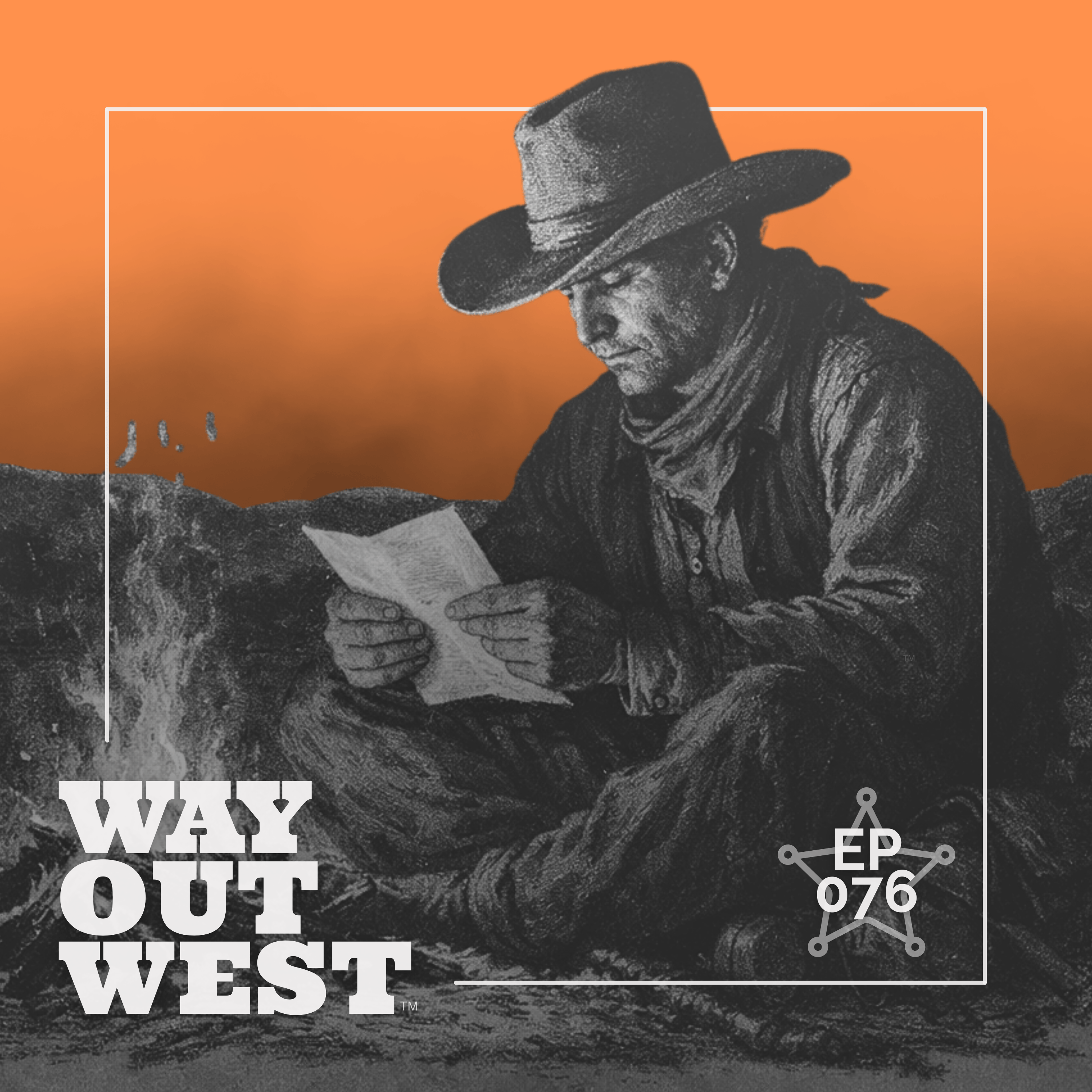
Cowboy poetry was shaped by long days, hard work, and quiet nights on the range. In this encore episode of Way Out West, we explore how the West found its voice through verse—and why those words still matter today.


Long before stages, spotlights, or festival programs, cowboy poetry lived beside the campfire.
Out on the trail, with nothing but stars overhead and miles still ahead, cowboys told stories to pass the time. Some of those stories found a rhythm. Some of them began to rhyme. And over time, those spoken words became one of the West’s most enduring traditions.
In this encore episode of Way Out West, we explore how cowboy poetry emerged from life on the range—shaped by long days, hard work, isolation, humor, and an intimate connection to the land. These weren’t poems written for applause. They were honest reflections of a demanding way of life, spoken aloud and shared among working hands.
We trace the roots of cowboy poetry back to the cattle drives of the late 1800s, when entertainment was scarce, and storytelling became a way to make sense of the trail. From there, we spotlight poets whose words helped define the genre, including Charles Badger Clark, whose poem Ridin’ captured the pull of the saddle and the romance of the open range, and Baxter Black, whose humor revealed the lighter side of ranch life.
We also look at where cowboy poetry lives today. Gatherings across the West continue to keep the tradition alive, most notably the National Cowboy Poetry Gathering, where working cowboys, poets, and listeners come together to celebrate the spoken word as part of Western heritage.
Finally, this episode reflects on why cowboy poetry still matters. In a fast-paced world, these verses remind us to slow down, notice the land, value resilience, and find meaning in everyday work. Cowboy poetry isn’t just about the past—it’s about remembering who we are and where we come from.
In This Episode, You’ll Hear:
- How cowboy poetry grew out of life on the cattle trail
- Why storytelling and verse mattered to working cowboys
- The origins of cowboy poetry in the late 1800s
- A spotlight on classic and modern cowboy poets
- How humor and hardship shaped the tradition
- Why cowboy poetry continues to resonate today
Cowboy Glossary Term of the Week
Chuck Line Rider
A cowboy who rode from cow camp to cow camp looking for a meal at the chuck wagon. In return, a chuck line rider offered odd jobs or help where needed—reflecting the unspoken code of hospitality and community on the range.
Listen & Learn More
This encore episode pairs naturally with our guide to the best Western events happening in 2026, including gatherings that continue to celebrate cowboy poetry and Western storytelling today. → The Best Western Events Happening in 2026
Enjoying the ride? Saddle up with us:
Transcript: For a full transcript of this episode, click on "Transcript"
Your Turn! Share your thoughts → howdy@cowboyaccountant.com
Support the Show: Buy me a coffee → https://buymeacoffee.com/thecowboycpa
Follow Along: Instagram → https://www.instagram.com/RideWayOutWest
02:31 - Chapter 1: Welcome
03:17 - Chapter 2: The Origins of Cowboy Poetry
04:32 - Chapter 3: Poetry Spotlight: Badger Clark’s “Ridin’”
05:43 - Chapter 4 - Humor on the Range: Baxter Black’s Wit
06:49 - Chapter 5 - Cowboy Poetry Today
07:54 - The Week in the West: Bob Wills
08:53 - Chapter 6 - Modern Reflections: Why Cowboy Poetry Still Matters
10:20 - Chapter 7 - Cowboy Glossary: What Is a Chuck Line Rider?
11:57 - Chapter 8 – Closing Thoughts & Thanks for Listening
Before we get started this week, I want to take you back to a story that feels especially timely.
Just this week, I published a new article on the best Western events happening in 2026. And right at the top of that list is the National Cowboy Poetry Gathering, which kicks off next week in Elko, Nevada.
Cowboy poetry isn’t just art for art’s sake. It’s how the West remembered itself—how working men and women turned long days, hard miles, and quiet moments into something lasting.
We first aired this episode earlier in the life of Way Out West, before the audience grew to what it is today. And with cowboy poets gathering again to speak the language of the range, it felt like the right moment to bring this one back.
This is an encore episode—Cowboy Poetry: How the West Found Its Voice.
[INTRO MUSIC]
Howdy y’all, Chip Schweiger, here. Welcome to another edition of Way Out West.
The podcast that takes you on a journey through the stories of the American West, brings you the very best cowboy wisdom, and celebrates the cowboys and cowgirls who are feeding a nation.
There’s something about the West that stirs the soul.
Maybe it’s the endless skies, the rolling plains, or the quiet nights under a blanket of stars.
Out here, Way Out West, life moves to a rhythm all its own, and every cowboy knows it’s a rhythm best captured in words.
So today on the show, we’re diving into the heart of the West—cowboy poetry. These aren’t just words on a page; they’re love letters to the land, to the life, and to the spirit of the cowboy.
We’ll wander into the poetry of the plains, where every rhyme carries the romance of the range.
After the episode, check out the show notes at WayOutWestPod.com/cowboy-poetry
[MUSIC]
Chapter 1: Welcome
Howdy and welcome back.
Now, don’t go thinking poetry’s just for city slickers or English majors.
Cowboy poetry is raw, real, and straight from the heart of the range.
It’s the voice of the West.
And today, we’re gonna saddle up and take a ride through its history, its purpose, and even hear a few verses that’ll make you feel the dust in your boots.
And because we’re talking about iconic cowboy stuff, it didn’t seem right to record this episode in a fancy indoor studio, so I’m back in the horse barn with Whiskey and friends, as well as rat-chasing barn cat I call Mama Cat and her new babies.
That just seems fittin’
Chapter 2: The Origins of Cowboy Poetry
Now, cowboy poetry has been around as long as there’ve been cowboys.
Picture it: You’re out on the trail, miles from home, the stars above you, and a campfire crackling at your feet.
What do you do to pass the time? You tell stories.
And sometimes, those stories rhyme.
Cowboy poetry is a way to capture the life of the cowboy. The long days, the hard work, the beauty of the land, and the humor that keeps you going.
It’s storytelling at its finest—simple, honest, and straight from the heart.
The roots of cowboy poetry go back to the cattle drives of the late 1800s.
Cowboys spent weeks, sometimes months, herding cattle across the plains. There wasn’t much entertainment out there.
No Netflix, no Spotify. Just you, your horse, and the open range.
So, cowboys got creative. They started putting their experiences into words.
At first, it was just spoken. But over time, those words were written down, passed along, and eventually became a tradition.
Chapter 3: Poetry Spotlight: Badger Clark’s “Ridin’”
One of the most famous cowboy poets was a man named Charles Badger Clark.
Now he never worked as a cowboy. In fact, he lamented when folks referred to him as a cowboy, saying, “I drearily acknowledge that I was no buckaroo worthy of the name.”
But still he wrote some of the finest cowboy poems ever written. They captured the life he observed around him in South Dakota.
Here’s a short part of one called, Ridin’
“There is some that likes the city—
Grass that's curried smooth and green,
Theaytres and stranglin' collars,
Wagons run by gasoline—
But for me it's hawse and saddle
Every day without a change,
And a desert sun a-blazin'
On a hundred miles of range."
Now, if that doesn’t give you goosebumps, I don’t know what will. Clark’s words remind us that cowboys didn’t just work the land—they were part of it.
Chapter 4 - Humor on the Range: Baxter Black’s Wit
But cowboy poetry isn’t all serious. It’s also funny.
Cowboys love to poke fun at themselves, their horses, and even folks who may not understand why they do what they do.
Here’s a bit of a lighthearted one from the late Baxter Black, one of the most well-known modern cowboy poets. It’s called a Vegetarian's Nightmare
“Ladies and diners I make you,
A shameful, degrading confession.
A deed of disgrace in the name of good taste,
Though I did it, I meant no aggression.
I had planted a garden last April,
And lovingly sang it a ballad.
But later in June beneath a full moon,
Forgive me, I wanted a salad!"
See? Cowboy poetry isn’t just about the highs and lows—it’s about the in-between moments, too. The quirks, the laughs, the little things that make life on the range so unique.
Chapter 5 - Cowboy Poetry Today
Today, cowboy poetry is alive and well. There are gatherings all across the country where poets and fans come together to share their work. The National Cowboy Poetry Gathering in Elko, Nevada, is one of the biggest.
It’s proof that the cowboy spirit is still kicking, even in today’s fast-paced world.
And you don’t have to be a cowboy to enjoy it. Cowboy poetry speaks to anyone who loves the land, values hard work, and appreciates a good story.
So, here’s my challenge to you.
Next time you’re out under the stars or sitting by a fire, try your hand at a little cowboy poetry.
You don’t need fancy words or perfect rhymes. Just speak from the heart.
Who knows? You might just surprise yourself.
Ok, let’s take a real quick break, but when we come back we’ll talk a little bit more about cowboy poetry.
Don’t wander off—be right back.
The Week in the West: Bob Wills
[Music]
Bob Wills didn’t just play music—he created a whole new sound. By blending swing, jazz, and country, he gave birth to the iconic genre of Western Swing. On the next episode of This Week of the West, my friends from the National Cowboy and Western Heritage Museum are diving into the life of this musical pioneer.
From his early days to criss-crossing the country with his band, Bob Wills left a mark that changed the music of the West forever.
Check it out and discover the story behind the man, the music, and the movement.
New episodes drop every Monday—on your favorite podcast provider.
[Music]
HOST:
Welcome back.
Chapter 6 - Modern Reflections: Why Cowboy Poetry Still Matters
You know, I’ve always believed that cowboy poetry isn’t just about the past—it’s about the here and now, too.
Sure, it’s rooted in the old days, when cowboys were out on the trail, far from home.
But the truths in those poems? They’re timeless.
Cowboy poetry reminds us to slow down. To see the beauty in the simple things.
A sunrise over the plains.
The sound of a horse’s hooves.
The quiet peace of a starlit night.
It also teaches us resilience. Cowboys lived tough lives, and their words reflect that grit.
They didn’t sugarcoat the hard times, but they found humor and hope in them.
And isn’t that something we can all learn from?
In today’s fast-paced world, cowboy poetry is like a breath of fresh air.
It reminds us to stay connected—to the land, to each other, and to the values that matter most.
So, as you listen to these verses, I hope you’ll take a moment to reflect.
What’s your connection to the world around you?
What stories would you tell if you had a campfire and a sky full of stars?
Because at the end of the day, cowboy poetry isn’t just about cowboys. It’s about all of us.
It’s about finding meaning in the everyday and keeping the spirit of the West alive in our hearts.
OK, before we wrap us this week, we’ve got one more thing. I know you know what it is.
Chapter 7 - Cowboy Glossary: What Is a Chuck Line Rider?
[BULL SOUND]
Yep, that distinctive call from Buster the Bull means it’s time for the cowboy glossary term of the week.
And today, we’ve got one that’s as much about survival as it is about the cowboy code. The term is "Chuck Line Rider."
Now, a Chuck Line Rider wasn’t your typical ranch hand. This was a cowboy who had fallen on hard times, maybe lost his job, his horse, or just hit a rough patch. But out on the range, there was an unspoken rule: no cowboy would go hungry if there was a chuck wagon nearby.
So, these cowboys would ride from cow camp to cow camp, stopping at the chuck wagon for a meal.
In exchange, they’d offer to do odd jobs—mend a fence, clean tack, deliver messages, or help out wherever they could.
It was a way to get by, sure, but it was also a testament to the camaraderie and kindness that defined the cowboy way of life.
And let’s not forget the chuck wagon itself—more than just a mobile kitchen, it was the heart of the camp.
It brought everyone together, whether for a hot meal or a good story after a long day.
So, next time you’re sharing a meal with friends or lending a hand to someone in need, tip your hat to the Chuck Line Riders of the past.
They remind us that even in the toughest times, community and kindness can carry us through.
Chapter 8 – Thanks for Listening
Cowboy poetry reminds us that the West wasn’t just built with muscle and grit—it was shaped by memory.
These poems carried the loneliness of the trail, the humor of camp life, the sorrow of loss, and the pride of honest work. And every year, when voices rise again in places like Elko, those stories get passed down one more time.
If you’d like to explore where that tradition is still alive today, you can find my full guide to the best Western events happening in 2026 on the main site. It’s a roadmap to the gatherings that keep Western culture breathing, and there’s a link to that in the show notes.
And next time on Way Out West, we turn to a very different story—one written not in verse, but in wind, snow, and survival.
We’ll be riding into the Great Plains blizzards of the 1880s—the storms that tested settlers, shattered illusions about the frontier, and reminded everyone on the plains just how unforgiving the land could be.
Until next week, this is Chip Schweiger reminding you: the West was never easy—but it was always worth remembering.
We’ll see ya down the road.