Scared Things Run Blind: What Cowboys Knew About Fear
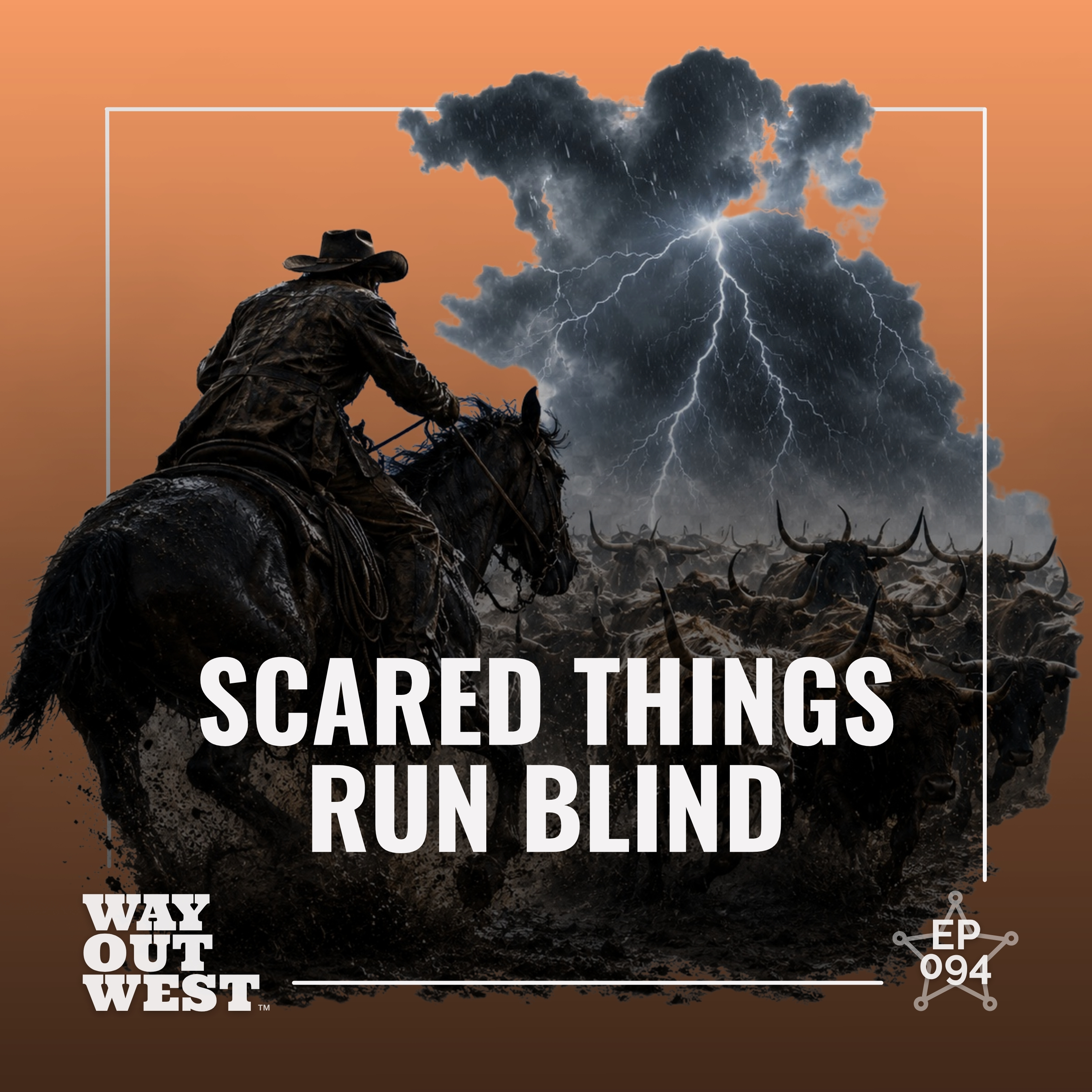
A violent storm. A terrified herd. And a trail boss forced to ride straight into chaos. This cinematic cowboy stampede story explores the dangers of the cattle trails, the realities of frontier life, and the steady courage that defined the Old West.
Scared Things Run Blind: What Cowboys Knew About Fear
When fear swept across the cattle trails, survival depended on the men willing to ride toward it.
A storm rolls across the plains in the dead of night. Lightning flashes over the prairie. Thousands of restless longhorn cattle begin to panic.
And then the herd breaks.
In this cinematic episode of Way Out West, experience the danger and intensity of a full cattle stampede during the height of the Old West cattle-drive era. Ride alongside trail boss Eli Mercer and a crew of exhausted cowboys as they attempt to turn a running herd in darkness, mud, and driving rain before disaster strikes.
But this story is about more than cattle.
It’s about responsibility.
Fear.
Leadership under pressure.
And the kind of steady courage that built the American West long before Hollywood turned cowboys into legends.
This episode blends historical reality with frontier storytelling in classic Way Out West fashion—where the line between history and legend sometimes blurs like dust on the horizon.
And by the end, you may find yourself wondering:
Was this story true?
Or simply the kind of story that could only come from the Old West?
What You’ll Hear
- The realities of life on the cattle trails
- How stampedes became deadly so quickly
- The role of the trail boss during a crisis
- Why experienced cowboys feared nighttime storms
- A reflection on fear, responsibility, and calm under pressure
Cowboy Glossary Term of the Week
Stampede: A sudden uncontrolled rush of frightened livestock—usually cattle or horses—often triggered by storms, predators, or unexpected sounds. On the cattle trails, stampedes were among the most dangerous situations cowboys faced.
Ride Way Out West
If you enjoyed this episode, be sure to follow Way Out West wherever you listen to podcasts.
And if you’d like to support independent storytelling about the American West, share this episode with somebody who loves cowboy history, frontier culture, and the stories that still ride on today.
Support the Show: Buy me a coffee → https://buymeacoffee.com/thecowboycpa
The storm came fast across the plains.
Not the kind that announces itself slowly with gentle rain and distant thunder.
This one arrived like something alive.
The cattle felt it first.
Thousands of longhorns shifting nervously in the dark…
horses pulling against their ropes…
cowboys waking to a pressure in the air they could not quite explain.
And somewhere beyond the firelight…
a trail boss named Eli Mercer stared into the northern horizon.
Because out on the cattle trails, a man learned something early:
Nature did not care whether you were ready.
And when the herd finally broke loose in the middle of the night…
forty-three hundred terrified cattle running blind through lightning and mud…
the only thing standing between survival and disaster…
was a handful of exhausted cowboys willing to ride straight into chaos.
[INTRO MUSIC]
Howdy. Chip Schweiger, here.
Welcome to another edition of Way Out West.
Where the stories of the American West are told…
Cowboy wisdom is earned…
And the legacy of the American cowboy still rides on.
There are some sounds that belonged only to the old cattle trails.
The creak of saddle leather before daylight.
Coffee boiling over a mesquite fire.
Spurs brushing against stirrups in the dark.
And then there was the sound cowboys feared most.
A herd beginning to run.
Not drifting.
Not moving.
Running.
Because once fear spread through thousands of longhorn cattle at night…
a trail drive could turn deadly in seconds.
The Old West demanded a particular kind of courage from the people who lived it.
Not loud courage.
Not theatrical courage.
Steady courage.
The kind built slowly through hardship, responsibility, exhaustion, and long miles under unforgiving skies.
Most cowboys were not gunfighters or outlaws.
They were working men trying to hold things together in conditions that often pushed human endurance to its limit.
And on one storm-torn night in 1876…
a handful of those men found themselves facing one of the most dangerous moments any trail crew could encounter:
A full stampede in the dark.
Tonight…
we’re telling that story.
After the episode, check out the show notes at WayOutWestPod.com/ cowboy-stampede-story
Chapter 1 - The Trail North
By the fall of 1876, the great cattle trails of the American West were already becoming legendary.
Texas longhorns moved north by the hundreds of thousands.
Cowboys pushed herds across rivers, through storms, around hostile terrain, and into railheads that connected the frontier to eastern markets hungry for beef.
The work was brutal.
Most trail drives lasted months.
Cowboys slept on the ground.
Ate beans, biscuits, salt pork, and black coffee.
Worked from before sunrise until long after dark.
And despite the romantic image Hollywood later created…
most cowboys were not gunfighters.
They were laborers.
Underpaid.
Sunburned.
Bone tired.
But skilled.
Very skilled.
A good trail outfit operated almost like a military unit.
Everybody had a role.
Everybody depended on each other.
And in the fall of 1876, one of those outfits was moving north through the open plains under the leadership of a trail boss named Eli Mercer.
Mercer was not famous.
No dime novels were written about him.
No town statues carried his name.
But men trusted him.
And in the West…
that mattered more than fame ever did.
He had spent nearly fifteen years on the trail by then.
Started as a wrangler.
Worked his way up.
Learned cattle the hard way.
The men under him said Mercer could read a herd almost like another man reads weather.
He knew when cattle were too tightly packed.
Knew when they were thirsty.
Knew when one nervous steer might start trouble for the entire drive.
Because cattle were emotional animals.
People forget that.
A herd could stay calm for days…
then panic over one lightning strike…
one rattlesnake…
one sudden sound in the dark.
And once fear spread through a herd…
it spread fast.
The outfit Mercer led that year was pushing more than four thousand longhorns north toward Dodge City.
Twelve hands.
One chuck wagon.
A remuda of horses.
Weeks from home.
The youngest cowboy on the drive was a kid everybody called Little Tom.
Nineteen years old.
Arkansas born.
Still trying to prove he belonged.
And like a lot of young cowboys…
he imagined trail life would feel adventurous.
The reality turned out to be dust…
saddle sores…
sweat…
and exhaustion so deep a man could fall asleep sitting upright beside a fire.
Still…
Little Tom loved it.
Because for all its hardship…
there was freedom out there too.
Endless country.
Big skies.
Campfire laughter at night.
The strange brotherhood that forms when people survive difficult work together.
And according to Tom years later…
everything changed the night the storm rolled in.
Chapter 2 - Silent Lightning
The warning signs started before sunset.
The herd grew restless.
Nothing dramatic at first.
Just subtle changes.
Steers crowd together.
Heads lifting toward the horizon.
Horses acting uneasy.
Old trail hands noticed those things.
Experienced cowboys watched cattle the same way sailors watched the sea.
At supper that night, the cook was serving beans and sourdough biscuits when Little Tom finally spoke up.
“Feels wrong tonight.”
A few of the older cowboys laughed.
One muttered:
“Storm’s got the kid nervous.”
But Mercer looked north.
And that was when he saw it.
Lightning.
Far away.
No thunder.
Just flashes silently lighting the horizon.
That bothered him.
Out on the plains, weather traveled differently than it did back east.
Storms built across enormous distances.
And cowboys learned to read them carefully.
Mercer stood there for a long moment beside the fire.
Then quietly told the men:
“Sleep light tonight.”
That alone made the camp uneasy.
Because Eli Mercer was not a nervous man.
By midnight, the air had changed completely.
The temperature dropped sharply.
Wind died almost to nothing.
And the silence became heavy.
That’s something people still describe before major storms:
the silence.
No insects.
No breeze.
No movement.
Just pressure.
Little Tom later said it felt like the whole prairie was holding its breath.
Then came the smell.
Rain.
Cold earth.
Electricity.
One cowboy stood from his bedroll and said:
“She’s coming.”
And then it hit.
Chapter 3 - When The Herd Broke
First came the wind.
Hard western wind slamming across the plains with enough force to scatter sparks from the campfire deep into the grass.
The chuck wagon canvas snapped violently.
Horses jerked against their ropes.
Then lightning exploded overhead.
And somewhere inside the darkness…
one steer bolted.
That was all it took.
Within seconds, thousands of longhorns erupted into motion.
The sound was unbelievable.
Not just loud.
Physical.
Like thunder rolling across the earth itself.
Men who survived stampedes often struggled to describe them afterward.
Some said it sounded like an avalanche.
Others said it felt like the ground shaking beneath them.
The truth was simpler.
It sounded like fear.
Pure animal panic multiplied thousands of times over.
Cowboys flew into saddles half-awake.
Rain slashed sideways through the darkness.
Lightning flashed so brightly men could briefly see the entire herd surging across the prairie before vanishing back into blackness.
Mercer shouted the only order that mattered:
“Turn the leaders!”
Because no cowboy stopped a stampede head-on.
That only got a man killed.
The trick was to slowly bend the front of the herd into a circle.
Let momentum eventually work against itself.
Keep the cattle moving until exhaustion overcame panic.
Simple in theory.
Terrifying in practice.
Especially in darkness.
Especially in mud.
Especially while riding inches away from thousands of terrified animals weighing over a thousand pounds each.
Little Tom rode beside Mercer during the worst of it.
The kid was terrified.
At one point his horse stumbled hard enough he nearly went under the herd.
Another cowboy grabbed his slicker and hauled him upright before the cattle crushed him beneath the hooves.
The rain became blinding.
And through all of it…
Mercer stayed focused.
No panic.
No wasted movement.
Just absolute concentration.
At one point Tom shouted over the storm:
“How do you know what to do?”
Mercer answered without turning his head.
“Because they’re scared,” he yelled back.
“And scared things run blind.”
That line stayed with Tom the rest of his life.
Hours passed.
The men kept pushing.
Slowly…
almost invisibly at first…
the herd began curving.
Then circling.
Then tiring.
And finally…
near dawn…
The stampede broke.
Chapter 4 - After The Storm
Morning arrived gray and cold.
Steam rose off the cattle.
Mud coated everything.
The prairie looked torn apart.
One cowboy had a broken wrist.
Another lost his bedroll entirely.
Several horses were cut up from rocks and brush in the dark.
But nobody died.
And considering what could have happened…
that was remarkable.
The cook rebuilt the fire.
Coffee boiled again.
Men sat silently in wet clothes too exhausted to speak much.
Little Tom later remembered watching Mercer sit alone for several minutes staring out across the herd.
Then finally the old trail boss said something quietly:
“I was scared too.”
Tom looked at him in surprise.
Mercer gave a tired smile.
“Difference is…
somebody still had to ride toward it.”
That may be one of the most honest descriptions of courage the Old West ever produced.
Because real frontier courage usually was not fearlessness.
It was responsibility.
The movies gave us fearless gunslingers standing tall without hesitation.
But the real West was built mostly by ordinary people carrying heavy burdens in hard conditions because nobody else could do it for them.
Cowboys.
Mothers.
Ranchers.
Freighters.
Homesteaders.
Lawmen.
People who were scared…
and kept going anyway.
And maybe that’s why these stories still resonate now.
Because life still sends storms.
Different kinds.
Financial storms.
Personal storms.
Family struggles.
Business failures.
Loss.
Fear.
Uncertainty.
And in those moments…
Most people are not looking for someone fearless.
They are looking for someone steady.
Somebody willing to ride toward the problem instead of away from it.
The myth survived.
But the reality still matters.
Chapter 5 - Closing Reflections
The cattle trails eventually disappeared.
Barbed wire closed the open range.
Railroads changed transportation.
The frontier itself slowly faded into history.
But something deeper survived.
The values.
Responsibility.
Calm under pressure.
Loyalty to the outfit.
The willingness to carry difficult things because others depended on you.
Those ideas still matter.
Maybe now more than ever.
And perhaps that is one reason the stories of the West continue to endure long after the trails themselves disappeared into the grass.
And now…
one final question before we ride out.
Was Eli Mercer real?
Was Little Tom?
Did this exact stampede actually happen?
Well…
parts of it are rooted deeply in the real history of the cattle trails.
The dangers were real.
The storms were real.
The stampedes were very real.
But like a lot of stories handed down across the West…
sometimes the line between history and legend starts to blur.
And maybe that’s fitting.
Because the West was built on both.
Chapter 6 – Buster the Bull & Cowboy Glossary Term of the Week
Before we close out for this week, we’ve got one more thing…
[BULL SOUND]
Yep, that distinctive call means Buster the Bull is back.
And that means it’s time for our Cowboy Glossary Term of the Week.
This week’s cowboy glossary term is: Stampede
A stampede is a sudden uncontrolled rush of frightened livestock—usually cattle or horses—often triggered by storms, predators, or unexpected sounds. On the cattle trails, stampedes were one of the most dangerous situations cowboys faced.
Chapter 7 – Thanks for Listening
Thanks for riding with me here, Way Out West
If you enjoyed this journey through history, share it with a friend. That way, we reach more fans of the American West. And if you’re so inclined, I’d appreciate it if you’d rate us or review us on Apple, Spotify, or your favorite podcast platform.
And remember —The West’s story belongs to everyone who lived it—and to all of us who still carry it forward.
Until next time, this is Chip Schweiger reminding you to ride steady and keep your eyes on the horizon.
We’ll see down the road.