The Cowboy Code: Why a Cowboy’s Word Meant Everything in the Old West
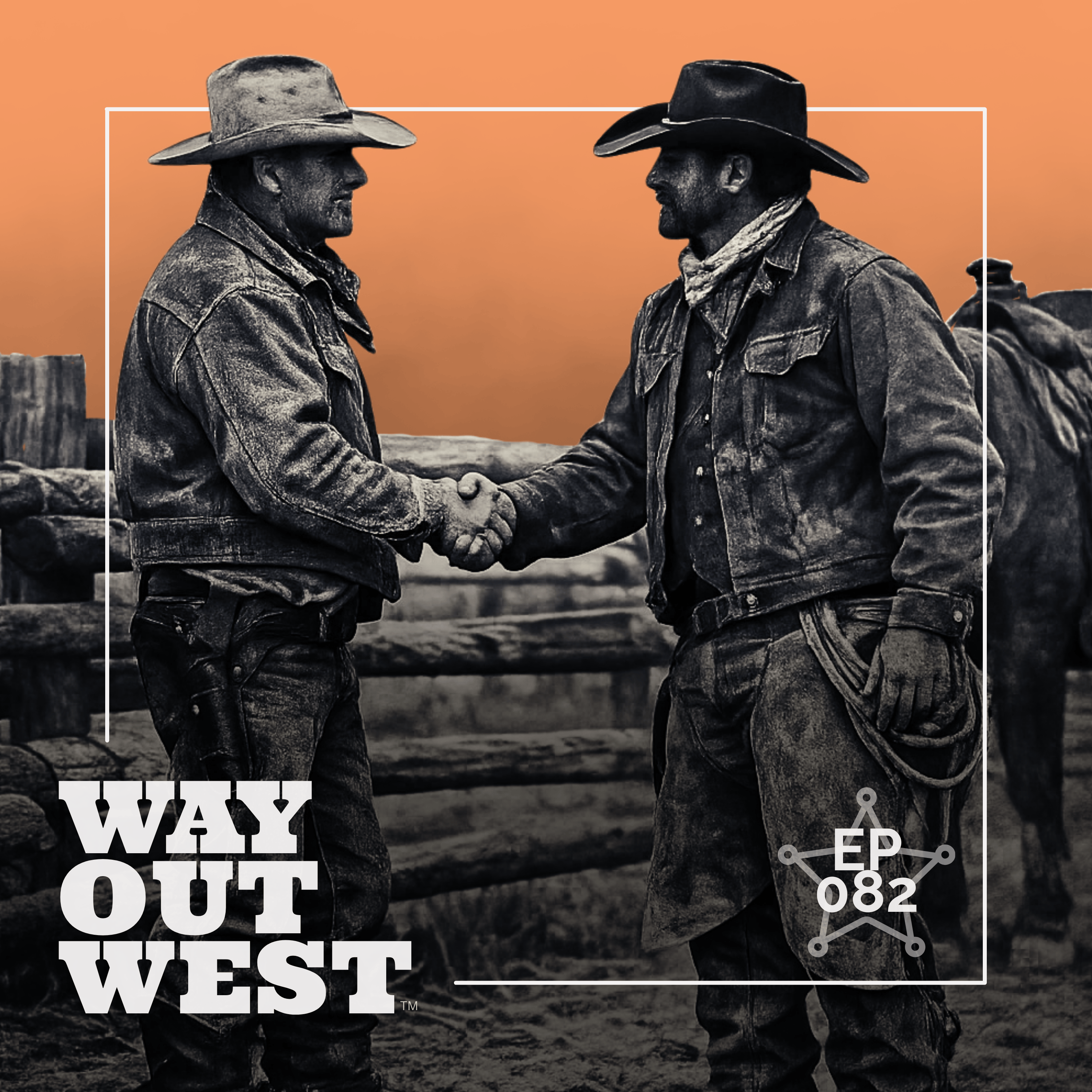
In the Old West, a handshake could be worth more than a contract. This episode explores why a cowboy’s word meant everything, and the moments when keeping that word came at a real cost.


Out on the frontier, contracts were rare, and reputation was everything.
In this episode of Way Out West, we explore the unwritten code that held the frontier together: a man’s word. Long before formal contracts and modern legal systems reached the open range, trust, reputation, and a simple handshake were the foundation of business and community across the American West.
But what happened when keeping your word became expensive?
Through stories from the cattle trail and frontier towns, we look at the moments when promises were tested—and why the men who honored them built the reputations that still echo through Western history.
In This Episode, You'll Hear:
- Why reputation mattered more than contracts in the Old West
- How cattle deals were often sealed with nothing more than a handshake
- The story of Charles Goodnight and Oliver Loving
- Why some ranchers honored deals even when it meant taking a loss
- How frontier communities relied on trust to function
🐎 Cowboy Glossary – Term of the Week
War Bag: Every working cowboy carried a small pouch on his saddle called a war bag. Inside were the essentials: matches, tobacco, a pocketknife, maybe a few small tools. It wasn’t fancy, but out on the range that little bag held the things a cowboy couldn’t afford to be without. Because when you’re fifty miles from town, the small things start to matter.
🎧 Listen & Subscribe
Subscribe to Way Out West for weekly stories of cowboy life, ranching history, and Western wisdom.
Transcript: For a full transcript of this episode, click on "Transcript"
Your Turn! Share your thoughts → howdy@ridewayoutwest.com
Support the Show: Buy me a coffee → https://buymeacoffee.com/thecowboycpa
Follow Along: Instagram → https://www.instagram.com/RideWayOutWest
03:48 - Chapter 1: The Promise Between Goodnight and Loving
05:46 - Chapter 2: Delivering Cattle After Disaster
07:18 - Chapter 3: A Merchant’s Price
08:35 - Chapter 4: What the West Really Valued
09:30 - Chapter 5: Cowboy Wisdom
10:25 - Chapter 6: Buster the Bull and Cowboy Glossary Term of the Week
11:11 - Chapter 7: Thanks for Listening
Dusty street.
Frontier town.
Two men standing outside a saloon.
One of them says:
“You gave me your word.”
And the other man answers:
“I know I did.”
The problem is…
Between that handshake and this moment…
the market collapsed.
The cattle died.
Or the deal suddenly got very expensive.
Now there are only two choices.
Break the promise.
Or pay the price.
Out on the frontier… that decision could follow a man for the rest of his life.
Because in the Old West…
your reputation rode ahead of you.
[MUSIC]
Howdy.
Chip Schweiger here.
Welcome to another edition of Way Out West.
The podcast that takes you on a journey through the stories of the American West…
brings you the very best cowboy wisdom…
and celebrates the legacy of the American cowboy.
Out on the frontier…
A man’s word was supposed to mean something.
At least… that’s how we remember it.
Two men stand beside a corral.
They shake hands.
Cattle will be delivered.
Money will change hands.
No lawyers.
No contracts.
Just a handshake.
Simple.
Until something goes wrong.
A drought hits.
A blizzard wipes out half the herd.
Prices collapse before you reach the railhead.
And suddenly that handshake…
looks like a terrible deal.
Because out on the frontier, if a man broke his word…
he didn’t just lose one deal.
He lost his reputation.
And reputation traveled faster than a horse.
So today on the show…
we’re talking about those moments.
When keeping your word got expensive.
And why the men who paid that price
are the ones the West still remembers.
After the episode, check out the show notes at WayOutWestPod.com/cowboy-word
[MUSIC]
Welcome back.
That image we opened with…
two men shaking hands beside a corral…
It’s one of the most enduring images of the American West.
A handshake.
A man’s word.
A deal sealed without paperwork.
But the reality behind those moments was often harder than the legend.
Because the frontier had a way of testing promises.
Weather could turn against you.
Markets could collapse.
Cattle could die.
And suddenly the agreement that seemed fair in the spring…
looked a whole lot different by the fall.
That’s when reputation was really built.
Not when things were easy.
But when the promise you made suddenly started to cost you something.
Out on the frontier, a man might lose cattle.
He might lose money.
But if he lost his word…
He lost the one thing that followed him from town to town.
His name.
And that’s why the stories the West remembers are often about the moments when someone kept their word…
even when it would have been easier not to.
One of the best examples of that comes from the early days of the cattle drives…
and a partnership that helped shape the trail system of the American West.
Charles Goodnight.
And Oliver Loving.
[MUSIC]
Chapter 1: The Promise Between Goodnight and Loving
In the late 1860s… cattle were moving north out of Texas by the millions.
One of the most famous partnerships on the frontier was between two men: Charles Goodnight and Oliver Loving.
Together they blazed what became known as the Goodnight–Loving Trail.
It ran from Texas up into New Mexico and Colorado.
Hard country.
Comanche territory.
Dry stretches with almost no water.
Miles of nothing but dust and sky.
But the trail worked.
And the cattle drives were profitable.
Then came the summer of 1867.
During one drive… Loving rode ahead of the herd to arrange supplies.
Somewhere along the Pecos River… he ran into a group of Comanche warriors.
He was shot.
Badly wounded.
Loving managed to make it back to camp… but the injury turned gangrenous.
He knew he wasn’t going to survive.
Before he died… Loving asked Goodnight for one final promise.
He didn’t want to be buried out on the frontier.
He wanted to be taken home to Texas.
Now think about that for a minute.
They were hundreds of miles away.
Transporting a body across that kind of distance in the 1860s was complicated, expensive, and dangerous.
Goodnight could have buried him right there.
No one would have blamed him.
But he had given his word.
And when the drive was finished…
Goodnight kept that promise.
He had Loving’s remains taken back to Texas for burial.
It cost time.
It cost money.
But reputation in the West was built on exactly that kind of decision.
When a man gave his word…
he carried it all the way to the end of the trail.
[MUSIC]
Chapter 2: Delivering Cattle After Disaster
Now let’s talk about cattle deals.
Because this is where keeping your word could really get painful.
Imagine you’re a rancher in Texas in the 1870s.
You’ve agreed to deliver 2,000 head of cattle to a buyer up in Kansas.
The price is locked in months ahead of time.
At the time, it sounds like a good deal.
Then something goes wrong.
Maybe a late-season blizzard hits the plains.
Maybe disease spreads through the herd.
Maybe rustlers take a few hundred head along the way.
By the time you reach Kansas… you’re short.
Now you’ve got a choice.
You can show up and say the deal’s off.
Or…
You can buy additional cattle locally — often at a much higher price — just to fulfill the contract you already made.
And yes…
That happened.
More than once.
Some ranchers took a loss just to deliver the number of cattle they had promised.
Why?
Because the next time they wanted financing…
the bank would remember.
The next time they wanted to sell cattle…
buyers would remember.
In the cattle business… your name was your credit.
Break your word once…
and suddenly nobody wanted to do business with you.
So some ranchers took the hit.
They finished the deal.
They rode home lighter in the wallet…
but stronger in reputation.
And out on the frontier…
That was the better bargain.
[MUSIC]
Chapter 3: A Merchant’s Price
Let’s step away from the trail for a moment and walk into a frontier town.
Picture a general store.
Barrels of flour.
Coffee in sacks.
Nails, lanterns, boots.
The storekeeper stands behind the counter.
And like everyone else in town… he’s operating on trust.
A rancher might walk in and ask about ordering supplies for the coming season.
The merchant quotes him a price.
They shake hands.
Delivery will happen later.
But out West… supply lines were unpredictable.
Maybe the railroad shipment arrived late.
Maybe prices back east suddenly jumped.
By the time the merchant restocked… the goods he promised had become much more expensive.
Now the merchant had a choice.
He could raise the price.
Or he could honor the one he quoted months earlier.
Some did the first.
But the merchants who built lasting reputations usually did the second.
They honored the original price.
Even if it cost them money.
Because word spread quickly in a frontier town.
People remembered who kept their promises.
And people remembered who didn’t.
[MUSIC]
Chapter 4: What the West Really Valued
Now here’s something interesting.
The Old West is often remembered as chaotic.
Lawless towns.
Gunfighters.
Range wars.
And sure… some of that happened.
But the truth is…
Most of the frontier ran on trust.
Because the legal system was thin.
Courts were far away.
Contracts were rare.
So people relied on something older.
Reputation.
And reputation came down to a simple question.
When things went wrong…
Did you still keep your word?
Because anyone can honor a promise when it’s easy.
The real test comes when the deal turns sour.
When the market shifts.
When the weather turns against you.
When suddenly the promise you made months earlier starts to hurt.
That’s when character shows up.
[MUSIC]
Chapter 5: Cowboy Wisdom
There’s an old piece of cowboy wisdom that fits here perfectly.
“Ride for the brand.”
It meant standing by the outfit.
Standing by the crew.
Standing by the commitments you made when you saddled up.
Sometimes that meant long nights in the saddle.
Sometimes it meant riding into a storm.
And sometimes…
It meant paying a price you hadn’t expected.
But the cowboys who did that…
The ranchers who honored their deals…
The merchants who kept their word…
Those were the people who built the reputation that held the West together.
And that kind of reputation still matters today.
Because the world may have changed…
But trust still works the same way it always has.
It’s built slowly.
One promise at a time.
And sometimes…
It costs you something.
Chapter 6: Buster the Bull and Cowboy Glossary Term of the Week
Before we close out for this week, we’ve got one more thing…
Yep, that distinctive call from Buster the Bull means it’s time for our Cowboy Glossary Term of the Week.
This week’s term is: War Bag
Every working cowboy carried a small pouch on the saddle called a war bag.
Inside, you’d usually find the basics:
Matches.
Tobacco.
Maybe a pocketknife.
A few small tools.
It wasn’t fancy.
But out on the range, that little bag held the things a cowboy didn’t want to be without.
Because when you’re fifty miles from town…
The small things start to matter.
Chapter 7: Thanks for Listening
Well, that’s about all for this episode of Way Out West.
I appreciate you spending part of your day with me—
and I hope you enjoyed this discussion about when deals were made without paper.
When a handshake could move cattle, land, or a life’s worth of work.
Next week on the show, we’re talking about fences.
The invention that helped end the open range,
started more than a few range wars…
and changed the American West forever.
Literally.
And figuratively.
Until next time…this is Chip Schweiger reminding you…
Your reputation rides ahead of you.
So make sure it’s a good one.
We’ll see ya down the road.