The Cowboy Gunfight: What Hollywood Got Wrong
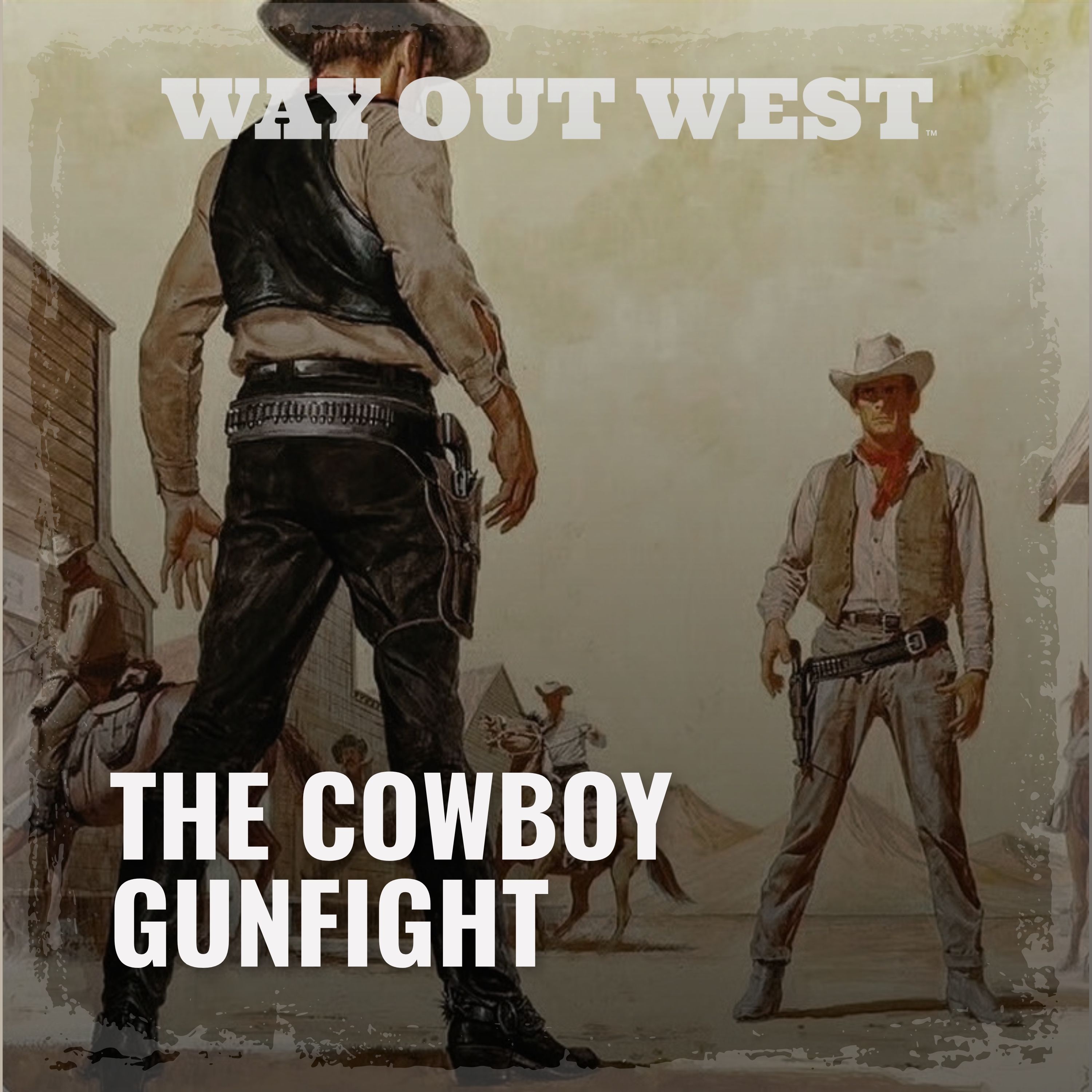
Did working cowboys really face off in the street at high noon? Chip Schweiger revisits Wild Bill Hickok’s famous shooting, the fight near the O.K. Corral, and the everyday cattle work Hollywood left out of its gunfight stories.
The Cowboy Gunfight: What Hollywood Got Wrong
Gunfights happened in the Old West. The familiar scene of two cowboys facing each other at high noon tells a much narrower, and more theatrical, story.

Two men step into an empty street. Their hands hover over their revolvers. The town waits to see who draws first.
That scene became one of the Western's defining images. But how much did it have to do with the lives of working cowboys?
In 1865, Wild Bill Hickok and Davis Tutt faced each other across the public square in Springfield, Missouri. Both fired, and Tutt was killed. Their encounter came unusually close to the showdown later made famous in films. Even so, it grew out of a personal dispute between two gamblers, not a quarrel between cattle hands. Details of where they stood are still debated.
The gunfight near the O.K. Corral was less like a duel. In 1881, the Earp brothers and Doc Holliday confronted a group of armed men in Tombstone, Arizona. Several people fired at close range. Three men died, and the conflict continued long after the shooting stopped.
Those encounters were real, but they don’t describe a typical day in a cowboy’s life. Working cowboys were hired to care for cattle, hold a herd together, find strays, and get livestock to market. Their reputations depended far more on how they handled that work than on how quickly they could draw a pistol.
Hollywood gave the gunfight a quiet street, a set of rules, and a clear ending. The history was rarely so orderly.
What You’ll Hear
- Why the Hickok–Tutt shooting became a model for the Western showdown
- What made the fight near the O.K. Corral more complicated than a movie duel
- Why Tombstone’s “Cowboys” shouldn’t be confused with all working cattle hands
- How weapons rules in Western towns complicate the familiar gunfight scene
- Why a cowboy’s skill with a herd mattered more than a fast draw
Cowboy Glossary
Gunfighter: A term commonly used for a person remembered for taking part in armed confrontations in the Old West. It describes a reputation for violence, not the occupation of a working cowboy.
Sources and Further Reading
- Springfield-Greene County Library District, “The Shootout on the Square”
- Springfield-Greene County Library District, “New Findings Regarding the 1865 Hickok-Tutt Shootout”
- National Park Service, Tombstone National Historic Landmark documentation
- “Gun Control Is as Old as the Old West,” Smithsonian Magazine
Ride Way Out West
Way Out West tells the stories of the history, culture, people, and traditions of the American West.
If you enjoyed this episode, follow the show and share it with someone who loves Western history. Then visit RideWayOutWest.com to explore the Way Out West Journal and discover more stories from across the West.
02:22 - Chapter 1 — The Gunfight That Looks Like the Movie
04:48 - Chapter 2 — What Happened Near the O.K. Corral?
06:25 - Chapter 3 — Where Were the Cowboys?
07:56 - Chapter 4 — The Street Wasn't an Open Stage
09:11 - Chapter 5 — How the Showdown Became the West
10:33 - Closing Reflections
10:53 - Chapter 6 – Buster the Bull and the Cowboy Glossary
11:33 - Chapter 7 – Thanks for Listening
Two men step into the middle of a dusty street. The townspeople disappear into doorways. One man's hand hovers over his revolver.
The other waits.
Somewhere, a clock strikes noon.
You know the scene. You've probably seen it a hundred times. But if you were standing in a cattle town in the nineteenth-century West, how likely were you to see anything like it?
The surprising answer is that a few men did face each other with guns. One famous shooting came remarkably close to the story Hollywood would later tell.
But most of what we call a cowboy gunfight didn't involve working cowboys. And the violence that did happen seldom followed the rules of a movie showdown.
[Music Up]
Howdy. Chip Schweiger, here.
Welcome to another edition of Way Out West.
Where the stories of the American West are told...
Cowboy wisdom is earned...
And the legacy of the American cowboy still rides on.
There's something irresistible about the high-noon gunfight. Two people, one empty street, and a moment when courage—or maybe foolishness—has nowhere left to hide.
It makes a powerful story. It also leaves out nearly everyone who built and worked in the West, including the cowboy whose name we've attached to the scene.
So today on the show we're asking: Did cowboys really have gunfights? We'll look at a shooting that seems made for the movies, the famous fight at Tombstone, and the ordinary work that never fit inside the frame.
Now, before we saddle up, remember you'll find additional resources for today's episode in the show notes at WayOutWestPod.com/gunfights
[BUMPER MUSIC]
Welcome Back
Let's start with a distinction. A gunfight is any violent encounter in which people exchange gunfire. That happened in the West. A showdown is the particular scene we remember: two armed men agreeing, more or less, to settle a dispute face to face in public.
The second kind is what Hollywood taught us to expect. And that's where the record gets thin.
Chapter 1 — The Gunfight That Looks Like the Movie
On July 21, 1865, Wild Bill Hickok and Davis Tutt faced each other across the public square in Springfield, Missouri. Both men fired. Tutt was hit and died.
If you're looking for the seed of the Western showdown, this is a good place to find it. They knew each other. They had a dispute. They met in public, with witnesses nearby, and the encounter ended with a single man standing.
But even this story becomes less tidy when you get close to it.
Hickok and Tutt were gamblers with a complicated history. A debt and Hickok's watch were part of the immediate quarrel. Springfield had just come through the Civil War; the men had served on opposing sides, yet had also spent time together. This wasn't a cattle-hand dispute over whose turn it was to ride night guard.
And Hickok didn't simply ride away after the shot. He was tried for killing Tutt and acquitted.
The details of the shooting have been argued over ever since. In fact, researchers at the Springfield-Greene County Library recently reexamined eyewitness testimony and period business locations. Their work suggests that the markers long used to show where the men stood may place Hickok in the wrong corner of the square. They also say the exact distance between the men is unknown.
That's a useful reminder. When even our clearest example has uncertain details, we ought to be careful about turning it into a universal custom.
The Springfield shooting was real. Its fame helped create the template. It doesn't prove that cowboys routinely settled arguments by stepping into the street and drawing on a count of three.
Chapter 2 — What Happened Near the O.K. Corral?
Then there's Tombstone.
Say “gunfight in the Old West,” and somebody will picture the O.K. Corral. On October 26, 1881, Virgil, Wyatt, and Morgan Earp, joined by Doc Holliday, confronted a group that included members of the Clanton and McLaury families. Shots were fired at close range. Billy Clanton and Frank and Tom McLaury were killed; Virgil and Morgan Earp were wounded, and Holliday was grazed.
The fight was real. The neat duel that lives in popular memory wasn't.
It took place in a lot near the corral, not inside some grand arena. The encounter grew out of an ongoing feud, threats, questions about weapons in town, and competing claims of authority. Accounts of who made the first move have been disputed for generations.
Nor did the story end when the smoke cleared. There was a legal hearing. The hostility continued. Virgil was later ambushed and badly wounded, and Morgan was murdered while playing pool.
The National Park Service's history of Tombstone describes the famous fight as fuel for the conflict that followed, not a clean resolution of it.
That's what a movie showdown does for a story: it gives the audience a clear beginning, a clear ending, and a way to know whom to cheer for. The people in Tombstone didn't get any of those things.
Chapter 3 — Where Were the Cowboys?
There's another problem with the phrase “cowboy gunfight.” The word cowboy meant different things in different settings.
In Tombstone, “Cowboys” could refer to a particular faction associated with cattle theft and other crimes. That wasn't a job description for every person who worked cattle across the West.
The working cowboy was hired to move and care for livestock. A trail outfit needed people who could ride, handle a rope, find strays, keep a herd together, and stay awake on night guard. The boss was paying for cattle to arrive alive and in condition to sell.
A hand who went looking for a personal gun battle wasn't doing the work he was hired to do. He was making trouble for himself and, very likely, for the outfit.
Of course, a cowboy might carry a gun, and cowboys could become involved in violence. Some got into trouble in town. Some lived through genuinely dangerous encounters. We don't need to pretend otherwise.
But being a cowboy didn't make a man a professional gunfighter. Most of the people whose names fill gunfighter stories were gamblers, law officers, outlaws, or men caught in feuds—sometimes more than one of those at once. The movie camera put them all under one hat.
Chapter 4 — The Street Wasn't an Open Stage
Even the setting of a showdown can mislead us.
Many Western towns had rules about carrying weapons within town limits. The point wasn't to turn every visitor into a harmless saint. It was to keep a crowded place from becoming more dangerous whenever tempers rose.
In Tombstone, the question of armed men in town was part of the confrontation itself. In Dodge City, peace officers enforced restrictions on carrying guns. Those rules didn't prevent every shooting. They do tell us that townspeople weren't simply waiting around for strangers to settle grudges in the street.
And real violence had no obligation to be fair. A threat might end with somebody backing down. A fight might break out suddenly at close quarters. A man could be shot without ever seeing his attacker draw. Morgan Earp's killing after Tombstone is a grim example of how little the rules of a duel governed what came next.
The empty street and the two evenly matched opponents gave Western storytellers a kind of order that real violence didn't have.
Chapter 5 — How the Showdown Became the West
The legend started growing while the frontier era was still underway. Hickok's Springfield shooting reached a national audience through a sensational magazine account published in 1867. The author embellished Hickok's reputation, and a real killing began its long second life as entertainment.
Newspapers, dime novels, Wild West shows, and then films each found something useful in the armed man who could settle everything in one moment. The Western movie made that moment visual: the hands, the holsters, the clock, the street.
It also gave the gunman the cowboy's face. A broad-brimmed hat, a pair of boots, and a horse were enough to make very different lives look like the same life.
The real cattle hand rarely offered such a clean climax. His work happened over days and months. There was no single draw that proved he knew his trade. You learned that by watching whether he could bring a herd through bad weather, find water, hold his place, and be counted on when the work got hard.
That's a less explosive story. To me, it's the more interesting one.
Closing Reflections
So did cowboys really have gunfights? Some did. But the high-noon duel was rare, and most working cowboys had more pressing things to do.
The West had its gunfighters. It also had thousands of hands who earned their reputations without ever drawing a pistol.
Chapter 6 – Buster the Bull and the Cowboy Glossary
OK, before we ride out today, we’ve got one more thing.
[BULL SOUND]
Yep, that distinctive call from Buster the Bull means it’s time again for our Cowboy Glossary Term of the Week.
And this week's term is gunfighter. It sounds like an old job title, but we often use it looking backward, for people who became known for armed violence. It's a useful word for telling a Western story. It isn't another name for a working cowboy.
And Buster says a steady hand with a herd might have been worth more than a fast hand with a pistol.
Chapter 7 – Thanks for Listening
Well, that’s all for this episode of Way Out West. Thanks for riding with me here.
If you enjoyed the episode, please follow, rate, and share the show with someone who loves the history, culture, and traditions of the American West.
If you’re new to the show, you can visit RideWayOutWest.com.
And while you’re there, take a few minutes to explore the Way Out West Journal, where we dive even deeper into the people, places, and history that continue to shape the West today.
That’s RideWayOutWest.com.
Until next time, this is Chip Schweiger, reminding you that while the West had its gunfights, most of its work was done by people who never drew a gun.
We’ll see ya down the road.