The Day Oklahoma Raced for Land
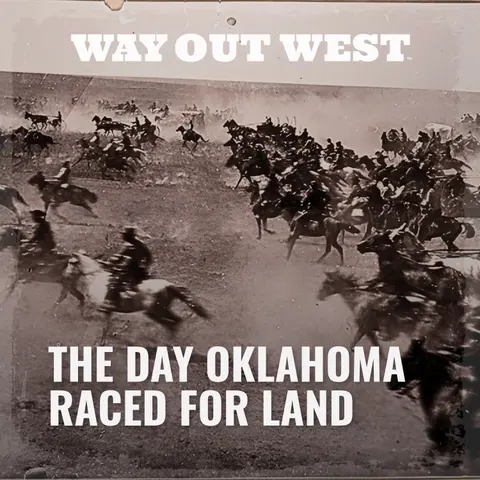
In 1893, people raced into the Cherokee Outlet on horseback, on foot, and by train. The Oklahoma Land Run offered families a chance at a farm, while the Cherokee Nation fought to hold on to land that already provided a living.
The Day Oklahoma Raced for Land
Before the Oklahoma Land Run of 1893, the Cherokee Outlet was cattle country. Then people came on horseback, on foot, and by train to stake a claim.

At noon on September 16, 1893, a cannon sounded near Orlando. The riders went first, then the wagons. Behind them came people on foot, carrying water, stakes, and blankets. They were hoping to spend the night on ground they could call their own.
Before the government opened the Cherokee Outlet to settlement, the Cherokee Nation earned income by leasing its grass to cattlemen. The episode follows what happened when federal pressure brought that business to an end, and families who’d endured drought, falling crop prices, and financial panic gathered along the border for a chance at a farm.
Then came the registration lines, the counterfeit certificates, and the passengers who jumped from trains before they reached the new towns. If you got far enough to drive a stake, you still had to establish that the claim was yours. After all that racing, some people found themselves standing in another line.
What You’ll Hear
- How Texas cattle and Cherokee grazing leases shaped the Outlet before the run
- Why people lined up for days just to get permission to race
- Why some town-lot seekers jumped from moving trains
- What happened when riders broke away before the noon signal
- What it took to turn a claim into a farm a family could live on
Cowboy Glossary Term of the Week
Sooner: Someone who entered the land before the legal opening to get a head start on a claim. The name eventually found its way onto University of Oklahoma uniforms.
Sources and Further Reading
- “Cherokee Outlet Opening,” Oklahoma Historical Society. Alvin O. Turner covers the grazing leases, federal negotiations, and the race itself. The entry includes the photograph of claimants waiting to file at the Enid land office. Read the entry and see the photograph
- The New York Herald, September 17, 1893. The Oklahoma Historical Society reproduces the newspaper’s accounts from near Orlando and Chilocco Creek. Read the newspaper excerpt
- “Order and Disorder: The Opening of the Cherokee Outlet,” The Chronicles of Oklahoma. Turner looks at why officials kept using land runs and what happened when the rules met the crowds. Read the article
Ride Way Out West
If you’d like to spend a little more time on the cattle trails that crossed this country, the Way Out West Journal takes you to the back of the herd in Riding Drag.
01:52 - Chapter 1 – Before the Run, There Were Cattle
03:45 - Chapter 2 – The Line Before the Starting Line
05:17 - Chapter 3 – Trains and Head Starts
07:09 - Chapter 4 – From the Starting Line to the Land Office
08:55 - Chapter 5 – Making a Living on the Land
10:03 - Chapter 6 – Buster the Bull and Cowboy Glossary
10:41 - Chapter 7 – Thanks for Listening
Now, imagine you’ve been waiting for days to get into this race.
You’ve followed the rules. You’ve got your paperwork.
You’ve got a reasonably good horse underneath you.
And then, before the starting signal, you see a bunch of riders take off.
What are you gonna do?
Because every second you sit there doing the right thing, somebody else is getting closer to your farm.
[MUSIC UP]
Howdy. Chip Schweiger, here.
Welcome to another edition of Way Out West.
Where the stories of the American West are told…
Cowboy wisdom is earned…
And the legacy of the American cowboy still rides on.
You know, I’ve spent a fair amount of time looking at land over the years.
And there are all sorts of things you want to know before you buy a piece of property.
Is there water? Is the soil any good? Can you get to it when it rains?
Pretty reasonable questions.
But on September 16, 1893, somewhere in the neighborhood of a hundred thousand people were given a different way of acquiring real estate.
Run.
Find yourself a piece of ground, get there before somebody else does, and stick a stake in it.
What could possibly go wrong?
Well, quite a bit, as it turns out.
And that’s what we’re gonna talk about today.
Now, remember, you’ll find additional resources for today’s episode in the show notes at WayOutWestPod.com/land-run
Chapter 1 – Before the Run, There Were Cattle
Welcome back.
Now, when most folks think about the Oklahoma land runs, they probably picture that great mass of horses and wagons charging across the prairie.
And there were several of those runs.
But the one we’re talking about today was the big one. The opening of the Cherokee Outlet in 1893.
Nearly six million acres of country along what is now northern Oklahoma.
And here’s something that might interest those of you in the cattle business.
Before it became the scene of one of the biggest land rushes in American history, it was cattle country.
Good cattle country, too.
Texas herds had traveled through there on their way to Kansas. And cattlemen eventually figured out that there was money to be made keeping cattle on that grass.
So they worked out an arrangement with the Cherokee Nation.
At one point, the cattlemen agreed to pay the Nation two hundred thousand dollars a year for grazing rights.
That’s in 1880s money, mind you.
They even offered to buy the land outright for three dollars an acre.
The Cherokees declined.
And the businessman in me can certainly appreciate that decision. You’ve got an asset that’s producing income every year. Why sell it?
Well, the federal government had other ideas.
Congress authorized the purchase of the land at a dollar and a quarter an acre. And when President Benjamin Harrison ordered the cattle off the Outlet, the Cherokee Nation lost that source of income.
Eventually, the Nation agreed to sell, after considerable pressure and negotiation.
So there’s a part of this story that tends to get lost in all those paintings of covered wagons racing across the prairie.
This wasn’t empty land waiting for somebody to come along and make something of it.
Somebody already had.
Chapter 2 – The Line Before the Starting Line
Meanwhile, things weren’t going particularly well for a lot of American farmers.
There’d been drought. Crop prices were a problem. And in 1893, the country was in the middle of a financial panic.
For a family that had lost its farm, the prospect of getting another one was pretty compelling.
And so they came.
With horses, wagons, mules, whatever they could put together.
Some came on foot.
But before anybody could race for a piece of land, they had to deal with something that’s apparently been a feature of American life for quite some time.
Government paperwork.
There were nine registration booths staffed by forty-five clerks.
Now, 45 people processing paperwork for that many prospective settlers.
You can probably see where this is going.
The lines stretched out across the prairie. In some places, a mile long.
It was September. It was hot. There wasn’t much shade, and water was scarce.
Some people waited for days. Some died from the heat.
And one of the reasons for all this paperwork was to prevent people from cheating.
Which, of course, created a whole new opportunity for people to cheat.
People started selling certificates. Others counterfeited them.
American entrepreneurship, I suppose, although not necessarily the sort we ought to celebrate.
Chapter 3 – Trains and Head Starts
Now, let’s talk about the race itself.
Because there were some things about this particular land run that don’t quite fit the Hollywood version.
For one thing, you could make the run by train.
I don’t know about you, but when I picture an Oklahoma land rush, I don’t picture a railroad passenger.
But if you were after a town lot rather than a farm, the railroad was an option.
The government said passengers couldn’t begin boarding more than thirty minutes before departure.
The railroad folks, quite reasonably, wondered how they were supposed to get everybody aboard, check their paperwork, and maintain some semblance of order in thirty minutes.
Well, people fought to get aboard.
And when the trains approached the new townsites, some passengers decided that waiting for the train to stop was entirely too much of a disadvantage.
So they jumped.
Apparently, getting a good commercial lot in Oklahoma was worth considerably more to some folks than the continued use of both ankles.
Up near the Kansas border, things weren’t going much better.
At Chilocco Creek, there was confusion over where some of the riders were permitted to start.
Some got a head start. Others objected. Riders broke away before noon, and when people at other locations saw them going, they took off, too.
Now, imagine you’ve been waiting for days to get into this race. You’ve followed the rules. You’ve got your paperwork. You’ve got a reasonably good horse underneath you.
And then, before the starting signal, you see a bunch of riders take off.
What are you gonna do?
Because every second you sit there doing the right thing, somebody else is getting closer to your farm.
That’s a pretty uncomfortable position to be in.
Chapter 4 – From the Starting Line to the Land Office
Near Orlando, on the southern side of the Outlet, a cannon sounded at noon.
The horseback riders went first.
Then the lighter wagons, followed by the heavier ones.
And finally, the people on foot.
A newspaper reporter noticed that some of those folks were carrying water, stakes and blankets.
Now, that’s optimism.
You’ve just watched an entire cavalry’s worth of people disappear over the horizon, and you’re standing there with a blanket and a couple of sticks, figuring you’re gonna be a landowner by sundown.
I admire those people.
I’m not entirely sure I’d have joined them, but I admire them.
And even having a horse or a wagon was no guarantee of success.
Up near Chilocco Creek, the dust got so thick that a wagon carrying six men went over the creek bank. One of the men broke his leg.
And the day had barely started.
But across the Outlet, people were finding ground, driving stakes and laying claim to farms.
Townsites filled with people in a matter of hours.
Places like Enid and Perry went from open country to bustling settlements with remarkable speed.
Of course, finding a piece of land was only part of the exercise.
You still had to establish that it was yours.
And if two people showed up claiming the same piece of ground, well, now you’ve got a problem.
There’s a wonderful old photograph of people lined up outside the land office in Enid.
After all that racing, all that dust and all that commotion, what did you get to do?
Stand in another line.
Chapter 5 – Making a Living on the Land
Most of the people who participated in the run didn’t get land.
And some of those who did discovered that getting a farm and making a living on a farm were two entirely different things.
That’s something anybody who’s ever worked the land understands.
A hundred and sixty acres sounds pretty good until you’ve got to find water, build a house, put in a crop, and somehow feed your family while you’re doing it.
By the end of the year, some people were already abandoning the very claims they’d raced to acquire.
Others stayed.
They built homes, raised families, and established communities that are still there today.
And that’s one of the things I find so interesting about the American West.
The same event can represent an extraordinary opportunity for one family and a tremendous loss for another.
The families who lined up that September morning were looking for a future.
The Cherokee Nation had been trying to protect one.
Both are part of the story.
And you don’t have to leave either one out to appreciate the history of the American West.
Chapter 6 – Buster the Bull and Cowboy Glossary
OK, before we ride out today, we’ve got one more thing.
[BULL SOUND]
Yep, that distinctive call from Buster the Bull means it’s time again for our Cowboy Glossary Term of the Week.
This week’s term is… Sooner.
A Sooner was somebody who entered the land ahead of the legal opening to get an advantage over everybody else.
Which makes it rather entertaining that an entire university eventually embraced the name.
Not many people manage to go from breaking federal land regulations to having a nationally recognized football program named after them.
But there you go.
Chapter 7 – Thanks for Listening
Well, that’s all for this episode of Way Out West. Thanks for riding with me here.
If you enjoyed the episode, please follow, rate, and share the show with someone who loves the history, culture, and traditions of the American West.
If you’re new to the show, you can visit RideWayOutWest.com.
And while you’re there, take a few minutes to explore the Way Out West Journal, where we dive even deeper into the people, places, and history that continue to shape the West today.
That’s RideWayOutWest.com.
Until next time, this is Chip Schweiger, reminding you: Getting a piece of land and making a home out of it are two entirely different things.
We’ll see ya down the road.