American Mustang: Legend vs. Reality
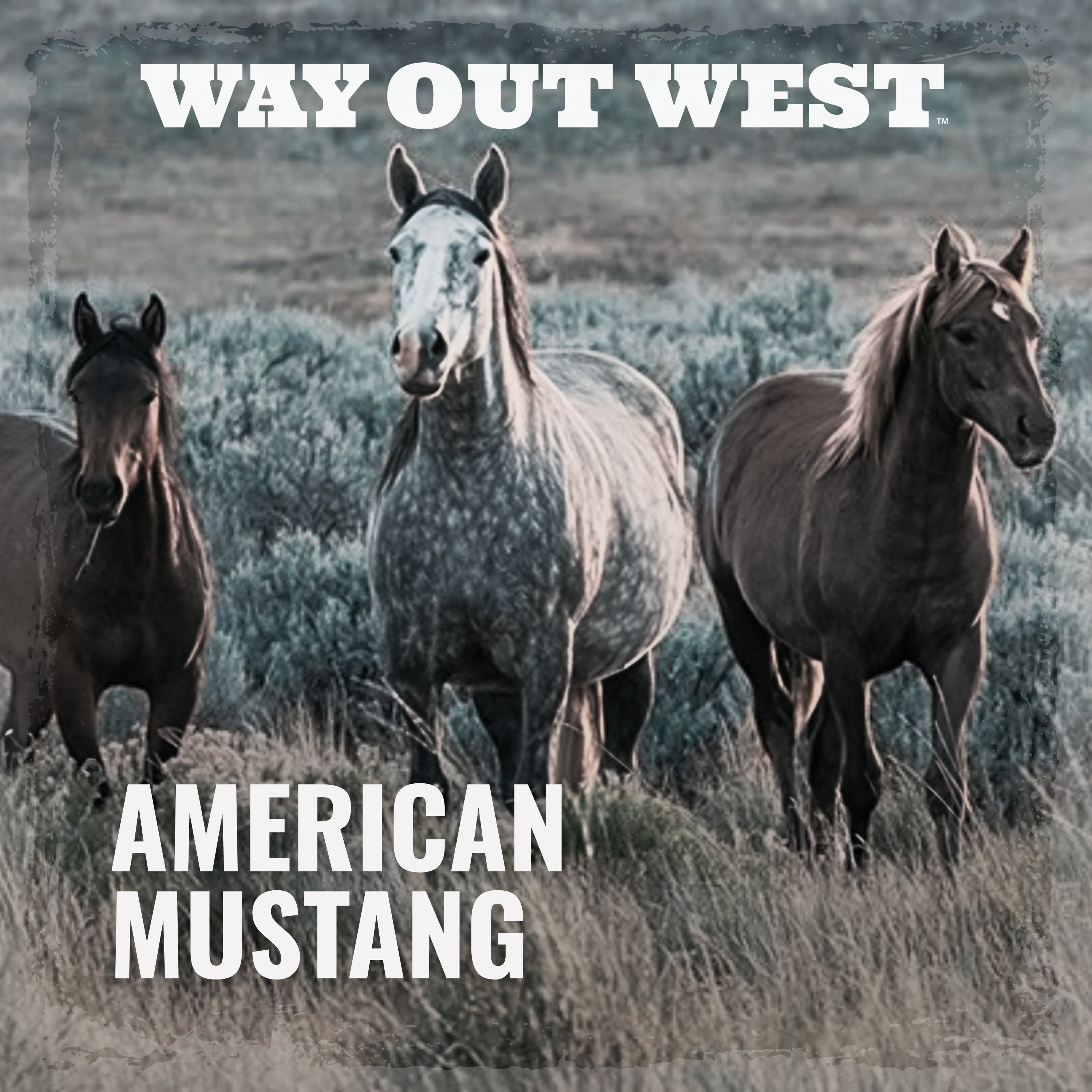
The American mustang has become one of the most enduring symbols of the West. But its real story is far more complex than most people realize. Explore the history, mythology, and modern reality behind America's iconic free-roaming horses.
American Mustang: Legend vs. Reality

Few images capture the spirit of the American West quite like a band of mustangs running across an open range. With no fences, no riders, and no destination beyond the next ridge, they have come to symbolize freedom, independence, and the untamed frontier.
But how much of that familiar story is history, and how much is mythology?
In this episode of Way Out West, we explore the remarkable history of the American mustang—from the prehistoric horses that first evolved in North America to the Spanish horses that returned centuries later and the free-roaming herds that still roam public lands today.
Along the way, we'll separate legend from reality without diminishing either. You'll discover why today's mustangs are not simply untouched descendants of conquistador horses, how Indigenous nations transformed life on horseback, why scientists and lawmakers sometimes disagree over whether mustangs should be considered "wild" or "feral," and how these iconic animals became protected by Congress in 1971.
We'll also examine the modern challenges of managing free-roaming horse populations, explore the work of Wild Horse Annie and the Bureau of Land Management, and look at how adoption and training programs continue to give thousands of mustangs new lives as trusted partners under saddle.
The American mustang may not be exactly the horse popular culture imagines. But its real story—one of extinction and return, escape and survival, adaptation and resilience—may tell us even more about the history of the American West than the legend ever could.
What You'll Hear
- Why the mustang became one of the defining symbols of the American West
- How horses evolved in North America before disappearing thousands of years ago
- The return of horses through Spanish exploration and settlement
- The origin of the word mustang and what it originally meant
- How Indigenous nations adopted and transformed horse culture across the West
- Why today's mustangs are genetically diverse rather than purely Spanish colonial horses
- The difference between "wild" and "feral" horses—and why the distinction matters
- The story behind the Wild Free-Roaming Horses and Burros Act of 1971
- Wild Horse Annie's campaign to protect America's free-roaming horses
- The modern challenges of managing mustang populations on public lands
- How adoption programs and trainers continue to demonstrate the remarkable qualities of the American mustang
- Why the legend of the mustang still matters today
Cowboy Glossary Term of the Week
Cayuse: A name once used for the tough, sure-footed horses associated with the Cayuse Tribe of the Pacific Northwest. Over time, the word came to describe hardy frontier horses known for their endurance, intelligence, and ability to thrive in rugged country.
Ride Way Out West
If you enjoyed this episode, be sure to follow Way Out West wherever you listen to podcasts.
And if you’d like to support independent storytelling about the American West, share this episode with somebody who loves cowboy history, frontier culture, and the stories that still ride on today.
Support the Show: Buy me a coffee → https://buymeacoffee.com/thecowboycpa
02:28 - Chapter 1 - The Horse We Think We Know
04:27 - Chapter 2 - A Horse Leaves... Then Comes Home
08:31 - Chapter 3 - The Legend Isn't Wrong. It's Just Incomplete.
12:50 - Chapter 4 - Freedom Has a Price
16:38 - Chapter 5 - When the West Chose to Protect the Mustang
19:19 - Chapter 6 - A Different Kind of Freedom
21:20 - Chapter 7 - Closing Reflection
23:35 - Chapter 8 – Buster the Bull & Cowboy Glossary Term of the Week
24:22 - Chapter 9 – Thanks for Listening
Every few years, another photograph captures America's imagination.
A band of horses racing across a Nevada desert.
Dust boiling behind them.
Manes flying.
Nothing but open country ahead.
We don't usually ask where those horses came from.
We don't wonder whether they're truly wild.
We simply look at them and think…
That's the American West.
But the horse that has become one of our greatest symbols of freedom has one of the most complicated histories on this continent.
It disappeared from North America…
Returned with Spanish explorers…
Escaped from ranches…
Helped transform Indigenous cultures…
Nearly vanished…
Became protected by Congress…
And today sits at the center of one of the West's most emotional debates.
The legend is real.
But the reality is even more remarkable.
[Music Up]
Howdy. Chip Schweiger, here.
Welcome to another edition of Way Out West.
Where the stories of the American West are told...
Cowboy wisdom is earned...
And the legacy of the American cowboy still rides on.
There are few sounds more unmistakably Western than the distant thunder of horses crossing open country.
Long before highways crossed the desert and fences divided the range, horses carried explorers, hunters, traders, soldiers, ranchers, and entire cultures across landscapes that seemed to stretch forever.
Somewhere along the way, one kind of horse escaped our control—and captured our imagination.
Today, the mustang has become more than an animal. It has become a symbol. Of freedom. Of resilience. Of the American West itself.
But symbols have a way of simplifying history.
And the real story is every bit as remarkable as the legend.
Just a note before we saddle up, you'll find additional resources for today's episode in the show notes at WayOutWestPod.com/mustang
Chapter 1 - The Horse We Think We Know
Welcome back.
If I asked you to picture a mustang, chances are you'd imagine a small band of horses moving across sagebrush country somewhere in Nevada, Wyoming, Utah, or Montana.
A stallion in front.
A few mares.
Young foals trying to keep up.
Dust hanging in the morning light.
It's almost impossible not to admire them.
Even people who've never owned a horse understand something instinctively when they see that image.
Freedom.
Independence.
Self-reliance.
Those aren't just Western values.
They're American values.
Maybe that's why the mustang occupies such a unique place in our imagination.
After all, we don't build monuments to coyotes.
We don't write songs about mule deer.
We certainly don't put jackrabbits on the hood of sports cars.
But horses?
That's different.
We've attached meaning to them for thousands of years.
Strength.
Loyalty.
Adventure.
Partnership.
And when those horses are running without people…
We tend to project our own hopes onto them.
The mustang becomes something almost mythical.
A reminder that somewhere beyond the pavement and the power lines, wildness still exists.
But here's a question we rarely ask.
Wild…
Compared to what?
Because the word "wild" carries more weight than most of us realize.
It suggests an animal that's always belonged exactly where it is.
Untouched by people.
Living the way nature intended.
The reality is considerably more complicated.
And that's where our story begins.
CHAPTER TWO - A Horse Leaves... Then Comes Home
One of the most surprising facts about the American horse is this:
Its story begins here.
Millions of years ago, the earliest ancestors of modern horses evolved in North America.
They spread across ancient land bridges into Asia and eventually throughout Europe and Africa.
Ironically…
While horses flourished across much of the world…
They disappeared from the continent where they first evolved.
Scientists generally agree that North American horses became extinct around ten to twelve thousand years ago, near the end of the last Ice Age.
Exactly why remains debated.
Changing climate almost certainly played a role.
Human hunting may have contributed.
Most researchers believe it was likely a combination of several pressures arriving at the same time.
Whatever the cause…
By the time Europeans reached the Americas…
There were no horses here.
Imagine North America without horses.
No cattle drives.
No Pony Express.
No mounted buffalo hunters.
No cavalry.
No stagecoaches.
No cowboys.
It becomes almost impossible to picture the West we know.
Then, beginning with Spanish exploration in the late fifteenth and early sixteenth centuries, horses returned.
Not as wild animals.
As livestock.
As transportation.
As military equipment.
The Spanish brought Andalusians, Barbs, Jennets, and other breeds that reflected centuries of horsemanship on the Iberian Peninsula.
To them, horses represented wealth and power.
They weren't meant to roam free.
But horses have always had opinions of their own.
Some escaped.
Others were stolen.
Some wandered away during storms.
Others were deliberately released when they became too difficult or expensive to keep.
Over time, those animals began reproducing across enormous landscapes.
And that's where another common misunderstanding enters the picture.
People sometimes imagine one dramatic moment when the horse suddenly spread across the West.
History is rarely that tidy.
Horses moved outward over generations.
They were traded between tribes.
Captured in raids.
Purchased from settlers.
Bred intentionally.
Lost accidentally.
Native nations didn't all become horse cultures overnight.
Some adopted horses earlier than others.
Some never relied on them to the same extent.
But for many Indigenous peoples—particularly across the Great Plains—the horse transformed nearly every aspect of life.
Travel became faster.
Hunting became more effective.
Trade expanded.
Territories changed.
Entire ways of living evolved.
It's difficult to overstate just how revolutionary the horse became.
In many ways, it reshaped the history of the West long before the cowboy ever appeared.
Meanwhile, ownerless horses continued multiplying across open country.
And people began calling them by a word borrowed from Spanish.
Mesteño.
Or mestengo.
It referred to an animal without an owner.
A stray.
An animal belonging to the common herd.
Over time, English speakers transformed the word into something we still use today.
Mustang.
Notice what that word doesn't mean.
It doesn't mean ancient.
It doesn't mean untouched.
It doesn't even necessarily mean wild.
It simply meant…
No one claimed ownership.
And that's an important distinction.
Because the legend of the mustang often imagines a single bloodline stretching back to Spanish conquistadors.
The truth…
Like most Western history…
Runs much deeper than that.
Chapter 3 - The Legend Isn't Wrong. It's Just Incomplete.
By now you've probably heard someone say it.
"Mustangs are the direct descendants of the horses brought here by the Spanish conquistadors."
There's truth in that statement.
Just not the whole truth.
Some modern mustang herds really do preserve a remarkable amount of Spanish colonial ancestry.
Herds like the Kiger in Oregon, the Cerbat in Arizona, and Utah's Sulphur herd have been studied because they retain many of the physical traits and genetics associated with early Iberian horses.
They're living reminders of some of the first horses to return to North America.
But they aren't the only story.
Think about everything that's happened across the West over the last five hundred years.
Spanish settlements.
Mexican ranches.
The fur trade.
Military forts.
The Oregon Trail.
The California Gold Rush.
Texas cattle drives.
Open-range ranching.
The U.S. Cavalry.
Every one of those chapters involved horses.
And horses have never paid much attention to property lines.
Ranch horses escaped.
Army remounts were turned loose.
Draft horses wandered off.
Thoroughbreds found their way into breeding stock.
Quarter Horse blood became common across many regions.
Generation after generation, horses mixed.
The result is that today's free-roaming herds aren't frozen in time.
They're living records of Western history.
Each herd tells a slightly different story depending on where it's lives.
That's actually far more interesting than imagining every mustang as a perfectly preserved Spanish horse.
Because the West itself was never static.
It was always changing.
Always adapting.
Always becoming something new.
And in many ways...
So were the horses.
Which brings us to another question.
One that seems simple until you try answering it.
Are mustangs...
Wild?
Or are they feral?
Biologically, the answer is fairly straightforward.
A feral animal is one descended from domesticated ancestors that now lives independently in the wild.
By that definition, modern mustangs are generally considered feral horses.
That's the language most wildlife biologists use.
But culturally...
The conversation gets more complicated.
Federal law doesn't call them feral horses.
The Wild Free-Roaming Horses and Burros Act of 1971 calls them exactly what most Americans already believed they were:
Wild free-roaming horses.
Congress went even further.
The law describes them as...
"Living symbols of the historic and pioneer spirit of the West."
Notice something.
That isn't biology.
It's culture.
It's history.
It's identity.
Horse advocates sometimes argue that calling mustangs "feral" diminishes their importance.
Others point out that horses evolved in North America long before humans domesticated them and see today's populations as something closer to a returned native species.
Most scientists don't go that far.
The horses living on today's public lands descend from domesticated animals, not from the prehistoric horses that disappeared thousands of years ago.
Those ancient populations are gone.
Today's mustangs followed a very different path.
Legally...
They're protected because Congress chose to protect them.
Scientifically...
They're generally classified as feral.
Culturally...
They're wild in almost every way that matters to the people watching them.
And maybe that's the better question.
Does an animal have to be biologically wild...
To become culturally wild?
I don't know that it does.
After all...
The bald eagle isn't powerful because we understand its taxonomy.
It's powerful because of what it represents.
The mustang has become much the same.
The legend isn't wrong.
It's just incomplete.
Chapter 4 - Freedom Has a Price
It's easy to romanticize life on the open range.
The photographs usually help.
A handful of horses.
Blue sky.
Golden light.
Miles of empty country.
What the photographs don't show...
Are August.
Or February.
A Nevada summer doesn't care whether a horse is wild or domestic.
Neither does a Wyoming blizzard.
Life on the range is beautiful.
It's also unforgiving.
Drought can dry up springs that horses have relied on for generations.
Harsh winters leave weakened animals unable to find enough forage beneath snow and ice.
Foals don't always survive.
Older horses break down.
Injuries that might be treatable in a pasture become life-threatening fifty miles from the nearest person.
Freedom has always carried risk.
That's true for people.
It's true for horses too.
Now add one more reality.
Mustangs reproduce.
A healthy mare can produce a foal every year or two.
Without enough natural predators to significantly reduce populations across much of the West, herds can grow faster than the land can support.
That doesn't mean every range is overpopulated.
Conditions vary tremendously from one Herd Management Area to another.
Rainfall changes.
Vegetation changes.
Wildlife changes.
But across the West as a whole...
Land managers face a difficult equation.
Only so much forage.
Only so much water.
More horses every year.
And suddenly the conversation shifts.
It isn't just about horses anymore.
It's about pronghorn.
Sage grouse.
Mule deer.
Cattle.
Elk.
Riparian habitat.
Public lands that belong to all Americans.
The problem is real.
People simply disagree about the solution.
Some argue gathers are essential to prevent starvation during drought.
Others believe gathers are used too aggressively.
Some support fertility-control vaccines that reduce reproduction.
Others question whether they're practical across vast landscapes.
Some believe livestock grazing should be reduced before horses are removed.
Others point out that ranching has long been part of how these public lands are managed.
And that's before anyone starts talking about budgets.
The Bureau of Land Management now cares for tens of thousands of horses that have already been removed from the range.
Feeding, veterinary care, transportation, and long-term holding cost taxpayers well over a hundred million dollars each year.
Ironically...
One of the biggest expenses in the entire program isn't managing horses on the range.
It's caring for horses that are no longer there.
None of this makes for an easy headline.
There are no cartoon villains here.
Not if we're being honest.
Most ranchers don't hate horses.
Most horse advocates genuinely care about the animals.
Wildlife biologists are trying to protect entire ecosystems.
BLM employees work within laws written by Congress.
Everyone sees part of the picture.
Very few people get to see all of it.
And maybe that's why this conversation has become so emotional.
Because nobody looks at a running band of mustangs and immediately thinks about carrying capacity.
Or range utilization.
Or appropriations bills.
We see something older than all of that.
We see freedom.
And freedom has always been difficult to manage.
Chapter 5 - When the West Chose to Protect the Mustang
By the middle of the twentieth century, America's wild horses faced a very different threat.
They weren't multiplying faster than the range could support.
They were disappearing.
Advances in transportation meant ranchers no longer depended on horses the way they once had. Trucks replaced wagons. Tractors replaced teams. Many free-roaming horses were rounded up for pet food, animal feed, and other commercial uses.
Some gathers were conducted humanely.
Others were anything but.
One day in the 1950s,
Velma Johnston found herself driving behind a truck loaded with captured wild horses on a Nevada highway.
Blood dripped from the trailer onto the pavement.
The image haunted her.
She later said she couldn't stop thinking about it—
and decided somebody had to speak for the horses.
Most people now know her as Wild Horse Annie.
She wasn't a scientist.
She wasn't a politician.
She was simply someone who believed these horses deserved better.
She began writing letters, organizing supporters, speaking to schoolchildren, and urging lawmakers to act.
Her campaign eventually grew into a national movement.
In 1971, Congress passed the Wild Free-Roaming Horses and Burros Act.
The law declared that these animals were "living symbols of the historic and pioneer spirit of the West" and placed them under federal protection on designated public lands.
It was an extraordinary moment.
Americans weren't just protecting an animal.
They were protecting an idea.
But history has a way of presenting new challenges.
The law succeeded.
Perhaps better than anyone imagined.
The horses survived.
Many herds grew.
And over time, the very success of the law created a new question.
How do you protect a symbol... when protecting it becomes increasingly difficult?
Today, the Bureau of Land Management is responsible for balancing healthy horse populations with the health of the land itself.
That means difficult decisions.
Gathering horses from some areas.
Offering them for adoption.
Using fertility control in selected herds.
Caring for tens of thousands of horses that have already been removed from the range.
None of those choices satisfy everyone.
Perhaps they never will.
But there is one part of the story that often gets overlooked.
Not every mustang's story ends behind a fence.
For thousands of them...
It's only just beginning.
Chapter 6 - A Different Kind of Freedom
Spend enough time around experienced horsemen, and eventually you'll hear someone say something surprising.
"There isn't much like a good mustang."
Not because they're easy.
Quite the opposite.
Mustangs ask something of the people who train them.
Patience.
Consistency.
Feel.
You can't bully one into becoming a willing partner.
You have to earn it.
Across the country, adoption programs have given thousands of these horses new homes.
Organizations host competitions like the Extreme Mustang Makeover, where trainers have just a few months to gentle, train, and demonstrate what these horses can become.
Prison training programs have paired incarcerated trainers with mustangs, creating second chances for both horse and human.
Some adopted mustangs have gone on to become dependable ranch horses.
Others compete in trail challenges, endurance riding, dressage, and working equitation.
Many simply become trusted companions.
That doesn't mean every mustang is right for every owner.
Far from it.
These horses require knowledgeable handling, appropriate facilities, and a willingness to let trust develop over time.
Some adapt quickly.
Others take months.
Or years.
But perhaps that's fitting.
The horse that survived on its own isn't likely to hand over its confidence all at once.
And when it finally does...
Horsemen will tell you it's something special.
Maybe that's because a trained mustang never completely loses the qualities that allowed its ancestors to survive.
Awareness.
Sure-footedness.
Resilience.
An ability to think for itself.
Those aren't flaws.
They're exactly what kept generations of horses alive on some of the harshest landscapes in North America.
Chapter 7 - Closing Reflection
So...
What do we make of the American mustang?
Is it a wild animal?
A feral horse?
A symbol?
A management challenge?
The answer...
Is yes.
To all of it.
The legend isn't wrong.
It's just incomplete.
The mustang isn't a frozen relic from the days of the conquistadors.
It isn't untouched by people.
It isn't separate from the history of the American West.
It is that history.
A story of extinction...
And return.
Of escape...
And adaptation.
Of Indigenous horse cultures...
Spanish colonists...
Mexican ranchos...
American cowboys...
Army remounts...
Open ranges...
Public lands...
And ordinary citizens who decided some things were worth saving.
The horse that came to symbolize untouched wilderness is, in many ways, a product of human history.
At first, that sounds like a contradiction.
But maybe it isn't.
Maybe that's exactly what the American West has always been.
A place where nature and people have shaped one another for centuries.
Where history rarely fits into neat categories.
Where legends grow from real events, even if they smooth away the rough edges.
And maybe that's why, when we see a band of mustangs disappear over a distant ridge, we still stop and watch.
Ranchers do.
Biologists do.
Photographers do.
Tourists do.
For just a moment...
Nobody is thinking about grazing permits.
Or genetics.
Or appropriations.
They're simply watching horses run.
And somewhere deep inside, they recognize something that feels bigger than the horses themselves.
Not because the mustang represents a West that never changed.
But because it reminds us that the West never stopped changing.
The mustang doesn't have to be exactly what the legend says it is.
Because the truth is...
Its real story—one of extinction and return, escape and survival, people and the land—is every bit as extraordinary.
The American mustang didn't inherit the history of the West. It lived it.
Chapter 8 – Buster the Bull & Cowboy Glossary Term of the Week
OK, before we ride out today, we’ve got one more thing
[BULL SOUND]
Yep, that distinctive call from Buster the Bull means it’s time again for our cowboy glossary term of the week.
Today's term is Cayuse.
Historically, a cayuse referred to a small, tough horse of the Northwest—particularly those associated with Native peoples of the Columbia Plateau. The name comes from the Cayuse Tribe of present-day Oregon, who became renowned horse breeders after acquiring horses in the early 1700s. Small and powerful, the cayuse is an exceptional horse.
Like the mustang itself, it's a reminder that a horse doesn't have to be large or fancy to earn respect.
[MUSIC UP AND FADE]
Chapter 9 – Thanks for Listening
Well, that’s all for this episode of Way Out West. Thanks for riding with me here
If you enjoyed the episode, please follow, rate, and share the show
with someone who loves the history, culture, and traditions of the American West.
And if you'd like to see more of the work we're doing,
you can visit RideWayOutWest.com.
And while you're there, take a few minutes to explore the Way Out West Journal, where we dive even deeper into the people, places, and history that continue to shape the West today.
That’s RideWayOutWest.com
Until next time…this is Chip Schweiger reminding you…
The West wasn't built in black and white.
It's a landscape of stories—some celebrated, some forgotten, and most far more complicated than we first imagine.
We’ll see ya down the road.