Why We Still Love Old Westerns
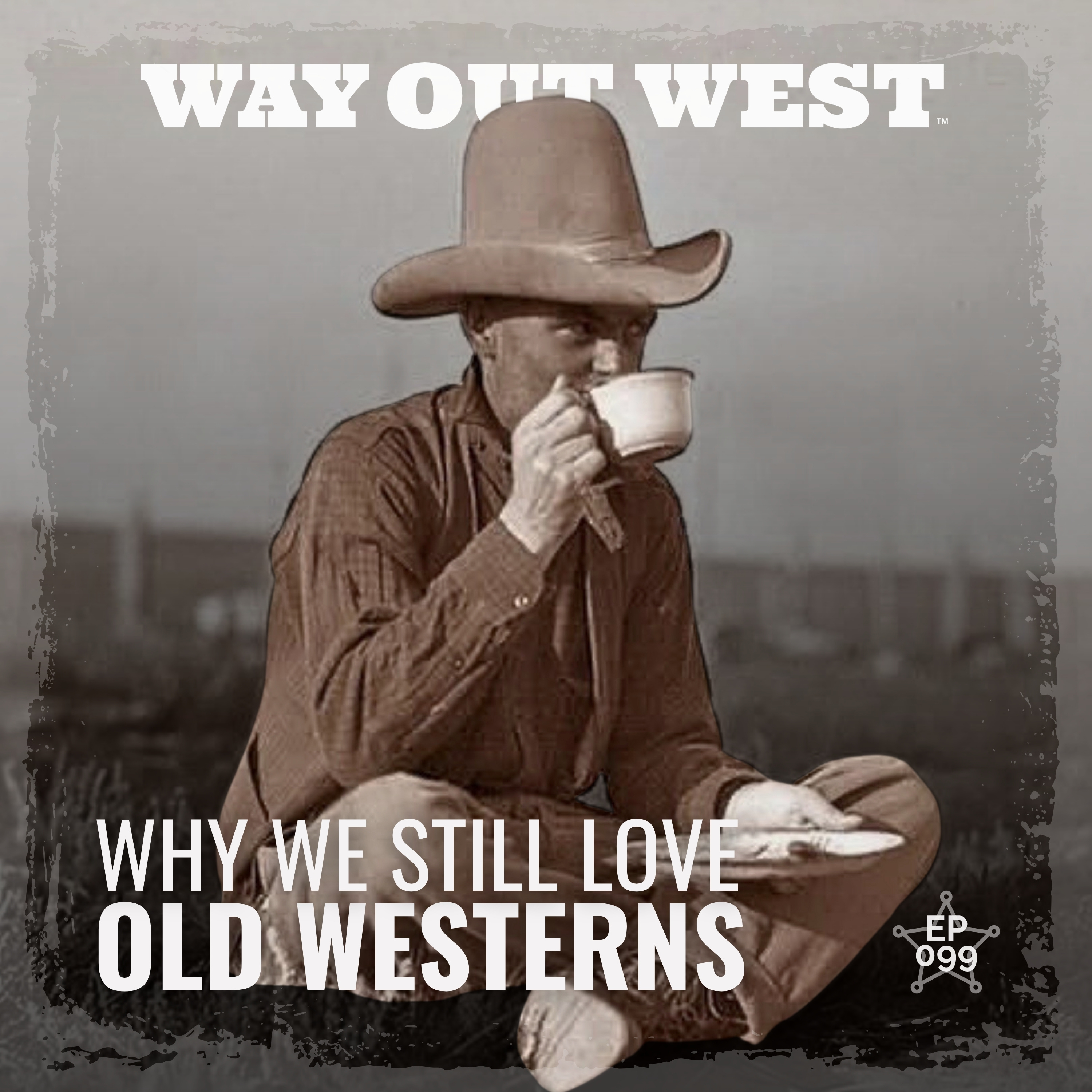
Classic Westerns continue to captivate audiences because they speak to timeless virtues like courage, integrity, hard work, and hope. Discover why these stories endure, and why perhaps we're nostalgic less for the Old West than for the character it encouraged us to admire.
Why We Still Love Old Westerns

Why do classic Westerns continue to captivate audiences long after the frontier closed?
From The Man from Laramie and Shane to High Noon, The Searchers, Gunsmoke, and Bonanza, generations of viewers have returned to these stories—not simply because of gunfights or horseback chases, but because they explore timeless questions about courage, honor, responsibility, and character.
In this episode of Way Out West, we look beyond Hollywood to examine why Westerns continue to resonate in the modern world. While the real American West was often far more complicated than the movies portrayed, these stories captured virtues that still speak to us today: keeping your word, working hard, helping your neighbors, and doing the right thing even when it's difficult.
Perhaps we aren't nostalgic for the Old West itself.
Perhaps we're nostalgic for the values these stories encouraged us to admire.
What You'll Hear
- Why classic Westerns continue to resonate across generations
- The difference between Western history and Hollywood mythology
- The enduring appeal of courage, integrity, and self-reliance
- Why craftsmanship and competence remain deeply satisfying
- The overlooked importance of community in the American West
- How the frontier became a test of character rather than simply a place
- Why Western stories continue to offer hope during uncertain times
Cowboy Glossary Term of the Week
Alamar Knot: A decorative knot used to tie a mecate around a horse’s neck. In traditional Old California horse training, when a horse had graduated to become a finished bridle horse, the Alamar knot was tied from two coils of a mane hair mecate draped over the horse’s neck, and the knot was worn on the horse’s chest to denote him as a bridle horse.
Listen Now
Whether you've watched Westerns your entire life or are discovering them for the first time, this episode explores why these stories continue to matter, and why the virtues they celebrate remain as relevant as ever.
Because maybe we don't miss the Old West.
Maybe we simply miss the kind of people we hoped we could become.
00:42 - Intro
02:24 - Chapter 1 — More Than Nostalgia
03:43 - Chapter 2 — The Land Itself
04:56 - Chapter 3 — Character Over Comfort
06:09 - Chapter 4 — Nobody Built the West Alone
07:14 - Chapter 5 — The Frontier Lives Inside Us
08:18 - Chapter 6 – Closing Thoughts
10:04 - Chapter 7 – Buster the Bull & Cowboy Glossary Term of the Week
10:57 - Chapter 8 – Thanks for Listening
I'm sitting here with a cup of coffee watching The Man from Laramie, and it got me wondering why so many of us still love these old Westerns.
I've seen this movie before.
I already know how it ends.
I know who's honorable.
I know who's broken.
I know who's hiding behind pride.
And yet, every time I watch it, I find myself settling into the story all over again.
It isn't just this film.
It's Shane.
High Noon.
The Searchers.
Episodes of Gunsmoke and Bonanza that I've probably seen a dozen times over the years.
Something keeps drawing us back.
And I don't think it's simply nostalgia.
I think it's something deeper.
[Music Up]
Howdy. Chip Schweiger, here.
Welcome to another edition of Way Out West.
Where the stories of the American West are told...
Cowboy wisdom is earned...
And the legacy of the American cowboy still rides on.
The American West has always occupied a unique place in our imagination.
It's a land of distant mountains.
Open skies.
Long trails.
And people who often had to depend on little more than their own judgment, their own hands, and the people beside them.
The real West, of course, was never as simple as the movies sometimes suggested.
It was complicated.
Often unfair.
Sometimes violent.
Filled with hardship and people from every imaginable background trying to build lives under difficult circumstances.
Hollywood smoothed over many of those rough edges.
But perhaps that's why these stories continue to matter.
Not because they always told history perfectly.
But because they explored something timeless about being human.
After the episode, check out the show notes at WayOutWestPod.com/old-westerns
Chapter 1 — More Than Nostalgia
Welcome back.
When people talk about old Westerns today, they'll often smile and say,
"They just don't make movies like that anymore."
Maybe that's true.
But I don't think what we miss is slower pacing or black-and-white film.
I think we miss clarity.
Classic Westerns often presented people facing difficult choices.
Sometimes the choice came at tremendous personal cost.
Do the right thing...
Or do the easy thing?
Stand your ground...
Or walk away?
Protect someone weaker...
Or protect yourself?
Real life rarely feels that clean.
History certainly wasn't.
The frontier was filled with moral ambiguity.
There were good people who made terrible decisions.
There were flawed people capable of remarkable courage.
There were heroes who carried serious faults.
And there were villains who believed they were justified.
That's real history.
Yet Westerns distilled those complexities into stories that helped us think about character.
Not because life is simple.
But because our values often are.
Honesty still matters.
Courage still matters.
Keeping your word still matters.
Even if we don't always live up to those ideals.
That's what those stories remind us.
Chapter 2 — The Land Itself
Of course...
Part of the attraction is simply the West.
Those enormous skies.
Snow-covered peaks.
Desert sunsets.
Miles of prairie where the horizon seems to go on forever.
Even people who've never been west of New York recognize those landscapes.
They represent freedom.
Possibility.
Room to breathe.
The landscape almost becomes another character.
It doesn't care who you are.
It doesn't bend to your wishes.
It asks something of you.
Whether it's crossing a mountain pass...
Finding water...
Or simply surviving another winter.
That's true in films like The Searchers.
The scenery isn't just beautiful.
It's indifferent.
Sometimes breathtaking.
Sometimes unforgiving.
Just like the real West.
Maybe that's part of why these films still resonate.
Most of us spend our days surrounded by traffic, notifications, meetings, and schedules.
Watching someone ride across open country reminds us that there are still places where the world feels larger than ourselves.
Chapter 3 — Character Over Comfort
One thing you'll notice in old Westerns...
Very few people are waiting for someone else to solve their problems.
The rancher fixes the fence.
The blacksmith repairs the wagon.
The sheriff walks toward danger.
The schoolteacher keeps teaching.
Everyone has a role.
Everyone contributes.
That doesn't mean they succeed every time.
Sometimes they fail.
Sometimes they lose everything.
But they still shoulder responsibility.
That's something we don't celebrate as often anymore.
Competence.
There's something deeply satisfying about watching someone who knows their craft.
A cowboy handling a difficult horse.
A saddle maker building something meant to last decades.
A ranch cook feeding twenty hungry hands before sunrise.
A marshal who understands people as well as he understands a six-shooter.
These aren't glamorous skills.
They're useful skills.
The truth is...
Competence builds confidence.
Hard work builds dignity.
Craftsmanship creates meaning.
That's as true today as it was then.
Chapter 4 — Nobody Built the West Alone
One of the biggest myths Westerns created is the image of the lone cowboy.
The solitary rider disappearing into the sunset.
It's a wonderful image.
But it isn't how most people actually lived.
Real ranches depended on crews.
Trail drives depended on teamwork.
Small towns survived because neighbors relied on one another.
If a barn burned...
People showed up.
If someone got sick...
Meals appeared.
If a family lost livestock...
Neighbors often pitched in.
Even in television shows like Gunsmoke or Bonanza, the stories weren't really about isolation.
They were about community.
About people disagreeing...
Failing...
Forgiving...
And helping one another anyway.
The frontier demanded independence.
But it also demanded cooperation.
Maybe that's something we quietly long for today.
Not isolation.
Belonging.
Chapter 5 — The Frontier Lives Inside Us
Perhaps the most important thing Westerns ever taught us...
Is that the frontier isn't only a place.
It's a test.
Every generation has its own frontier.
Sometimes it's financial hardship.
Sometimes illness.
Sometimes raising children.
Starting over.
Losing someone you love.
Beginning a new career.
The details change.
The challenge doesn't.
Character is still forged the same way.
One difficult decision at a time.
One promise kept.
One setback overcome.
One act of courage nobody else ever sees.
That's why stories like High Noon continue to matter.
Not because most of us will ever face an outlaw gang at noon.
But because every one of us eventually finds ourselves standing alone, wondering whether we'll do what's right when it's inconvenient.
That's the frontier.
And every generation eventually rides into it.
Chapter 6 – Closing Thoughts
Maybe that's why these old Westerns continue to find new audiences.
Not because they're flawless.
Not because they're perfectly accurate.
And certainly not because they tell the whole story of the American West.
They don't.
The real West was richer than that.
More diverse.
More complicated.
More difficult.
History deserves to be understood honestly.
But stories serve a different purpose.
They help us imagine the people we'd like to become.
When we watch those old Westerns, I don't think we're wishing to live without electricity...
Or air conditioning...
Or modern medicine.
I don't think we're nostalgic for cattle drives or frontier hardship.
I think we're nostalgic for something else entirely.
For neighbors who could be counted on.
For work that meant something.
For people who kept their word.
For courage that wasn't loud.
For competence that didn't need applause.
For sacrifice that expected nothing in return.
For hope that tomorrow could be better if you were willing to do your part today.
Those aren't Western values.
They're human values.
The cowboy simply became one of the most recognizable symbols carrying them.
Maybe that's why these stories refuse to fade away.
Because every generation needs reminders that character still matters.
That integrity is still worth something.
That perseverance still changes lives.
And that even in a complicated world, there is still honor in trying to do the right thing.
The myth survived.
But the virtues behind it are still worth riding toward.
And perhaps that's the real reason we still love old Westerns.
Chapter 7 – Buster the Bull & Cowboy Glossary Term of the Week
OK, before we ride out today, we’ve got one more thing
[BULL SOUND]
Yep, that distinctive call from Buster the Bull means it’s time again for our cowboy glossary term of the week.
And this week’s term is an ALAMAR KNOT
Now, I’m not sure if we’ve talked about this one before, but we’re going talk about it again.
So, an Alamar Knot is a decorative knot used to tie a mecate around a horse’s neck.
In traditional Old California horse training, when a horse had graduated to become a finished bridle horse,
the Alamar knot was tied from two coils of a mane hair mecate and draped over the horse’s neck.
And that knot worn on the horse’s chest denotes him as a finished bridle horse.
Alamar Knot.
Something earned, not something simply given away.
[MUSIC UP AND FADE]
Chapter 8 – Thanks for Listening
Well, that’s about all for this week’s episode. Thanks for riding with me here, Way Out West
If you enjoyed the episode, please follow, rate, and share the show
with someone who loves the history, culture, and traditions of the American West.
And if you'd like to see more of the work we're doing,
you can visit RideWayOutWest.com.
There you'll find articles, a mercantile, the podcast archive, and more resources for fans of the American West.
That’s RideWayOutWest.com
Until next time…
this is Chip Schweiger reminding you…
that the greatest frontiers have never been found on a map.
They're found in the choices we make every day.
We’ll see ya down the road.