Riding Shotgun: The Deadliest Job in the Old West
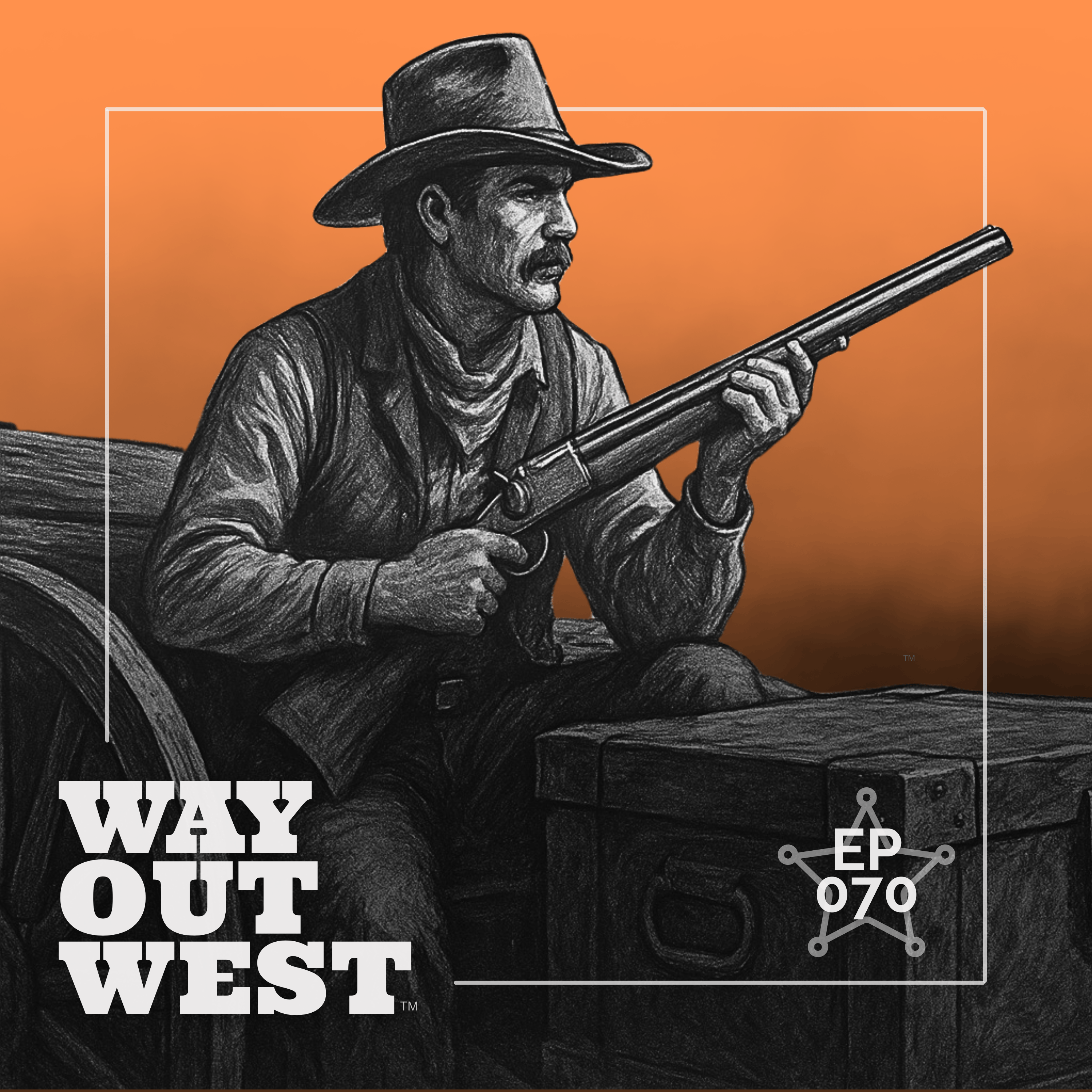
Riding shotgun wasn’t just a seat on a stagecoach — it was the deadliest job in the Old West. This episode takes you onto the box seat with the fearless shotgun messengers who guarded gold shipments, battled outlaws, and kept the frontier moving.


When most folks picture a stagecoach, they think of passengers bouncing across the prairie or teams of horses pulling hard through the dust. But up on the front seat — high, exposed, and staring straight into danger — rode the most vital man on the trail: the stagecoach shotgun messenger.
Their mission was simple, but deadly serious: protect the strongbox at all costs.
In this episode of Way Out West, ride right into the heart of the frontier to meet the men who guarded gold shipments, stared down outlaw gangs, and kept the wheels of the West turning. You’ll hear how shotgun messengers were chosen, what weapons they carried, and why outlaw bands like Black Bart and Rattlesnake Dick feared the steady-eyed guard riding beside the driver.
We dig into real ambush tactics, legendary messengers such as Bob Paul, the difference between dime-novel myth and hard frontier fact, and the gritty professionalism that defined this forgotten role. These were men who didn’t blink, didn’t freeze, and didn’t ride in that seat unless they were ready for anything.
Saddle up and ride along. This is one episode you won’t want to miss.
What You’ll Hear in This Episode
Why shotgun messengers had the most dangerous job on the stagecoach
The weapons, gear, and tactics they relied on
Real ambush scenarios and how messengers responded
The legendary figures who defined the role
The rules, written and unwritten, of guarding the strongbox
- What we can all take away from how these protectors did their job
Cowboy Glossary: Term of the Week
Chasing the Sun — A cowboy phrase meaning to ride hard and make the most of the daylight ahead. A reminder that opportunity, safety, and a day’s work were often defined by the light left in the sky.
Further Reading & Related Episodes
EP 49 - Riding Against the Clock: How the Pony Express Changed the West
Shotguns and Stagecoaches: The Brave Men Who Rode for Wells Fargo in the Wild West
(As an Amazon Associate, I earn from qualifying purchases. These recommendations help support the show at no extra cost to you.)
Enjoying the ride? Saddle up with us:
- Transcript: For a full transcript of this episode, click on "Transcript"
- Your Turn! Share your thoughts → howdy@cowboyaccountant.com
- Support the Show: Buy me a coffee → https://buymeacoffee.com/thecowboycpa
- Follow Along: Instagram → https://www.instagram.com/RideWayOutWest
02:41 - Chapter 1: The Hardest Seat on the Stagecoach
04:01 - Chapter 2: The Weapons of the Messenger
05:18 - Chapter 3: Outlaws and Ambushes
06:40 - Chapter 4: Famous Messengers Who Rode Shotgun
07:44 - Chapter 5: Rules of the Job and They Weren't Just Suggestions
08:29 - Chapter 6: A Real Robbery and a Real Fight
09:28 - Chapter 7: The Decline of the Shotgun Messenger
10:06 - Chapter 8: Closing Reflections and Carry Your Own Strongbox
10:52 - Chapter 9: Buster the Bull & the Cowboy Glossary Term of the Week
11:40 - Chapter 10: Thanks for Listening
The trail was quiet.
Too quiet.
The kind of quiet that made seasoned men sit a little straighter in the box seat.
Because out on the stagecoach lines, danger didn’t announce itself.
It hid in the rocks.
It waited in the brush.
And when it came, it came fast.
That’s why one man rode with a shotgun across his lap and eyes that never stopped scanning the horizon.
He wasn’t there for show.
He was there because outlaws feared him more than the strongbox they were after.
[MUSIC]
Howdy. Chip Schweiger, here. Welcome to another edition of Way Out West.
The podcast that takes you on a journey through the stories of the American West, brings you the very best cowboy wisdom, and celebrates the cowboys and cowgirls—who are feeding a nation.
The road was a dust ribbon twisting through the badlands.
Shadows long.
Air still.
And the only sound was the creak of leather and the steady clatter of horses on the trail.
Up on the driver’s box, a man sat beside the reinsman.
Wide-brim hat pulled low.
Double-barreled shotgun cradled across his lap.
Eyes never resting.
He watched the ridges. The arroyos. The tree lines.
Because he knew something, the passengers inside the coach didn’t.
Danger didn’t always come with a shout.
Sometimes it whispered.
A glint of sunlight on steel.
A horse snort carried on the wind.
The quick flicker of movement behind a boulder.
And if you were the shotgun messenger…
You needed to see it before anyone else did.
So today on the show, we’re talking about the wildest, most dangerous job in the Old West—the men who rode shotgun on stagecoaches.
The last line of defense between outlaw gangs and the strongbox of gold locked beneath their boots.
These weren’t hired guns looking for trouble.
They were professional protectors.
Sharp-eyed, steady-handed, and cool under fire.
The kind of men who didn’t blink when fate stared them down.
After the episode, check out the show notes at WayOutWestPod.com/riding-shotgun
[MUSIC]
Welcome back.
Today, we’re climbing up onto the box seat of a thundering stagecoach and riding beside the men who carried the most dangerous job in the Old West — the shotgun messenger.
The ones who guarded the strongbox, watched the ridgelines, and faced down outlaws with nerves of steel.
Chapter 1: The Hardest Seat on the Stagecoach
It wasn’t glamorous.
And it wasn’t for the faint of heart.
The shotgun messenger sat to the right of the driver—high, exposed, and in full view of anyone with bad intentions.
The position had a purpose.
From up there, he had a clear field of fire.
A commanding view of every bend in the trail.
And the advantage of surprise—if he was good enough to hold it.
These men weren’t just muscle.
They were trusted employees of Wells Fargo, Butterfield Overland, and dozens of regional coach lines.
They transported fortunes.
Gold dust.
Currency.
Payroll shipments.
Important papers.
The messenger wasn’t guarding the passengers.
Not really.
He was guarding the box.
And the box—well—that was everything.
It was bolted to the floor.
Locked.
Reinforced.
And the messenger’s key never left his body.
Even in death, some men had that key recovered from their cold fingers.
That’s how serious the job was.
A stagecoach carried people.
But the shotgun messenger carried the West’s economy on his shoulders.
Chapter 2: The Weapons of the Messenger
Let’s talk gear.
Because these men didn’t ride with just anything.
The signature tool?
A 10-gauge or 12-gauge double-barrel shotgun.
Short barrel.
Wide spread.
Devastating at close range.
It wasn’t for hunting.
It wasn’t for show.
It was built for stopping power.
And here’s the important part:
Most messengers didn’t load both barrels the same.
One barrel was packed with buckshot—for reaching a little distance.
The other with birdshot—for up close.
Why?
Because fights happened fast.
Real fast.
And the messenger needed to choose his response in the blink of an eye.
Some also carried:
· A Colt Navy or Colt Peacemaker
· A Henry or Winchester repeating rifle
· A hidden backup pistol, often tucked in a boot
But the shotgun…
That was the calling card.
The symbol.
The reason we still say riding shotgun today.
You didn’t touch that weapon unless you meant it.
And you didn’t ride with it unless you knew how to use it.
Chapter 3: Outlaws and Ambushes
A stagecoach robbery wasn’t like the movies.
Nobody lined up politely.
Nobody fired warning shots.
Nobody waited for the perfect cinematic moment.
Robbers attacked at choke points:
· Narrow canyons
· Creek crossings
· Tight bends in the trail
· Heavy brushlines
Think of names like: Black Bart, The Davis Gang, The Whipple Robbers, Rattlesnake Dick, The Mason Henry Gang
These weren’t random drifters.
They were organized.
They studied routes.
They watched habits.
They counted shipments and collected rumors.
Some were gentlemen bandits.
Some were vicious killers.
A few were failed cowboys, ranch hands, or Civil War vets with nowhere else to go.
And every single one of them feared a good shotgun messenger.
Because seasoned messengers were fast.
Cold-blooded in a crisis.
And more than a few had reputations that preceded them.
Shootouts were quick.
Ten seconds.
Maybe twelve.
The messenger rarely had cover.
Rarely had warning.
But he did have resolve.
And that gave him an edge.
Chapter 4: Famous Messengers Who Rode Shotgun
Let’s talk about the legends.
Because this job produced some remarkable men.
Boone May: Fearless. Unflinching. Once took down three outlaws in a single ambush.
Jack Slade: Hard man. Fast temper. But one of the most respected protectors on the Overland Stage Line.
Hank Monk: More famous as a driver—but he often doubled as a shotgun.
Mark Twain wrote about him.
Bob Paul: Probably the most skilled shotgun messenger of all. Sharpshooter. Future lawman. Foiled a robbery so effectively that the gang swore off attacking any coach he was riding on.
And then there was the nameless majority—the ones who never made it into dime novels but kept the frontier running.
The quiet men.
The steady men.
The ones who got the job done and went home.
Those were the backbone of the West.
Chapter 5: Rules of the Job and They Weren't Just Suggestions
Stagecoach companies had strict policies for their messengers.
Never drink on duty. Ever.
Never fall asleep. Not even for a moment.
Never let passengers see the strongbox open.
Never advertise what you were carrying.
Never trust the quiet stretch of road.
Because that’s where the danger lived.
Messengers also developed their own unwritten rules:
· Always reload before you need to.
· Always scan the ridgelines.
· Never assume a fallen tree is just a fallen tree.
· If the driver tenses, you tense.
· And never—ever—freeze.
They were professionals.
And they acted like it.
Chapter 6: A Real Robbery and a Real Fight
Let’s walk through a true story.
Tombstone. 1881.
A stage was making its run from Bisbee, loaded with silver bullion.
Bob Paul was the shotgun messenger that day.
The night was quiet.
No moon.
Just the creak of the coach and the steady clop of horses.
Then—
A shout.
Gunfire.
A pack of masked riders came out of the dark.
The driver was hit instantly.
Bob Paul grabbed the reins with one hand, braced with his boot, and fired with the other.
Boom.
Boom.
Two outlaws fell.
A third turned tail.
The rest scattered.
Paul kept that coach upright—alone—steering and shooting and refusing to give that strongbox up.
When the dust settled, the shipment was intact.
That’s the difference a single good messenger could make.
Chapter 7: The Decline of the Shotgun Messenger
As railroads pushed west, stage lines declined.
Bank transfers replaced strongboxes.
Law enforcement became more organized.
By the early 20th century, the job of shotgun messenger faded into history.
A relic of a rougher time.
But its legacy stayed.
The grit.
The readiness.
The silent courage.
It lived on in cowboy stories.
In movies.
In the phrase riding shotgun.
And in the idea that sometimes the person beside you is the one keeping the whole operation alive.
Chapter 8: Closing Reflections and Carry Your Own Strongbox
There’s a little cowboy wisdom in this old job.
Shotgun messengers didn’t chase glory.
They didn’t brag.
And they didn’t go looking for a fight.
They just showed up.
Prepared.
Focused.
Alert.
Responsible for what they carried.
In your life.
Your work.
Your ranch.
Your business.
You’ve got your own strongbox to protect.
Your values.
Your reputation.
Your family.
Your clients.
Your word.
Nobody else is riding shotgun for you.
And nobody else can.
Sometimes doing the right thing means sitting in the hardest seat.
The most exposed seat.
The place where danger comes first.
And sometimes—
That’s exactly where you’re needed.
Chapter 9: Buster the Bull & the Cowboy Glossary Term of the Week
Well, before we finish up this week, we’ve got one more thing.
Yep, that distinctive call from Buster the Bull means it’s time for the Cowboy Glossary term of the week, and this week’s term is "Chasing the Sun"
Chasing the Sun is a phrase cowboys used for long rides where the goal was simple: stay in the daylight and cover as much country as possible before nightfall.
Sometimes it meant pushing a herd.
Sometimes it meant racing a storm.
And sometimes it meant making it home before darkness set in.
A reminder that in the West, daylight was more than light.
It was opportunity.
Safety.
And the measure of a day’s work.
Chapter 10: Thanks for Listening
Well, that’s about all for this episode of Way Out West.
I appreciate you spending part of your day with me — and hope you enjoyed diving into the wild world of the stagecoach shotgun messenger.
If you enjoyed the show, please consider sharing it with a friend who loves a good Western tale. That helps us reach more fans of the American West.
And don’t forget to drop us a review on your favorite podcast app, and connect with us on Instagram and Facebook.
Next time on Way Out West, we’re stepping into the life of one of the most influential, complicated, and legendary figures in frontier history… Kit Carson.
Scout. Explorer. Frontiersman.
A man whose name is carved into maps and stories across the West, and whose real life was far bigger — and more conflicted — than the dime novels ever told.
And before I head out, I’ve got a little news from the trail…
The Way Out West Mercantile is officially on the horizon.
And this is something I’ve wanted to do for a while. It’s a place for Western books, gear, gifts, and hand-picked items that fit the cowboy lifestyle — whether you’re living it every day or just carrying a little piece of the West with you.
More details soon.
Until next week, this is Chip Schweiger reminding you that the West belongs to those who keep riding.
We’ll see ya down the road.