The Alamo: Thirteen Days That Changed America Forever
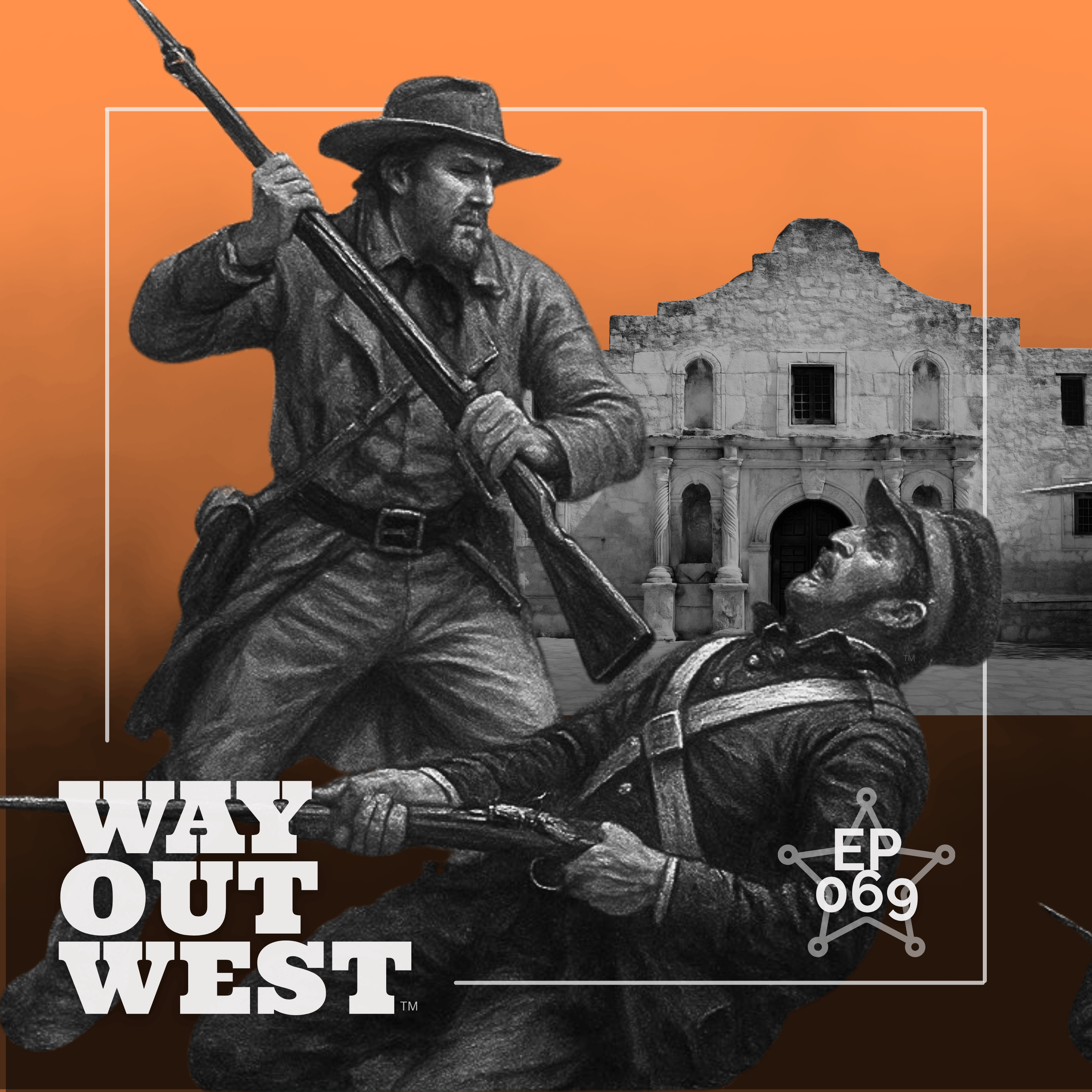
Step inside the Alamo during thirteen days of courage, fear, and defiance. This episode walks through the siege moment by moment and explores how the battle shaped Texas independence, fueled America’s expansion west, and became one of the West’s most enduring legends.


For thirteen days in 1836, a battered Spanish mission transformed into the most unlikely fortress on the frontier. Inside, a small band of Texians, Tejanos, volunteers, and adventurers held their ground against Santa Anna’s massive army — not because they expected victory, but because they believed the stand mattered.
This episode of Way Out West takes you inside the walls of the Alamo with cinematic, moment-by-moment storytelling. You’ll hear the thunder of the Mexican artillery, the defiant courage of Travis and Bowie, the arrival of the “Immortal 32,” and the desperate final battle in the predawn darkness of March 6th.
In the second half of the episode, we explore how the Alamo’s legacy grew beyond the battle itself — becoming a symbol of independence, sacrifice, and the frontier spirit that continues to shape the American West. This isn’t myth-making. It’s a deeper reflection on how memory becomes meaning, and why the Alamo still echoes today.
What You'll Hear in This Episode
A cinematic retelling of the thirteen-day siege
The leadership and legacy of Travis, Bowie, and Crockett
The arrival of the “Immortal 32”
The predawn final assault and fall of the Alamo
How “Remember the Alamo” became a defining rallying cry
Why the battle still shapes our ideas of courage and independence
Cowboy Glossary Term of the Week
In cowboy talk, Backbone means courage with a steel frame. Not the loud kind or the showy kind — the kind that keeps a person steady when everything around them is coming apart. Out on the range, a cowboy with backbone didn’t flinch when the storm rolled in or when the herd got restless. He stayed put. He held fast. He did the hard thing because it was the right thing.
Further Resources
A Time to Stand by Walter Lord
The Blood of Heroes by James Donovan
Texas State Historical Association: “Battle of the Alamo”
The Alamo official site & museum archives
Enjoying the ride? Saddle up with us:
- Transcript: For a full transcript of this episode, click on "Transcript"
- Your Turn! Share your thoughts → howdy@cowboyaccountant.com
- Support the Show: Buy me a coffee → https://buymeacoffee.com/thecowboycpa
- Follow Along: Instagram → https://www.instagram.com/RideWayOutWest
02:30 - Chapter 1: The Siege Begins
04:13 - Chapter 2: Travis, Bowie, and the Men Behind the Walls
06:20 - Chapter 3: Thirteen Days of Fire and Fear
07:15 - Chapter 4: The Final Assault
08:22 - Chapter 5: Memory Becomes Myth
09:17 - Chapter 6: What the Alamo Still Means Today
12:28 - Chapter 7: Buster the Bull & the Cowboy Glossary Term of the Week
13:22 - Chapter 8: Thanks for Listening
The year is 1836. Dawn breaks over a crumbling Spanish mission on the edge of a newborn Texas — and inside those battered walls, two hundred defenders tighten their belts, check their rifles, and brace for what they know is coming.
Outside, thousands gather under blood-red banners, preparing to crush the rebellion in one decisive blow. But inside the Alamo… something unbreakable is taking shape. Courage. Defiance. And a stand the world will never forget.
[MUSIC]
Howdy. Chip Schweiger here. Welcome to another edition of Way Out West.
The podcast that takes you on a journey through the stories of the American West, brings you the very best cowboy wisdom, and celebrates the cowboys and cowgirls—who are feeding a nation.
Night settles differently on old battlegrounds. The air gets heavier, the shadows a little deeper, as if the past is still pacing behind the walls.
And if you’ve ever stood inside the Alamo after closing time — when the last footsteps fade and the mission goes silent — you can almost feel the echo of what happened there.
The courage.
The fear.
The stubbornness that borders on myth.
So today on the show… we’re stepping into those thirteen days when a dusty frontier mission became the crucible of independence. A place where ordinary men dug in their heels against impossible odds — and in doing so, wrote themselves into legend.
After the episode, check out the show notes at WayOutWestPod.com/the-alamo
[MUSIC]
Welcome back.
Let’s push open the old wooden gates and step into February 23rd, 1836 — the day the Alamo’s final chapter began.
Chapter 1: The Siege Begins
It started with dust.
A long, choking plume rising on the horizon where the San Antonio road disappeared into brush country. At first, the men inside the Alamo weren’t sure what they were seeing. Traders? Drifters? Another small patrol from the Mexican Army?
But the plume kept growing.
By mid-afternoon, the truth arrived like a hammer blow: Santa Anna’s vanguard was riding hard for San Antonio. The Mexican president himself — the “Napoleon of the West” — had crossed the Rio Grande weeks earlier, forcing his army through blizzards and freezing rivers to crush the Texas rebellion once and for all.
Inside the Alamo, Lieutenant Colonel William Barret Travis called the men to the walls.
What they saw was terrifying.
Rank after rank of Mexican cavalry. Infantry columns. Artillery teams. The red “no quarter” flag rising above San Fernando Church — a promise that this army would take no prisoners.
What would you have done?
Run for your life?
Slip out under darkness?
Try to bargain with a man who had no interest in bargaining?
The Alamo defenders stayed.
Some because they believed Texas had to stand its ground.
Some because they felt bound by honor.
Some because they simply couldn’t bring themselves to abandon the men beside them.
When the first cannon shots thundered into the mission walls, the thirteen-day siege began.
Chapter 2: Travis, Bowie, and the Men Behind the Walls
Inside the fortress, two very different leaders shared command.
William Barret Travis was only twenty-six during the siege of the Alamo, but he carried the determination of a man twice his age.
A lawyer by training and a newspaper editor by ambition, he came to Texas chasing a new start after a failed marriage and financial troubles back home.
What he lacked in frontier experience, he made up for in discipline, intelligence, and conviction.
His famous “Victory or Death” letter wasn’t written by a man seeking glory — it was written by someone who understood the odds, accepted the danger, and chose to stand his ground anyway.
James Bowie was already a frontier legend long before he walked through the Alamo gates.
Famous for his larger-than-life toughness and the iconic Bowie knife, he was a seasoned fighter, land speculator, and respected figure in San Antonio.
But he was also a man shaped by loss — the death of his wife and children left him with a quieter, hardened resolve beneath the bravado.
Gravely ill during the siege, Bowie gave orders from his cot and met the final assault the only way he knew how: with his pistols drawn, refusing to yield.
Together, they led a mixed band of Texians, Tejanos, volunteers, settlers, adventurers, and drifters. Men who spoke different languages. Men who came for different reasons. But in those days, behind those walls, they forged a single purpose.
Travis wrote it in ink — in the most famous letter in Texas history.
“To the People of Texas and All Americans in the World… I shall never surrender or retreat… Victory or Death.”
He didn’t know if anyone would come.
But he sent the message anyway — because courage isn’t about certainty. It’s about resolve.
Chapter 3: Thirteen Days of Fire and Fear
The bombardment never stopped.
Day after day, the Mexican artillery pounded the mission. The walls shook. Dust rained from the rafters. The defenders slept in short bursts, rifles beside them, waiting for the final attack they knew was coming.
What holds a man together in moments like that?
Routine helps.
Prayer helps.
Telling jokes helps.
But make no mistake — fear lived inside those walls. You could feel it. Yet those men stayed at their posts.
On March 1st, hope rode in — a small reinforcement of thirty-two men from Gonzales. They knew they were riding into a trap. They went anyway.
Why?
Maybe loyalty.
Maybe pride.
Maybe the understanding that some stands are worth taking… even if you don’t walk away.
Chapter 4: The Final Assault
It happened before dawn on March 6th.
Cold. Dark. Silent.
Then — a trumpet.
The bugle call of the deguello — the signal of no quarter.
Mexican soldiers surged toward the walls from every direction. Ladders slammed against the stone. Musket fire roared. The defenders returned volley after volley, lighting the predawn darkness with muzzle flashes.
But there were too many attackers.
The north wall broke first.
Then the courtyard fell.
Then the rooms where the last of the defenders made their final stand.
Travis died early — shot while defending the north wall.
Bowie went down fighting from his sickbed.
Davy Crockett fought until he couldn’t anymore.
And just like that — the Alamo was silent.
Thirteen days.
Two hundred defenders.
Hundreds of Mexican casualties.
One terrible, iconic defeat.
Chapter 5: Memory Becomes Myth
The Alamo fell — but the story didn’t.
Something powerful happened in the days that followed. The defeat carried across the frontier like wildfire. Settlers, ranchers, volunteers, and revolutionaries didn’t see the battle as hopeless. They saw it as defining.
A reminder that freedom costs something.
A warning of what Santa Anna intended for Texas.
A call to action.
“Remember the Alamo!”
The phrase became a rallying cry. A unifying force.
Six weeks later at San Jacinto, those words fueled Sam Houston’s army as they charged across the prairie and captured Santa Anna — winning Texas independence in eighteen minutes.
The Alamo became more than a battle.
It became a symbol.
Chapter 6: What the Alamo Still Means Today
And this is where history meets heritage.
The Alamo isn’t perfect history.
It isn’t simple.
It isn’t clean.
It’s a story with complexities. Conflicts. Cultural intersections. Debates still alive today.
But at its core, the Alamo asks a timeless question:
What do we stand for — even when the odds are impossible?
Courage isn’t the absence of fear.
It’s choosing to act anyway.
Sacrifice isn’t about glory.
It’s about conviction.
And independence — whether it’s the birth of a republic or the choices we make in our own lives — always carries a price.
The Alamo reminds us that ordinary people can shape history.
It reminds us that grit matters.
And it reminds us that sometimes, the smallest place on the map becomes the biggest place in memory.
The Alamo wasn’t defended by perfect men.
It was defended by real men — flawed, ambitious, hopeful, brave.
Travis brought discipline, structure, and a young man’s idealism.
Bowie brought experience, grit, and the raw confidence of someone who’d already lived through the impossible.
Together, they embodied two sides of the frontier spirit:
conviction and courage.
principle and toughness.
the pen and the knife.
And when the last cannon smoke cleared, their lives — as different as they were — fused into a single story of defiance that has endured for nearly two centuries.
But the legacy of the Alamo didn’t stop with Texas independence.
Its shockwaves rolled far beyond the banks of the San Antonio River.
Because when Texas won its freedom — fueled by the cry “Remember the Alamo!” — it didn’t remain a lone republic forever. Less than a decade later, the United States annexed Texas, setting off a chain of events that reshaped the entire continent.
The annexation led directly to the Mexican–American War.
The victory in that war gave the United States massive new territories — stretching west through New Mexico, Arizona, Colorado, Utah, Nevada, and all the way to California.
And suddenly, the frontier wasn’t just the plains of Texas.
It was the Rocky Mountains.
The desert basins.
The gold fields of California.
The river crossings of the Oregon Trail.
The Alamo — a single, desperate stand — helped set the stage for the greatest era of expansion America had ever seen.
It created momentum.
It created resolve.
It created a belief — right or wrong, complicated as it is — that the American frontier was meant to stretch wide and far.
In a way, those thirteen days in 1836 didn’t just shape Texas.
They helped shape the map of the entire American West.
Because once the torch of independence was lit in Texas, the nation kept carrying it… mile after mile… until it touched the Pacific.
Chapter 7: Buster the Bull & the Cowboy Glossary Term of the Week
Well, before we finish up this week, we’ve got one more thing.
Yep, that distinctive call from Buster the Bull means it’s time for the Cowboy Glossary term of the week, and this week’s term is Backbone
Backbone — it’s cowboy shorthand for raw, unshakable courage.
Not the loud kind.
Not the bragging kind.
The quiet, grit-your-teeth kind that shows up when the chips are down.
On the range, a cowboy with backbone rode into the storm instead of around it. He held the herd when lightning cracked. He stepped up when everyone else stepped back.
At the Alamo, “backbone” wasn’t a figure of speech.
It was the difference between running — and standing your ground.
Because sometimes in life, the only thing between you and the impossible…
is a little backbone.
Chapter 8: Thanks for Listening
Texas was born from a stand that ended in defeat.
But defeat didn’t define it.
Resolve did.
Unity did.
Memory did.
And today, when we walk through that old stone mission in San Antonio, we’re not just visiting a battlefield. We’re walking through one of the most powerful stories in the American West.
Well, that’s about all for this episode of Way Out West.
If you enjoyed the show, please consider sharing it with a friend who loves a good Western tale. That helps us reach more fans of the American West.
And don’t forget to drop us a review on your favorite podcast app, and connect with us on Instagram and Facebook.
Next time on Way Out West, we’re saddling up for the wildest, most dangerous job in the Old West — the stagecoach shotgun messenger.
Until next week, this is Chip Schweiger reminding you that the stories worth remembering are the ones worth standing for.
We’ll see ya down the road.