Why America Still Needs the Cowboy
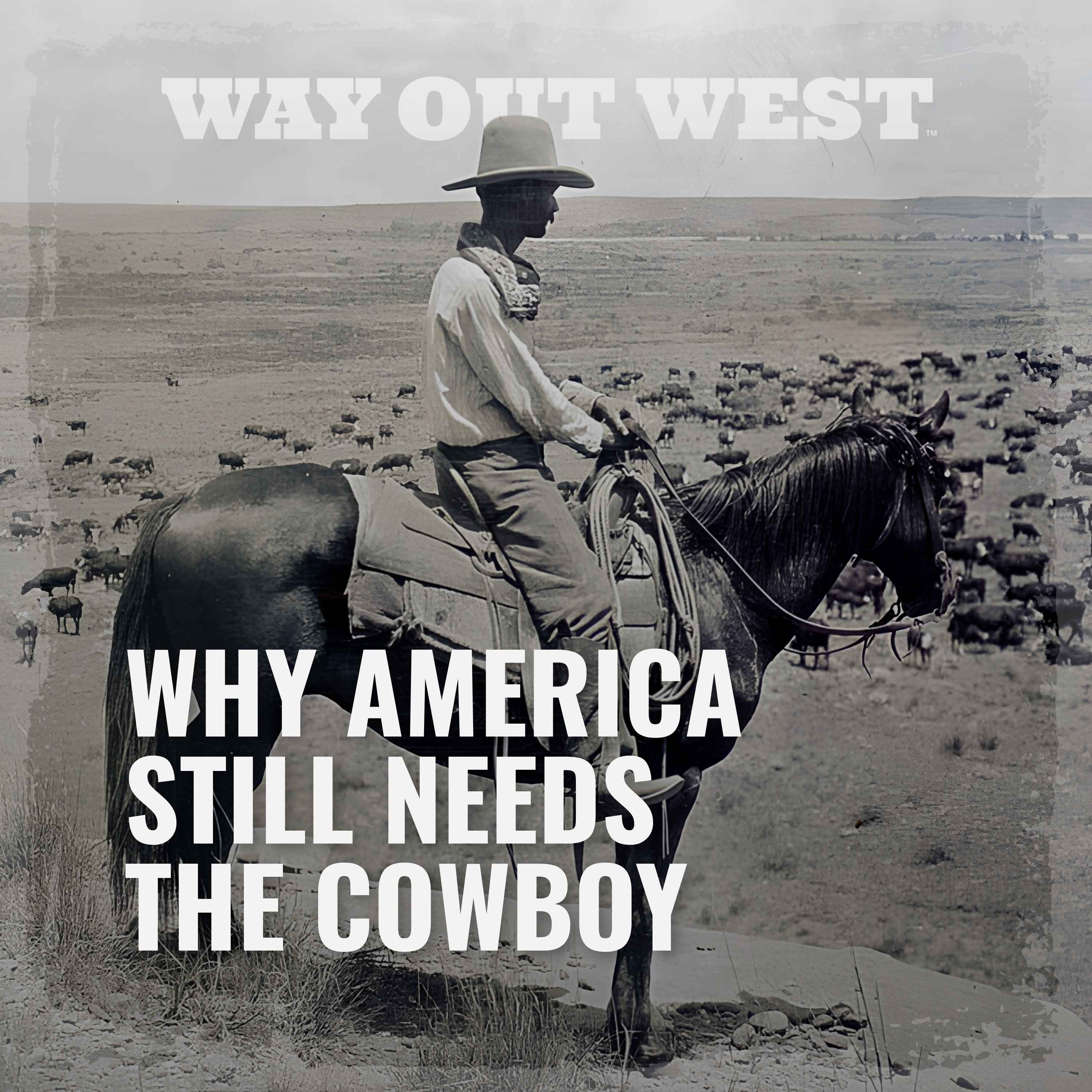
The cowboy began as a working hand and became one of America's most enduring cultural archetypes. This episode separates history from mythology to ask why cowboy values—competence, courage, responsibility, loyalty, resilience, and self-reliance—still resonate far beyond the ranch.
Why America Still Needs the Cowboy
The cowboy became more than an occupation. He became a way Americans talked about independence, competence, responsibility, courage, and character. More than a century later, does that idea still have something useful to say?

America still needs working cowboys. Wherever cattle are worked, skilled men and women are still doing the job.
But why does the idea of the cowboy matter to millions of Americans who have never ridden a horse, worked cattle, or lived anywhere near a ranch?
In this episode of Way Out West, Chip Schweiger separates the historical working cowboy from the cowboy America invented—and asks what remains when we strip away the horse, hat, boots, and Hollywood mythology.
What You'll Hear
- How the nineteenth-century working cowboy became an American cultural archetype
- Why the popular image of the fiercely independent cowboy doesn't quite match the cooperative reality of ranch work
- How dime novels, Buffalo Bill, The Virginian, movies, radio, and television helped create the cowboy America remembers
- Why the formal Code of the West came later than the cowboys whose values it supposedly described
- How Mexican vaquero, Black, Native, and women's histories complicate the familiar cowboy story
- Why toughness and compassion aren't necessarily opposites in cowboy culture
- Whether mythology can preserve something valuable even when it isn't historically precise
- What cowboy values might mean when you take away the cattle, horse, hat, boots, and open range
From Working Cowboy to American Archetype
The nineteenth-century cowboy was first and foremost a worker. He needed horsemanship, judgment, endurance, and the ability to handle cattle in difficult country.
He was also never quite the solitary figure Americans later imagined.
Cattle drives, roundups, and ranch work depended on crews. The real cowboy was expected to be self-reliant precisely because other people were relying on him.
The Cowboy America Invented
Even before the historical frontier disappeared, America was creating another cowboy.
Dime novels, Buffalo Bill's Wild West, Owen Wister's The Virginian, advertising, movies, radio, and television gradually transformed an occupation into a symbol of independence, courage, competence, and character.
Later ideas such as the Code of the West made those associations more explicit.
The mythology wasn't always historically accurate. But does that necessarily make it meaningless?
The Contradictions Inside the Cowboy Ideal
The cowboy becomes more interesting when we stop treating him as a simple symbol of rugged individualism.
Independence existed alongside dependence on a crew. Freedom came with obligation. Toughness included caring for animals. Individual competence mattered because the entire outfit depended on everyone doing his or her job.
Those contradictions may tell us more about cowboy values than the familiar image of the lone rider.
Who Gets to Be the Cowboy?
American cowboy history was also considerably broader than popular culture once suggested.
Mexican vaquero traditions profoundly shaped cowboy culture. Black cowboys worked throughout the cattle industry. Native people developed ranching and horsemanship traditions of their own. Women worked cattle, managed ranches, rode, roped, and competed.
The cowboy's history was never as uniform as Hollywood sometimes made it.
Neither are the qualities we've attached to him.
What Remains Without the Hat and Horse?
Take away the horse, cattle, hat, boots, rope, saddle, and Hollywood landscape.
What's left?
Competence. Responsibility. Courage. Loyalty. Resilience. Keeping your word. Doing your share. Staying steady when circumstances become difficult. Helping when help is needed.
And perhaps doing some of it without requiring an audience.
Most Americans will never become cowboys.
Maybe that's precisely why the cowboy still matters.
Archetypes give cultures a way of talking about the kind of people they hope to be.
Cowboy Glossary Term of the Week
Slicker: the raincoat traditionally carried by a cowboy, often rolled or tied behind the saddle until bad weather arrived. Early versions were commonly made from fabric treated with oil or another waterproofing material.
Miles from shelter, a slicker wasn't something a cowboy carried because rain was in the forecast.
He carried it because eventually, it would be.
Ride Way Out West
Way Out West tells the stories, history, people, and traditions of the American West—looking beyond the mythology without losing sight of why those stories still matter.
Listen to Why America Still Needs the Cowboy wherever you get your podcasts, and follow Way Out West for more stories from the living West.
03:33 - Chapter 1 – The Cowboy Before the Myth
06:28 - Chapter 2 – America Invents a Cowboy
08:39 - Chapter 3 – When Myth Becomes a Moral Language
10:14 - Chapter 4 – The Lone Cowboy Who Wasn't Alone
11:59 - Chapter 5 – The Cowboy Was Never as Tough as the Myth Pretended
13:39 - Chapter 6 – Who Gets to Be the Cowboy?
14:55 - Chapter 7 – What Happens When You Take Away the Hat?
16:11 - Chapter 8 – Why Archetypes Survive
18:22 - Chapter 9 – The Cowboys Who Never Left
19:37 - Chapter 10 – Closing Thoughts
20:50 - Chapter 11 – Buster the Bull & Cowboy Glossary Term of the Week
21:30 - Chapter 12 – Thanks for Listening
Most Americans will never be cowboys.
They’ll never rope a calf.
Never push cattle through a cold rain.
Never spend a night horseback under a sky with no electric light for a hundred miles.
Most will never own a horse, mend a fence, pull a calf, or know what it feels like…
to climb into a saddle before daylight…
because the work has to be done…
whether they feel like doing it or not.
And yet—
more than a century after the great cattle drives ended, the cowboy is still here.
On movie screens.
In advertising.
In music and literature.
In the language Americans use to describe courage, independence, toughness, recklessness, competence—even character.
There are still real cowboys, of course.
But there is also something else.
The idea of the cowboy.
And maybe that idea has survived for a reason.
Because perhaps America still needs the cowboy.
Just not in quite the way we think.
[Music Up]
Howdy. Chip Schweiger, here.
Welcome to another edition of Way Out West.
Where the stories of the American West are told...
Cowboy wisdom is earned...
And the legacy of the American cowboy still rides on.
Today we're asking a question that sounds simple until you really start thinking about it:
Why does America still need the cowboy?
Now, I'm not asking whether America still needs working cowboys.
That's an easy question.
Where cattle are raised and worked, there are still jobs that skilled men and women on horseback can do remarkably well.
Ranches across the West still depend on people who understand cattle, horses, weather, land, machinery, fencing, water—and the thousand other things that have to be understood to keep an operation running.
The working cowboy didn’t disappear when the nineteenth century ended.
But that's not really what this episode is about.
The more interesting question is why the cowboy still matters to people who have absolutely nothing to do with ranching.
Why does someone sitting in an apartment in Manhattan know what a cowboy represents?
Why does a child who has never seen a working ranch recognize the hat, the horse and the silhouette of a rider against the horizon?
And why, after dime novels, Wild West shows, advertising campaigns, Hollywood Westerns and more than a century of mythmaking, does the cowboy remain one of America's most durable cultural figures?
To answer that, we have to separate three cowboys who are often confused with one another.
The cowboy who actually lived.
The cowboy America invented.
And the cowboy who is still working today.
Because somewhere between those three is the reason the cowboy still matters.
Now, before we saddle up, remember you'll find additional resources for today's episode in the show notes at WayOutWestPod.com/why-america-still-needs-the-cowboy
Chapter 1 – The Cowboy Before the Myth
Start with the historical cowboy,
and the first thing we need to do is make him smaller.
Not less important.
Just smaller.
The working cowboy of the nineteenth-century cattle industry wasn’t originally a national symbol.
He was a worker.
Usually a young one.
He tended cattle, broke horses, repaired equipment, stood night guard, worked roundups and, during the great cattle-drive era,
helped move herds hundreds of miles from Texas toward railheads farther north.
The work demanded skill.
A cowboy had to read cattle.
He had to understand horses.
He had to notice weather.
He needed to know when an animal was getting ready to bolt, when a horse was beginning to tire, and when something that looked insignificant might become a serious problem.
But we should be careful about turning every cowboy into some philosopher of the plains.
They were human beings.
Some were dependable.
Some weren't.
Some were generous.
Others were mean.
You had courageous ones.
And some undoubtedly knew exactly how much work they could avoid before the trail boss noticed.
And the cowboy workforce itself was far more diverse than the popular image that later emerged.
Mexican vaqueros had developed much of the horsemanship, equipment and cattle-working tradition inherited by Anglo cowboys.
Black cowboys worked throughout the cattle industry.
Native people participated in ranching and cowboy traditions across parts of the West.
Immigrants became cowhands.
So did former soldiers, farm boys and men looking for wages and opportunity.
The American cowboy was never quite as uniform as Hollywood eventually made him.
And here's another complication.
We remember the cowboy as perhaps the supreme American individualist.
But cattle work was profoundly cooperative.
A trail herd of several thousand cattle could be managed by a surprisingly small crew because everybody had a job.
Point riders helped guide the herd.
Swing and flank riders kept cattle together.
Drag riders worked the miserable, dusty position at the rear.
A horse wrangler managed the remuda.
A cook kept everybody fed.
One rider refusing to do his job could create problems for everybody else.
That makes the historical cowboy more interesting than the mythology.
Because his independence existed inside obligation.
You were expected to handle yourself.
But you were also expected to do your part.
And those aren't opposites.
They depend on one another.
Chapter 2 – America Invents a Cowboy
The cowboy didn't have to wait long to become something larger than an occupation.
Even while real cowboys were still working cattle across the West, writers and entertainers were transforming them into characters.
Dime novels had already taught Americans to consume the West as adventure.
Then came Buffalo Bill Cody.
Beginning in the 1880s, Buffalo Bill's Wild West show carried a spectacular version of frontier America across the United States and eventually into Europe.
There were horses.
Sharpshooters.
Stagecoach attacks.
Military scenes.
Races.
Cowboys and Indians presented within a carefully constructed drama of the frontier.
It wasn't history in the way we'd understand a documentary.
It was entertainment.
But millions of people saw it.
And that matters.
Because the West was becoming mythology almost before the historical frontier had disappeared.
Then literature took another turn.
In 1902, Owen Wister published The Virginian. And I’ve talked about this before
Its central cowboy was capable, restrained, dangerous when necessary, loyal to his own sense of honor and deeply independent.
The novel became enormously influential.
And the cowboy increasingly became something you could be, even if you had never worked cattle.
He’d become a character.
Then movies arrived.
And radio.
And television.
Tom Mix.
Gene Autry.
Roy Rogers.
John Wayne.
Gary Cooper.
Clint Eastwood.
Each generation changed the cowboy a little.
Sometimes he was cheerful and clean-cut.
Sometimes morally certain.
Other times weary and complicated.
Occasionally he was violent.
And other times almost saintly.
The cowboy became whatever Americans needed him to be.
And that should make us suspicious of the mythology.
But it shouldn't necessarily make us dismiss it.
Chapter 3 – When Myth Becomes a Moral Language
One of the clearest examples came with Gene Autry.
By the late 1940s, Autry's public image had developed into something called the Cowboy Code.
It included ideas about keeping your word, telling the truth, helping people in distress, treating animals and vulnerable people gently, and being a good worker.
Now, as we've discussed before on Way Out West,
nineteenth-century cowboys weren’t riding around with a laminated copy of the Cowboy Code tucked into their saddlebags.
There was no single universally recognized frontier rulebook.
The formal codes came later.
But the fact that they came later doesn't make them meaningless.
It tells us something else.
Americans had begun using the cowboy as a way to talk about character.
And that's an important distinction.
The historical question is:
Did real cowboys live according to a formal Code of the West?
I think the answer is:
Probably not in the neat form later generations gave it.
But the cultural question is different:
Why did Americans believe the cowboy was the kind of person who should have a code?
That question gets us closer to why the cowboy endured.
Because by the middle of the twentieth century, the cowboy had become an archetype.
And archetypes don't have to be perfectly historical to be useful.
They just have to express something a culture recognizes.
Chapter 4 – The Lone Cowboy Who Wasn't Alone
Consider perhaps the most famous cowboy image of all.
A single rider.
Maybe he's crossing an open plain.
Maybe he's silhouetted against a sunset.
Or maybe he's riding away from town at the end of the movie.
That image has done enormous work in American culture.
It says independence.
Freedom.
Self-reliance.
The person who doesn't need anyone.
Except—
that isn't how ranching works.
A roundup is cooperative.
A branding is cooperative.
A cattle drive was cooperative.
Even the cowboy's ability to ride alone depended upon other people.
Someone bred the horse.
Someone raised the cattle.
People dug wells.
Someone had to cook meals.
Someone else owned the outfit.
And Some cowboy would eventually take the next watch.
The real cowboy was expected to be self-reliant precisely because other people were relying on him.
And I think that's a much more useful idea than simple rugged individualism.
Self-reliance didn't mean:
I don't need anybody.
It meant:
You shouldn't have to carry me because I refused to carry my own weight.
Those are very different things.
And that tension runs through the cowboy ideal.
Independence—but loyalty to the outfit.
Freedom—but responsibility.
Toughness—but care for an injured animal.
Courage—but enough judgment to know when showing off will get somebody hurt.
The ability to work alone—and the ability to become part of a crew when the job requires it.
Maybe the cowboy endured because he holds those contradictions together.
Chapter 5 – The Cowboy Was Never as Tough as the Myth Pretended
Cowboy mythology often mistakes toughness for hardness.
They're not the same thing.
A good hand couldn't afford to be indifferent.
He had to pay attention.
A horse beginning to favor one leg mattered.
A cow separated from her calf mattered.
A change in the weather mattered.
Another rider getting into trouble mattered.
Competence required observation.
And observation sometimes required compassion.
That's easy to miss because popular culture gave us another kind of cowboy.
The gunfighter.
In Western movies, the distinction between cowboy and gunman became badly blurred.
Historically, most cowboys were not professional gunfighters.
Their principal tools were related to livestock and horses, not dramatic confrontations at high noon.
Yet Hollywood repeatedly put a revolver in the cowboy's hand because gunfights make better endings than fixing fence.
And somehow, beneath all that theatrical violence, another quality survived.
Restraint.
Think about how often the ideal Western hero is defined not simply by whether he can use force, but whether he knows when not to.
That isn't necessarily an accurate description of every historical cowboy.
It’s something the mythology added.
But perhaps that's exactly the point.
The imagined cowboy gradually became not a description of how every cowboy behaved but a proposition about how someone ought to behave.
Chapter 6 – Who Gets to Be the Cowboy?
There's another part of the mythology we have had to correct.
For much of the twentieth century, popular culture presented the cowboy as overwhelmingly white, male, and Anglo-American.
The historical record is considerably more complicated.
Cowboy culture owes an enormous debt to Mexican vaquero traditions.
Black cowboys were a meaningful part of the nineteenth-century cattle industry.
Native communities developed their own ranching, horsemanship and rodeo traditions.
Women worked cattle, ran ranches and became accomplished riders, ropers and competitors.
The West has always been more complicated than the casting department of an old Hollywood studio.
And recognizing that doesn't weaken the cowboy as an American symbol.
It actually strengthens him.
Because if the cowboy represents competence, courage, responsibility, resilience and keeping your word, then none of those virtues belongs to a particular race, region or class.
And they certainly don't require owning a pair of boots.
The cowboy becomes more useful as an archetype when we stop treating him as a costume.
Chapter 7 – What Happens When You Take Away the Hat?
So let's try something. And stick with me here.
Let’s take away the horse.
Take away the cattle.
Take away the hat.
The boots.
The rope and the saddle.
Take away Monument Valley.
Take away campfires.
Hell, even take away John Wayne riding toward the horizon.
What's left?
Maybe this:
Do the work that’s yours to do.
Learn enough to be useful.
Keep your word.
Take responsibility when something goes wrong.
Don't make someone else carry your share.
Stay calm when conditions get difficult.
Know the difference between confidence and showing off.
Help when help is needed.
Take care of the things entrusted to you.
And don't require an audience every time you do the right thing.
Now, none of that belongs exclusively to the West.
A nurse in Chicago can live that way.
So can a mechanic in Atlanta.
A teacher in Boston.
A firefighter in Los Angeles.
A parent raising children in Brooklyn.
And a young person starting a first job anywhere in America.
You don't have to imitate cowboys.
That's not the point.
What is the point is that the image was never the important part.
Chapter 8 – Why Archetypes Survive
Every culture tells stories about the kind of people it admires.
Sometimes those people actually existed.
Sometimes they’re exaggerated versions of real people.
Sometimes history and mythology become so tangled that separating them requires a fair amount of work.
The cowboy is all three.
There was a historical cowboy.
There is a mythological cowboy.
And there are working cowboys today.
They overlap.
But they aren't identical.
Maybe that's why the cowboy has been able to survive.
If he were merely an occupation from the nineteenth century, he would belong mostly to agricultural history.
If he were merely a Hollywood invention, he might have disappeared when Western movies declined.
But he became something else.
A vocabulary for talking about character.
That doesn't mean every part of the mythology deserves preservation.
Some of it doesn't.
The West was never as empty as the movies suggested.
Its history wasn't exclusively white.
Violence wasn't as constant as Hollywood implied.
Cowboys weren't wandering philosophers dispensing homespun wisdom beside campfires.
And the supposedly solitary cowboy depended far more heavily on other people than our mythology usually admits.
But myths can contain truths even when they aren't literally true.
The lone rider may not tell us much about how a cattle drive actually operated.
But he can still represent the moment when a person has to make a decision without anyone else making it for him.
The loyal ranch hand can represent responsibility to something larger than oneself.
The skilled horseman can represent mastery earned through patience rather than proclaimed through confidence.
The trail crew can represent something Americans sometimes forget about the cowboy altogether:
People accomplishing difficult things because everyone does his part.
The mythology becomes valuable not when we mistake it for history.
But when we understand what it is trying to say.
Chapter 9 – The Cowboys Who Never Left
And after all this discussion of symbols and archetypes, it's worth remembering something.
The cowboy isn't only a symbol.
He's still working.
There are men and women horseback today checking cattle in country where an ATV can't easily go.
There are ranch hands fixing water gaps after storms.
There are people calving through cold nights, hauling feed through drought, doctoring cattle, breaking ice, repairing fence and trying to keep family operations alive through weather and markets they cannot control.
Their lives don't look much like a Western movie.
And they probably shouldn't have to carry the burden of representing some national ideal.
They're working people doing a job.
Which brings us back to where we started.
America doesn't need to become a nation of cowboys.
It never was one.
Most Americans will never work cattle.
Most will never ride the range.
And that's fine.
Perhaps the cowboy matters precisely because most of us will never become one.
Archetypes give cultures a way of talking about the kind of people they hope to be.
Not literally.
But morally.
Chapter 10 – Closing Thoughts
So why does America still need the cowboy?
Maybe because competence still matters.
Responsibility still matters.
Keeping your word still matters.
Knowing how to stand on your own while understanding that you’re responsible to other people. That still matters.
None of that requires us to pretend the nineteenth-century West was something it wasn't.
It doesn't require turning history into nostalgia.
And it doesn't require pretending every cowboy lived up to the ideals later attached to him.
They didn't.
People rarely live up to their archetypes.
That's why we create archetypes in the first place.
Somewhere tonight, a working cowboy will shut a gate, check a water tank, feed a horse, or look over cattle before heading home.
Most of America will never see it.
There won't be a soundtrack.
Nobody will ride into the sunset.
Tomorrow, there will simply be more work to do.
And maybe that's as good a place as any to leave the cowboy.
Not back in the nineteenth century.
Not trapped on a movie screen.
But still useful.
Still working.
And still reminding the rest of us that some old virtues remain worth carrying forward.
Chapter 11 – Buster the Bull & Cowboy Glossary Term of the Week
OK, before we ride out today, we’ve got one more thing
[BULL SOUND]
Yep, that distinctive call from Buster the Bull means it’s time again for our cowboy glossary term of the week.
This week's cowboy glossary term is slicker.
A slicker is the raincoat a cowboy carried with him, usually rolled or tied behind the saddle until the weather turned.
Early versions were made from fabric treated to repel water.
And when you're working cattle miles from shelter, a slicker isn't something you carry because rain is in the forecast.
You carry it because eventually, it will be.
[MUSIC UP AND FADE]
Chapter 12 – Thanks for Listening
Well, that’s all for this episode of Way Out West. Thanks for riding with me here
If you enjoyed the episode, please follow, rate, and share the show
with someone who loves the history, culture, and traditions of the American West.
And if you'd like to see more of the work we're doing,
you can visit RideWayOutWest.com.
And while you're there, take a few minutes to explore the Way Out West Journal, where we dive even deeper into the people, places, and history that continue to shape the West today.
That’s RideWayOutWest.com
Until next time, this is Chip Schweiger,
reminding you that the West doesn't ask us to live in the past.
Only to remember what was worth bringing forward with us.
We'll see ya down the road.