Wild Bill Hickok: Lawman, Gambler, Gunfighter
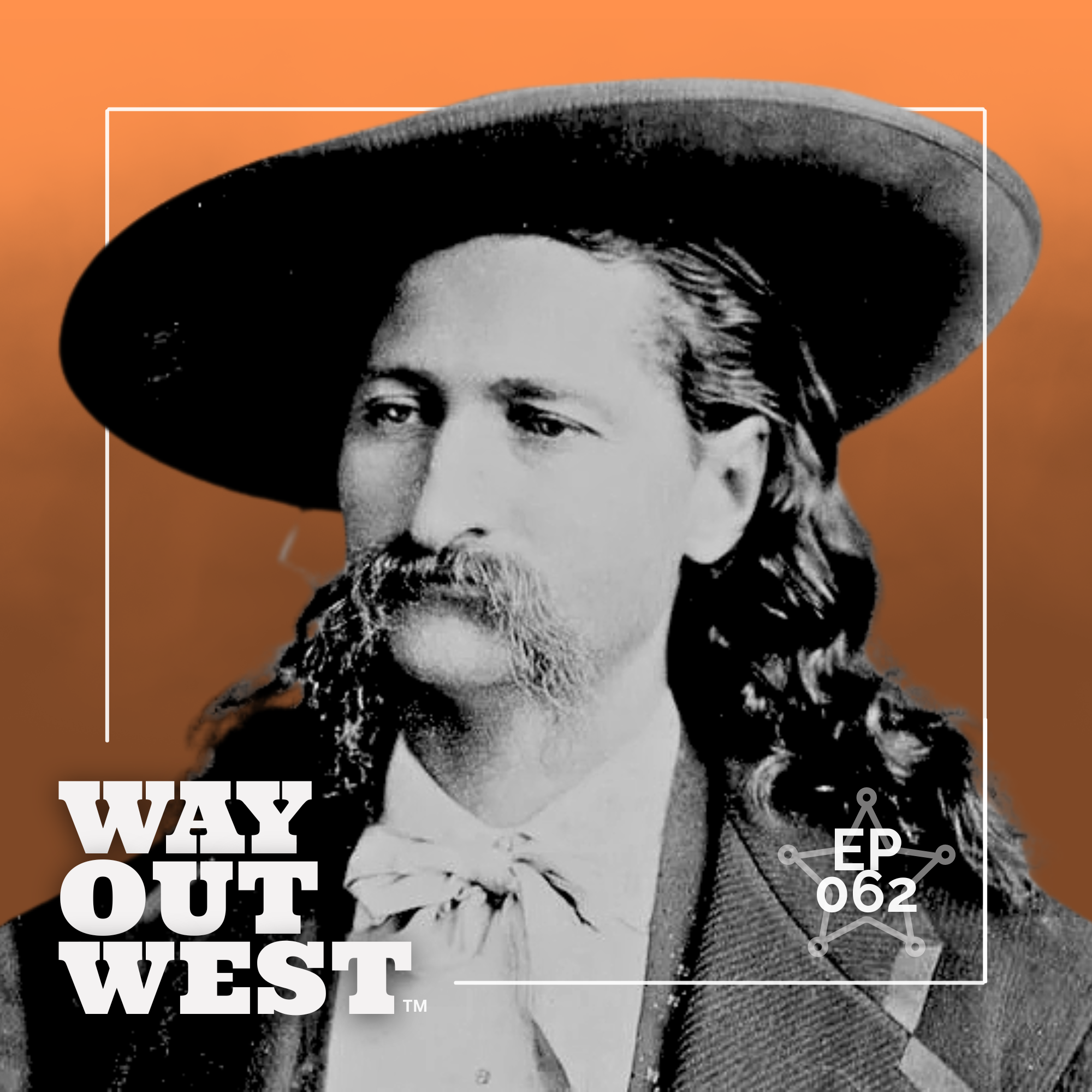
The West was built on stories, and few are larger than the life and legend of Wild Bill Hickok. In this episode of Way Out West, explore the full arc of Hickok’s story — from his early years as a frontier boy in Illinois, to his daring service as a Civil War scout, to his time as a lawman taming cattle towns like Hays and Abilene. We’ll follow him through gunfights and gambling halls, where his reputation as one of the fastest men alive spread across the plains. And finally, we’ll ride with h...
The West was built on stories, and few are larger than the life and legend of Wild Bill Hickok.
In this episode of Way Out West, explore the full arc of Hickok’s story — from his early years as a frontier boy in Illinois, to his daring service as a Civil War scout, to his time as a lawman taming cattle towns like Hays and Abilene. We’ll follow him through gunfights and gambling halls, where his reputation as one of the fastest men alive spread across the plains.
And finally, we’ll ride with him into Deadwood, South Dakota — the gold camp where his restless spirit met its end at a poker table, holding the hand that would become a legend: the Dead Man’s Hand.
For show notes, visit WayOutWestPod.com/Wild-Bill-Hickok
Transcript: For a full transcript of this episode, click on "Transcript"
Your Turn! Share your thoughts → howdy@ridewayoutwest.com
Support the Show: Buy me a coffee → https://buymeacoffee.com/thecowboycpa
Follow Along: Instagram → https://www.instagram.com/RideWayOutWest
He was born a farm boy in the Midwest. He became a Union scout, a frontier lawman, a gambler, and a gunfighter whose reputation spread faster than the telegraph.
Some saw a hero. Others swore he was nothing but a killer with good luck. But no one doubted he was larger than life.
This is the story of a man whose legend still drifts like smoke through the saloons and plains of the American West.
[INTRO MUSIC]
Howdy. Chip Schweiger, here. Welcome to another edition of Way Out West.
The podcast that takes you on a journey through the stories of the American West, brings you the very best cowboy wisdom, and celebrates the cowboys and cowgirls—who are feeding a nation.
Well, there are stories of the West that drift through saloons and campfires, whispered under the rattle of poker chips or the low strum of a fiddle. Stories of men larger than life, whose names still echo across the plains.
One of those names belonged to a man who wore his hair long, like some prophet from the Old Testament, carried a pair of ivory-handled Colts, and walked with a gambler’s swagger that made folks stop and stare. He was handsome, dangerous, and unpredictable—equal parts charm and menace.
So today on the show, we’re telling the story of Wild Bill Hickok — lawman, gambler, and gunfighter — and the hand of cards that turned his life into legend.
After the episode, check out the show notes at WayOutWestPod.com/wild-bill-hockok.
Welcome back. So, let’s begin at the start. Long before poker tables and gunfights made him famous, Wild Bill Hickok was just a farm boy born in Illinois. But he was never meant for an ordinary life. From the very beginning, there was a restless fire in him, one that pushed him further west, chasing something always just beyond the horizon.
Chapter 1: A Frontier Beginning
James Butler Hickok was born in 1837, in the rolling farmland of Illinois. Like so many frontier boys, he grew up hunting, tracking, and testing himself against the rough edges of nature. But there was a restlessness in him. Hickok wasn’t meant to stay put.
As a young man, he worked as a stagecoach driver, running dangerous routes where highwaymen and rough terrain made every mile a gamble. It was on those routes that Hickok first made a name for himself as a man who didn’t flinch when others hesitated.
When the Civil War broke out, Hickok put his talents to use as a scout, and even a spy, for the Union Army. His ability to slip behind enemy lines, read terrain, and move quickly under pressure made him invaluable. More than once, he found himself close enough to Confederates to overhear their plans, and just bold enough to ride away with the information before they caught him.
He was shaping into more than a soldier. He was becoming a man of legend.
Chapter 2: The Gunfighter’s Reputation
After the war, Hickok wandered west, like so many restless veterans. But unlike most, his reputation began to spread faster than his footsteps.
In 1865, in Springfield, Missouri, he fought one of the most famous quick-draw duels in frontier history. His opponent was Davis Tutt, a fellow gambler. The two quarreled over a debt and a watch, and the argument spilled out into the town square. When Tutt challenged Hickok in the street, Hickok is reported to have said, “Don’t you come any closer, Dave.”
But Tutt did. At a distance of seventy-five yards—far beyond the range of most pistols—Hickok drew, fired, and shot Tutt through the heart.
Word of that shot traveled like wildfire. A man who could make a shot that clean, that cold, became a figure of awe and fear. Hickok had just stepped out of the ordinary world and into folklore. After the shot, townsfolk recalled him lowering his pistol and calmly declaring: “One shot is enough.”
In the years that followed, he wore a marshal’s badge in towns like Hays and Abilene. Lawless cattle towns, boiling with trail-hardened cowboys who had just been paid and were ready to raise Cain. Hickok stood tall in the dust and chaos, his reputation as sharp as the revolvers on his hips. He didn’t always go looking for trouble. But trouble had a way of finding him.
And when it did—Hickok was faster.
Chapter 3: The Gambler’s Table
But every legend carries its weight. By the 1870s, Hickok’s eyes were failing. Years of dust, gun smoke, and strain had clouded his vision. The man who once saw targets at seventy yards now struggled to see clearly across a room.
With his gunfighter’s edge dulling, Hickok leaned into another love: gambling. He had always been a card sharp, as comfortable with a hand of poker as with the grip of his Colt.
He drifted into Deadwood, South Dakota—a lawless mining camp that was more gold fever than town. Deadwood was wild. No sheriff, no law, just greed, whiskey, and a hundred kinds of desperation. It was the kind of place where a man’s luck could turn with the fall of a card—or the draw of a gun.
And in Deadwood, Wild Bill was no longer the fastest gun in the West. He was a man chasing comfort in cards, whiskey, and fading glory.
Chapter 4: The Dead Man’s Hand
On August 2, 1876, Hickok walked into Nuttal & Mann’s Saloon No. 10. He joined a poker game, but broke one of his own lifelong rules: never sit with your back to the door. The only open seat forced him into that position, and for once, he let it slide.
A fellow gambler in Deadwood later said Hickok muttered as he took the unlucky seat: “Boys, I don’t like it. I never sit with my back to the door.”
In his hand, he held a pair of black aces and a pair of black eights. The fifth card has been debated ever since. Some say a queen of hearts, others a jack of diamonds. What’s certain is that behind him walked Jack McCall, a drifter nursing a grudge and a whiskey habit.
McCall raised a pistol, aimed, and fired. The bullet struck Hickok in the back of the head. He fell forward, the cards slipping from his hand. The crowd froze, stunned. In that instant, Hickok—the scout, the lawman, the gambler, the gunfighter—was gone.
And the hand he died holding became legend. From that day forward, black aces and eights would be known as the Dead Man’s Hand.
Chapter 5: Legend vs. Truth
Now, how much of Hickok’s life was truth, and how much was story? That depends on who you ask.
Some said he killed dozens of men in cold blood, that he was the deadliest shot the frontier ever saw. Others claimed the stories were spun out of proportion, dime-novel exaggerations to feed an eager public.
The truth probably lies somewhere in between. Hickok was certainly a skilled gunfighter, a lawman who stood his ground, and a gambler who knew the feel of both fortune and ruin. But he was also human—haunted by poor eyesight, by fading relevance, and by the weight of living up to his own legend.
In the end, though, legend is what lasts. And Hickok’s legend still walks the streets of Deadwood, whispered over poker tables, carried in the memory of a hand of cards that no gambler forgets.
Chapter 6: Closing Reflection
Well, there are stories of the West that drift like campfire smoke across the years. We began tonight with one of them — the tale of a man called Wild Bill.
He was a lawman, a gambler, a gunfighter. Part flesh-and-blood, part folklore. The kind of man whose name lived larger than the man himself, carried on whispers through saloons and down dusty trails.
And in the end, maybe that’s what the West was always about — not the clean line between truth and fiction, but the power of a story to outlast the man who lived it.
So remember this: when you hear the shuffle of cards or the rattle of poker chips, when you see the long shadows stretching across the plains at sundown — you’re brushing against the same legend that made the West what it is.
Wild Bill Hickok.
Chapter 7: Buster the Bull & Cowboy Glossary Term of the Week
Ok, before we head out of this town, we’ve got one more thing.
Yep, that distinctive call from Buster the Bull means it’s time for the Cowboy Glossary Term of the Week. And this week’s term is Dead Man’s Hand – A poker hand of aces and eights, said to be the cards held by Wild Bill Hickok when he was shot in Deadwood in 1876.
Thanks for Listening
Thanks for joining me here Way Out West.
If you enjoyed this journey through history, share it with a friend. That way we reach more fans of the American West. And if you’re so inclined, I’d appreciate it if you’d rate us or review us on Apple, Spotify, or your favorite podcast platform.
And remember — The West wasn’t just cattle and cowboys — it was lawmen, gamblers, and gunfighters like Wild Bill Hickok, where legend and truth ride side by side.
Until next time, this is Chip Schweiger reminding you that legends never die — they just ride on in the stories we tell.
We’ll see y’all down the road.