Five Things Hollywood Actually Got Right About Cowboys
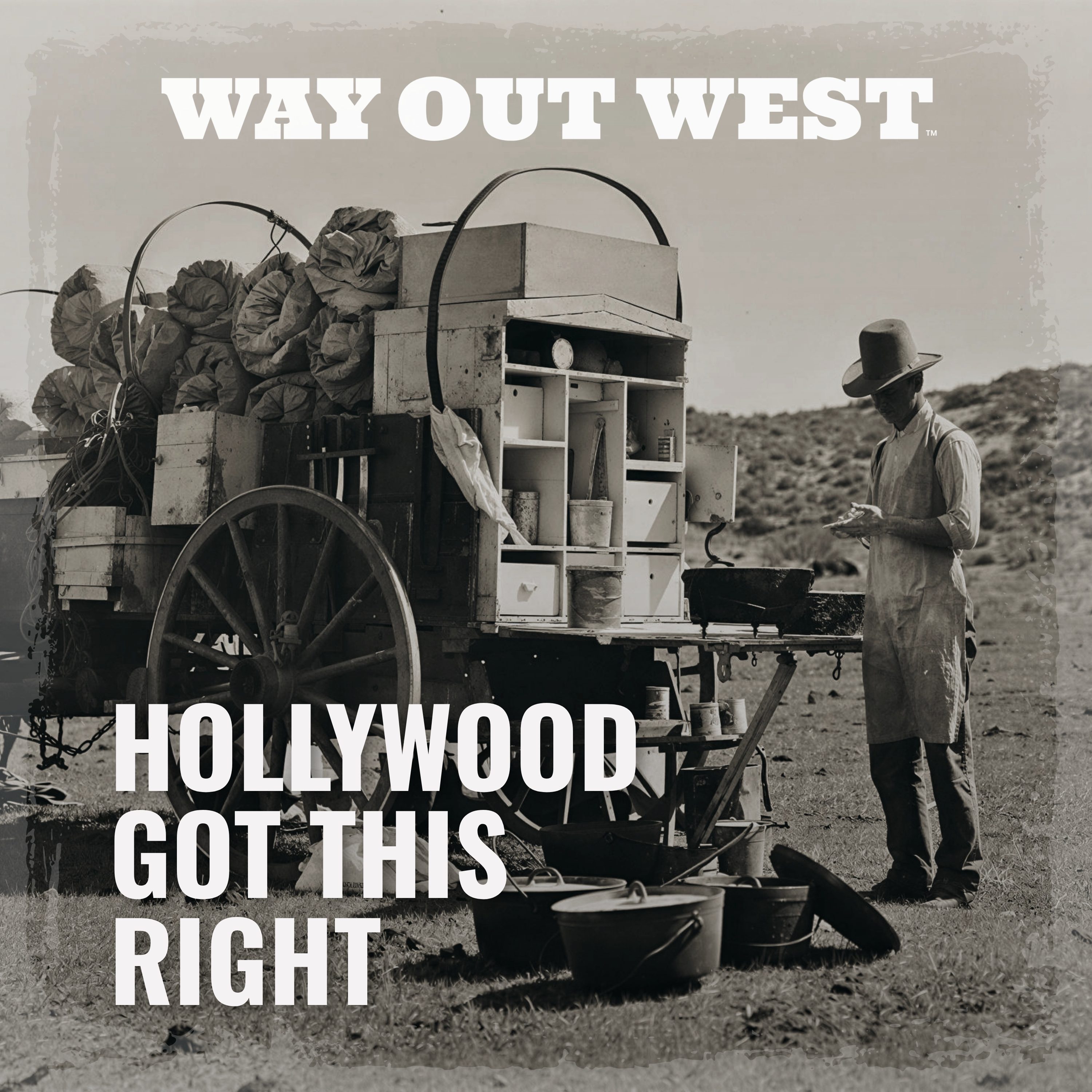
Classic Westerns created plenty of myths about the American cowboy—but they also got some remarkable details right. Discover five authentic traditions Hollywood faithfully preserved, from singing to cattle and trail drives to chuck wagons, remudas, and the practical gear of the working cowboy.
Five Things Hollywood Actually Got Right About Cowboys

Hollywood has created some of the biggest myths about the American West. From endless gunfights to spotless shirts and impossible horseback chases, Western films often sacrificed historical accuracy for great storytelling.
But they didn't get everything wrong.
In this episode of Way Out West, explore five details Hollywood consistently portrayed with surprising authenticity. From cowboys singing to cattle and the careful organization of a trail drive to the chuck wagon, the remuda, and the practical clothing that defined life on the range, you'll discover that many of the most recognizable images from classic Westerns were grounded in real cowboy life.
Along the way, we'll separate Hollywood's embellishments from the historical record and uncover why some of the most iconic scenes in Western cinema have deeper roots than most people realize.
Sometimes the truth really is every bit as interesting as the legend.
What You'll Hear
- Why cowboys really did sing while riding night guard
- How trail drives were carefully organized—not chaotic adventures
- Why every trail cowboy depended on a remuda of fresh horses
- The surprising history and importance of the chuck wagon
- How cowboy hats, boots, chaps, wild rags, and spurs were practical tools before they became Hollywood icons
- Why classic Westerns often preserved authentic details even while dramatizing the larger story
Cowboy Glossary
Cow Sense: One of the highest compliments a rancher can give a cowboy. Cow sense is the instinctive ability to read cattle behavior, anticipate what they'll do next, and handle them calmly and efficiently. It's a skill earned through experience rather than taught from a book.
Listen Next
Like this episode? You'll love these:
- How the Movies Created the Cowboy We Know - Episode 98
- The Last Real Cowboy - Episode 97
- Why We Still Love Old Westerns - Episode 99
Ride Way Out West
If you enjoyed this episode, be sure to follow Way Out West wherever you listen to podcasts.
And if you’d like to support independent storytelling about the American West, share this episode with somebody who loves cowboy history, frontier culture, and the stories that still ride on today.
Support the Show: Buy me a coffee → https://buymeacoffee.com/thecowboycpa
02:58 - Chapter 1 — Cowboys Really Did Sing to Cattle
05:38 - Chapter 2 – Trail Drives Really Were Organized
07:50 - Chapter 3 – Cowboys Really Did Ride More Than One Horse
09:53 - Chapter 4 – The Chuck Wagon Really Was the Center of Camp
12:53 - Chapter 5 – Cowboy Clothing Was Built for the Work
15:01 - Chapter 6 – Closing Thoughts
15:54 - Chapter 7 – Buster the Bull & Cowboy Glossary Term of the Week
16:47 - Chapter 8 – Thanks for Listening
Hollywood has gotten plenty wrong about cowboys.
The gunfights were too frequent.
The shirts were too clean.
And somehow, every dusty trail seemed to lead directly to a saloon full of trouble.
But beneath all that invention, Hollywood occasionally preserved something real.
Cowboys really did sing around cattle.
Trail drives really were organized down to the position of every rider.
And almost everything a cowboy wore served a practical purpose long before it became a costume.
It’s easy to correct Hollywood. But it’s best to give credit where credit is due.
Because maybe Hollywood wasn’t always wrong about cowboys.
[Music Up]
Howdy. Chip Schweiger, here.
Welcome to another edition of Way Out West.
Where the stories of the American West are told...
Cowboy wisdom is earned...
And the legacy of the American cowboy still rides on.
There is a moment in almost every great Western when the noise falls away.
The gunfire stops.
The town disappears behind a ridge.
And somewhere out on the open range, a cowboy rides alongside a moving herd.
There may be a line of cattle stretching toward the horizon.
A chuck wagon rolling through the dust.
A group of horses moving under the care of a young wrangler.
Or a lone rider circling the herd after dark, singing softly beneath a sky crowded with stars.
For generations, scenes like these shaped how the world imagined the American cowboy.
And much of that picture was exaggerated.
Hollywood compressed decades of history into a single landscape.
It blended the traditions of Texas cowhands, California vaqueros, Great Basin buckaroos, rodeo riders, lawmen, scouts, and Wild West performers until they all appeared to inhabit the same town.
But the real story runs deeper than that.
Because while Hollywood often misunderstood the cowboy’s world,
it did pay close attention to the details that made that world recognizable.
The filmmakers may have added the villains.
Or added the romance.
But in a surprising number of cases, they didn’t invent the work.
So today, we’re looking at five things Hollywood actually got right about cowboys.
Before we saddle up, remember you'll find additional resources for today's episode in the show notes at WayOutWestPod.com/hollywood-got-right.
Chapter 1 - Cowboys Really Did Sing to Cattle
Perhaps nothing seems more like a Hollywood creation than the singing cowboy.
He rides beneath the moonlight, guitar resting against the saddle,
singing a perfect song while the cattle settle peacefully around him.
By the 1930s, actors like Gene Autry and Roy Rogers had turned the singing cowboy
into one of the most popular figures in American entertainment.
The music was polished.
The horses were beautifully trained.
And the cattle always seemed unusually appreciative.
But the basic idea was real.
Cowboys did sing while working cattle.
John Lomax, who began collecting cowboy songs in Texas during the late 19th century,
described them as songs created
and sung by cowboys as they went about their work.
Some were old melodies with new words.
Others were fragments passed from one outfit to another.
Verses changed along the trail.
Names changed.
Locations changed.
A song might belong to Texas one season and Montana the next.
And singing served a purpose.
Night guards rode slowly around the outside of a bedded herd,
watching for movement and listening for signs of trouble.
Cattle could become nervous in unfamiliar country,
especially during storms or after a difficult day on the trail.
A steady human voice may have helped reassure them.
It also helped the cowboy stay awake.
The songs weren’t usually polished performances.
There wasn’t an orchestra waiting beyond the firelight.
A cowboy might hum,
repeat a familiar chorus,
improvise a verse,
or sing simply because the alternative was riding alone in the darkness
listening to several thousand animals breathe.
And not every cowboy sang.
Some later hands remembered very little singing on night guard.
Others described it as common.
And that’s often the trouble with cowboy history.
The work varied from ranch to ranch,
region to region,
and one generation to the next.
But the evidence is strong enough to say that the singing cowboy was not invented by Hollywood.
Hollywood simply took a quiet working tradition,
added a guitar,
cleaned up the harmonies,
and gave the cowboy top billing.
One old cattle-trail song collected by Lomax included the line:
“The dust hangs thick upon the trail, but in right good cheer the cowboy sings.”
Hollywood made the cowboy sing for an audience.
The real cowboy often sang for the cattle,
for the other man riding night guard,
or perhaps just for himself.
Chapter 2 – Trail Drives Really Were Organized
If you've watched enough Westerns, you've probably seen the classic cattle drive.
A long line of cattle stretching toward the horizon.
A trail boss riding at the front.
Cowboys spread along both sides of the herd.
A chuck wagon somewhere ahead.
And another rider bringing along a herd of saddle horses.
For once, Hollywood wasn't making that up.
A large cattle drive was a carefully organized operation.
Moving two or three thousand head of cattle hundreds of miles across open country required planning, discipline, and teamwork.
Every cowboy had an assigned position.
Point riders helped establish the direction of travel.
Swing riders worked just behind them, keeping the herd together.
Flank riders watched the sides.
And drag riders followed at the rear, encouraging tired cattle to keep moving through a cloud of dust that no one volunteered to ride in.
The chuck wagon moved ahead to prepare camp.
The horse wrangler managed the remuda of spare horses.
Everyone knew where they belonged, and every job mattered.
Hollywood often showed this arrangement remarkably well. Those sweeping shots of riders spread across a moving herd weren't simply cinematic—they reflected how trail drives actually worked.
Where the movies simplified things was in the pace.
A real cattle drive was slower than most people imagine, often covering only ten to fifteen miles in a day. The cattle needed time to graze, drink, and arrive at market in good condition. Rushing them simply cost the rancher money.
And while stampedes, swollen rivers, and violent storms certainly happened, they were memorable precisely because they interrupted the routine.
Most days weren't dramatic.
They were steady.
Methodical.
And built on teamwork.
That's perhaps the biggest truth Hollywood preserved.
The cowboy wasn't simply a lone rider crossing the prairie.
He was part of a well-organized crew whose success depended on everyone doing their job.
Chapter 3 – Cowboys Really Did Ride More Than One Horse
One of the most recognizable images in any Western is the cowboy and his horse.
And Hollywood absolutely understood one important truth.
Nothing mattered more to a working cowboy than a good horse.
Without one, he couldn't gather cattle, rope a steer, ride drag, cross rough country, or spend long days in the saddle. The horse wasn't transportation. It was the tool that made the job possible.
But here's the detail Hollywood usually showed without drawing much attention to it.
Trail outfits didn't travel with just one horse per cowboy.
They traveled with an entire remuda—a herd of fresh saddle horses managed by the horse wrangler.
Throughout the drive, cowboys changed horses regularly.
One horse might be especially steady during night guard. Another might be quicker after strays.
Another might simply be rested while yesterday's mount recovered from a long day's work.
Historical accounts describe outfits carrying several horses for every rider.
It wasn't a luxury.
It was a necessity.
A single horse simply couldn't perform that demanding work day after day for months at a time.
If you've ever noticed a herd of loose horses traveling alongside the cattle in an old Western, that's one of those details Hollywood quietly got right.
Where the movies simplified the story was by giving every hero one legendary horse that carried him through every chase, every gunfight, and every cattle drive.
Real cowboys certainly had favorite horses.
Some became trusted partners.
But most working cowboys depended on a string of horses, each with its own strengths, its own quirks, and its own job.
Because taking care of your horse wasn't sentiment.
It was good business.
A tired horse couldn't do the work.
And a cowboy who wore out his horse wasn't likely to stay employed very long.
Chapter 4 – The Chuck Wagon Really Was the Center of Camp
Few images are more closely associated with the cattle-drive West than the chuck wagon.
Hollywood usually shows it rolling ahead of the herd,
carrying cast-iron pots,
sacks of flour, coffee, bedrolls,
and a cook with a personality strong enough to keep a dozen hungry cowboys in line.
That picture is largely accurate.
Charles Goodnight is commonly credited with developing the familiar trail-drive chuck wagon during the Goodnight-Loving drive of 1866.
Goodnight adapted a sturdy wagon with storage compartments and a fold-down chuck box that became a portable kitchen.
The wagon carried food, cooking equipment, tools, water, and other supplies the outfit needed along the way.
It often traveled ahead of the herd so the cook could reach the next campsite, locate water and fuel, and begin preparing a meal before the cowboys arrived.
The cook’s job was much harder than most Westerns made it appear.
He might begin work before daylight.
He prepared breakfast, packed the wagon, drove ahead, set up camp, prepared supper, cleaned equipment, managed supplies, and repeated the process the next day.
In bad weather, he still cooked.
When the wagon broke down, he helped repair it.
When a cowboy was hurt or sick,
the cook might serve as the nearest thing the outfit had to a medic.
The chuck wagon carried the practical necessities of life.
But it also gave the trail crew something that felt like home.
The fire provided warmth.
The coffee provided routine.
The wagon created a place where the crew gathered, exchanged news, complained about the cattle, and occasionally told stories that improved with every retelling.
Hollywood did exaggerate the menu.
Trail food was not an endless parade of beautifully browned biscuits and thick steaks served beneath a painted sunset.
Meals depended on what could be stored, carried, or occasionally obtained along the way.
Beans, bacon, coffee, flour, salt, sugar, dried fruit, and canned goods were common. Beef could be available, although outfits did not casually slaughter valuable cattle every night for supper.
The food could be plain and repetitive.
But a talented cook knew how to make limited supplies feel less limited.
That skill mattered.
A trail crew might forgive an average rider.
It had a much harder time forgiving a bad cook.
Hollywood understood that the chuck wagon was more than background scenery.
It was the kitchen, storeroom, medicine cabinet, office, and gathering place of the entire outfit.
Four wooden wheels carrying the nearest thing a trail crew had to a home address.
Chapter 5 – Cowboy Clothing Was Built for the Work
Hollywood turned the cowboy into one of the most recognizable figures in the world.
The hat. The boots. The spurs. The neckerchief. The chaps.
The heavy saddle and coiled rope.
Even people who have never been near a working ranch can recognize the silhouette.
And while Hollywood polished that image into a costume, it didn’t invent the individual pieces.
Almost everything a cowboy wore or carried solved a problem.
A broad-brimmed hat offered shade from the sun and some protection from rain.
Long sleeves protected the skin from sun, dust, thorns, and rope burns.
Cowboys often buttoned shirts high at the neck for the same reason. The look may seem formal to modern eyes, but exposed skin in hot, dusty country quickly became burned, scratched, and irritated from insects.
A wild rag or neck cloth could absorb sweat, cover the mouth and nose in dust, provide warmth, bind an injury, or serve any number of improvised purposes.
Chaps protected the legs from brush, horns, rope, and weather.
They weren’t always worn, and their design differed by region. Texas brush riders, California vaqueros, and Northern cowboys did not necessarily use the same style.
Spurs were not simply decoration. In capable hands, they allowed a rider to communicate precise signals to a horse.
Boot heels helped keep the foot from sliding too far through the stirrup, while the smooth design of the boot allowed the foot to come free more easily during a fall.
And the saddle horn developed from the demands of roping cattle.
Many of these traditions came through Mexican and Spanish horsemanship.
Now no working cowboy remained as clean or color coordinated as the people riding across a movie screen.
But the foundation was authentic.
Hollywood turned practical gear into a uniform.
The gear itself had already been created by generations of working horsemen solving problems one piece at a time.
What became a costume on the screen had first been a collection of solutions.
And that may be the larger point.
Chapter 6 – Closing Thoughts
Hollywood was rarely satisfied with the ordinary truth.
It added faster horses, straighter shooting, cleaner shirts, and villains who always managed to arrive before the final reel.
But beneath all that invention, it preserved something real.
The songs around the herd.
The carefully arranged trail crew.
The remuda moving behind the wagon.
The cook preparing coffee before daylight.
And the clothing and equipment shaped by generations of hard work.
Maybe that is why the Hollywood cowboy endured.
He was exaggerated, certainly.
Simplified, almost always.
But he wasn’t created from nothing.
Somewhere beneath the costume was a working hand.
Somewhere beneath the song was a lonely night guard.
And somewhere beneath the legend was a real cowboy doing a difficult job.
Chapter 7 – Buster the Bull & Cowboy Glossary Term of the Week
OK, before we ride out today, we’ve got one more thing
[BULL SOUND]
Yep, that distinctive call from Buster the Bull means it’s time again for our cowboy glossary term of the week.
This week's term is cow sense.
Ask ten ranchers to define it, and you'll probably get ten slightly different answers. But they'll all mean roughly the same thing.
Cow sense is the ability to anticipate what cattle are about to do before they do it.
It's knowing when a nervous herd is likely to drift toward water... when one frightened animal is about to start the rest moving... or when pushing harder will only make the job more difficult.
Some people say you can teach cow sense.
Others insist you either have it or you don't.
Either way, it has always been one of the highest compliments you could pay a working cowboy.
[MUSIC UP AND FADE]
Chapter 8 – Thanks for Listening
Well, that’s all for this episode of Way Out West. Thanks for riding with me here
If you enjoyed the episode, please follow, rate, and share the show
with someone who loves the history, culture, and traditions of the American West.
And if you'd like to see more of the work we're doing,
you can visit RideWayOutWest.com.
And while you're there, take a few minutes to explore the Way Out West Journal, where we dive even deeper into the people, places, and history that continue to shape the West today.
That’s RideWayOutWest.com
Until next time…this is Chip Schweiger reminding you…
that the American West is full of legends.
But the real stories—
the ones built on hard work, quiet resilience, and everyday lives—
are the ones worth preserving.
We’ll see ya down the road.